
Your Geraniums Stop Blooming In The August Heat – Here’s The Simple Reset That Brings The Color Back

If your geraniums have gone from a burst of color to almost nothing in the August heat, you are not alone and you have probably not ruined the plant. Common garden geraniums often slow or pause flowering during the hottest stretch of summer, and that pause can be alarming when you have been watering and caring for them all season.
The good news is that a few practical steps can support recovery, though honest expectations matter just as much as the right actions.
August heat can slow geranium flowering without killing the plant
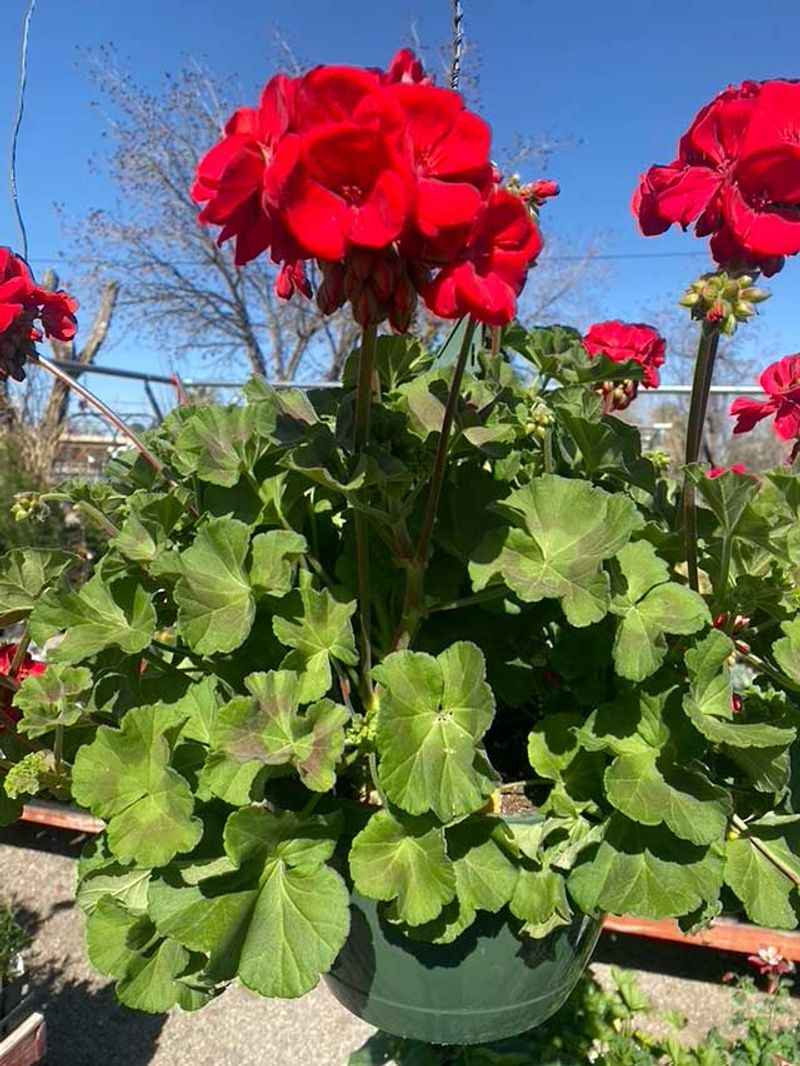
Before blaming yourself for the missing blooms, it helps to understand what kind of plant you are actually growing. Most “geraniums” sold at garden centers, nurseries, and big-box stores in the United States are Pelargonium, a tender plant from South Africa that is commonly called a garden geranium.
Zonal and ivy-leaf types are the most widely sold. These are not the same as hardy perennial cranesbills, which belong to the genus Geranium and behave very differently in summer heat.
Care advice written for one group should not automatically be applied to the other.
Pelargoniums tend to perform best in the moderate temperatures of spring and fall. NC State Extension classifies them as cool-season annuals whose flowering typically declines during the middle of a hot summer.
That means a reduction in blooms during August is often a normal physiological response rather than evidence of neglect or disease.
Temperature thresholds are real but not rigid. The University of Arkansas notes that zonal geraniums may flower inconsistently in July and August in that state, and that temperatures above 95 degrees Fahrenheit can stop flowering under those regional conditions.
UMass greenhouse research reports that mean daily temperatures above 80 degrees, or daytime temperatures above 85 degrees sustained for 12 hours or more, can sharply reduce growth and development in Pelargoniums, while also emphasizing that cultivar variation plays a significant role. These figures are regional or greenhouse observations, not a single outdoor rule that applies everywhere.
Hot days combined with warm nights are particularly hard on flowering. When nighttime temperatures stay elevated, the plant gets little relief and flowering can remain inconsistent for weeks.
Iowa State Extension notes that zonal geraniums are among the most popular summer annuals, yet even they struggle to maintain peak bloom when heat is sustained. A flower pause in August is one plausible explanation for what you are seeing, but it is not the only one, which is why the next step is a closer look at the plant itself.
Check whether the flower pause is normal or a warning sign
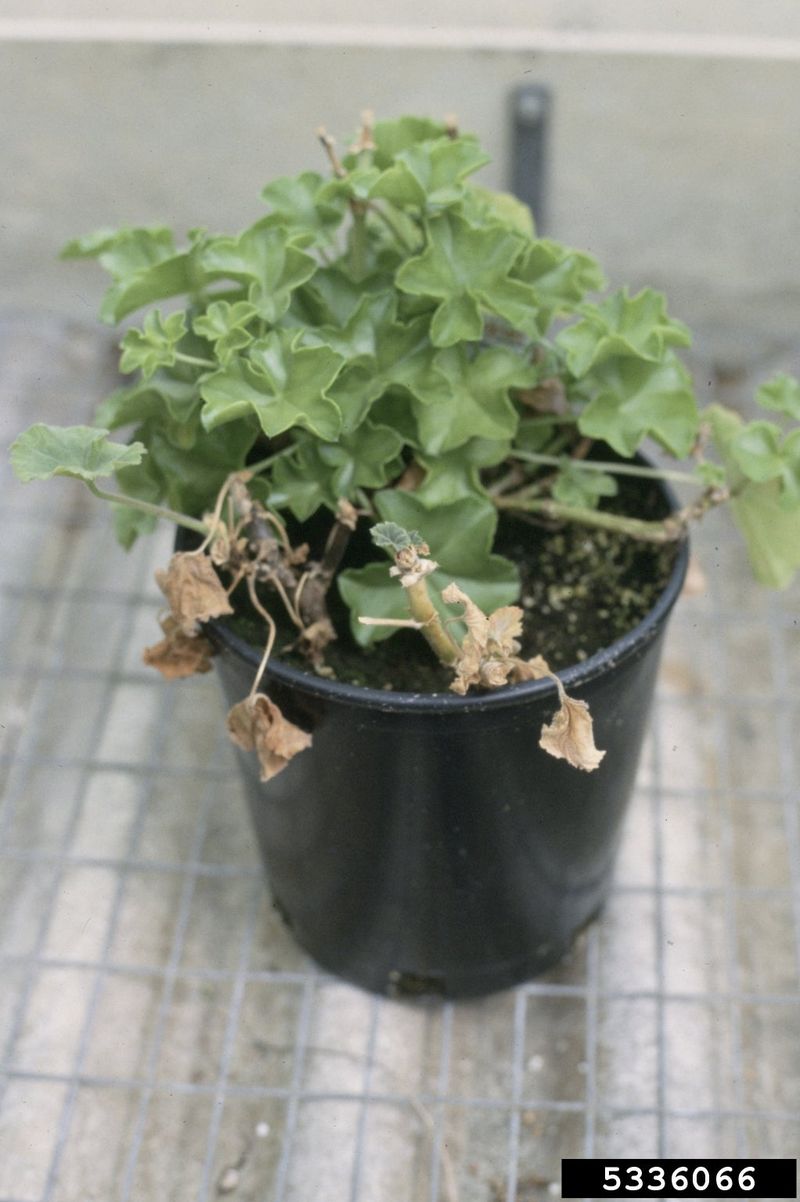
A garden geranium that is green, firm, and otherwise stable but carrying fewer flowers during a heat wave is probably doing exactly what the plant does under stress. That is a very different situation from a plant showing physical symptoms that point to something more serious.
Before you change anything about how you water, feed, or shade the plant, spend two minutes looking it over carefully.
Signs that suggest a normal heat pause: leaves are green or slightly pale but not yellowing rapidly, stems are firm and upright, the potting mix or soil smells neutral, and the plant is producing some new growth even if blooms are scarce. A plant in this condition is a good candidate for the supportive reset described in later sections.
Signs that warrant closer attention include persistent wilting that does not recover overnight or after watering, widespread and rapid yellowing of leaves, stems that feel soft or look blackened at the base, soil that stays wet for days without drying, or a foul or sour smell coming from the root zone. UC IPM notes that wilting in geraniums can result from underwatering, excessive light, or root decay caused by overwatering and poor drainage, so the same symptom can have very different causes.
Other red flags include water-soaked spots on leaves or stems, spreading lesions with yellow halos, or a gray fuzzy coating on flowers or foliage. UC IPM pest management guidelines for geraniums identify Botrytis gray mold, bacterial leaf spot, and other pathogens as separate problems that require targeted responses.
Applying extra water or fertilizer to a plant with root rot or active disease can make the situation significantly worse.
If you see any of those warning symptoms, the heat-reset steps below may not be the right starting point. Treat the underlying problem first, whether that means improving drainage, removing diseased material, or consulting your local extension office for a diagnosis.
Begin with deadheading and clean plant debris
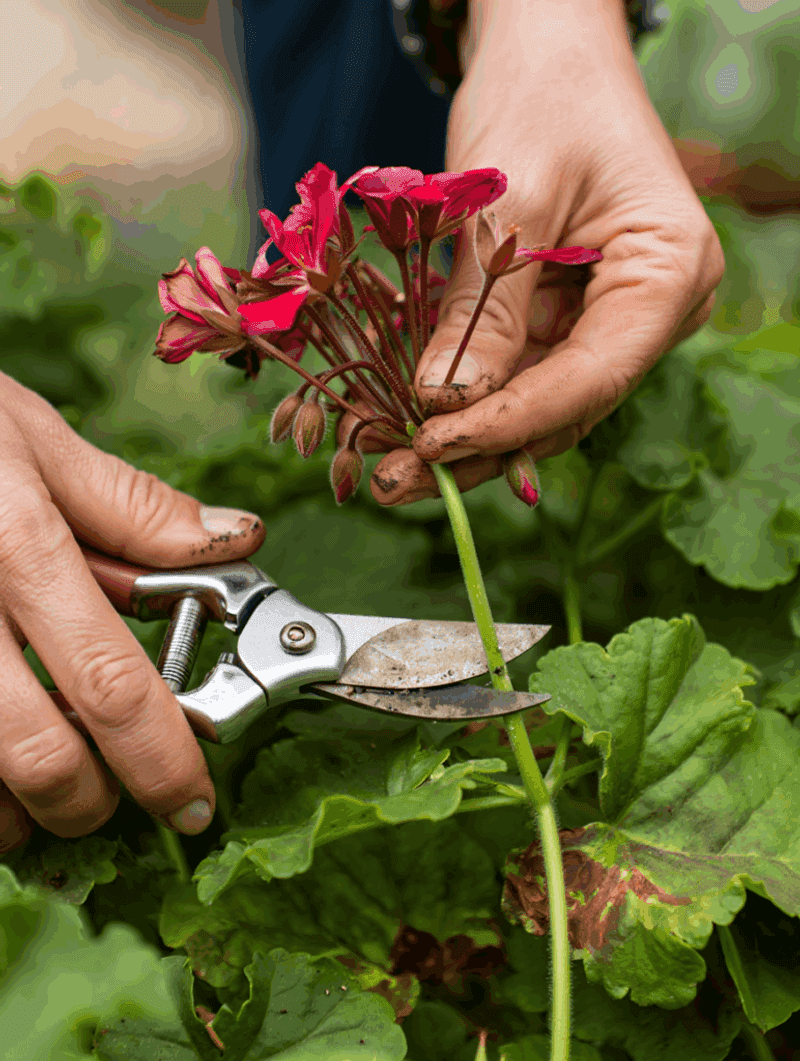
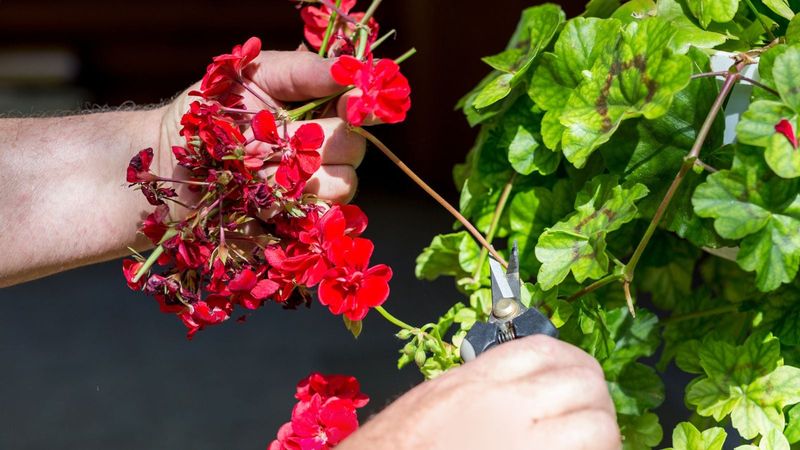
Once you have confirmed the plant looks structurally healthy, the first hands-on step is also the simplest. Remove every faded or spent flower cluster, tracing the stalk back to the main stem and pinching or cutting it cleanly at that point.
A clean snip with scissors or your fingernails works fine. Leaving the stalk behind is a common mistake – the whole stem that held the flower head should come off, not just the petals.
University of Illinois Extension explains that removing faded flower clusters reduces or prevents seed formation and encourages the plant to put energy toward additional flowers. Deadheading does not force new buds to appear immediately or override the heat, but it does remove the reproductive signal that tells the plant its job is done for that cycle.
Think of it as clearing the runway rather than starting the engine.
After the spent blooms are gone, look the plant over for dead, yellowed, or diseased leaves and remove those too. Pick up any fallen petals or leaf debris from the soil surface or the saucer beneath a container.
That fallen material holds moisture against the plant and creates favorable conditions for Botrytis gray mold, a fungal problem that thrives on old flower tissue and humid air. Canopy cleanup reduces the environment where Botrytis spores establish, which is a separate benefit from the bloom-maintenance function of deadheading.
Keep this step separate in your mind from any kind of pruning or cutback. Deadheading removes spent flowers and dead material.
Pruning cuts back living stems to reshape or rejuvenate the plant, and that is a later and more conditional decision covered in section six. For now, focus only on removing what is already finished or dead.
Water the root zone according to its actual moisture
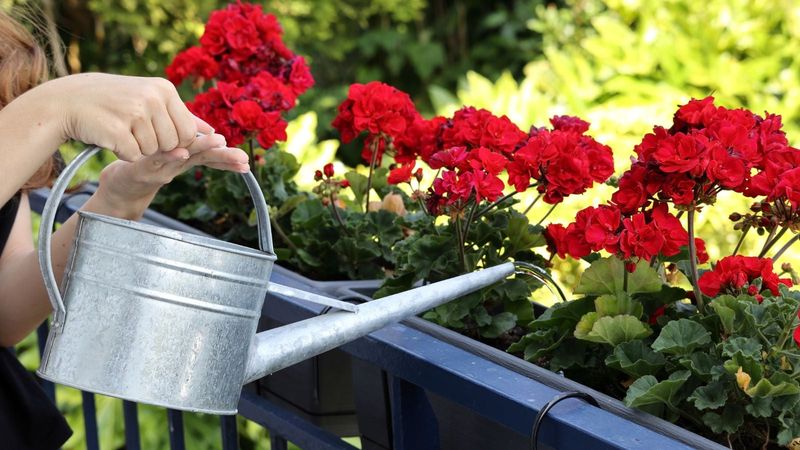
Watering geraniums by the calendar is one of the easiest ways to create a problem. Pot size, pot material, wind, sun exposure, potting mix composition, plant size, and daily humidity all affect how quickly a container or bed dries out.
A small terracotta pot on a south-facing patio can go bone dry in a single hot afternoon. A large plastic container in partial shade may still be moist three days later.
Following a fixed schedule without checking the medium first puts you at risk of both underwatering and overwatering, and both cause wilting.
The reliable method is to check the soil or potting mix directly before you water. For containers, push your finger about an inch into the mix.
If it feels dry at that depth, water thoroughly until the excess drains freely from the bottom. If it still feels moist, wait and check again the following day.
Iowa State Extension recommends watering containers when the soil surface is dry and stresses the importance of good drainage. During hot, dry spells, some containers may need water two or three times a week; in cooler or humid conditions, far less often.
In-ground plants generally retain moisture longer than containers but still benefit from deep, infrequent irrigation rather than frequent shallow wetting. Water slowly at the soil line so the moisture reaches the root zone rather than running off.
Iowa State Extension guidance on managing gardens in extreme heat recommends deep watering during heat events to support root systems under stress.
Avoid wetting the flowers and foliage when you can, particularly late in the day. Wet plant surfaces overnight raise the risk of bacterial leaf spot and fungal issues.
Aim the water at the base of the plant and let the leaves stay dry. UC IPM notes that chronic saturation and poor drainage are a direct path to root decay, which can look like drought stress from the outside.
Free-draining soil or potting mix is not optional for geraniums; it is the foundation the rest of the reset depends on.
Reduce afternoon heat without sacrificing flowering light
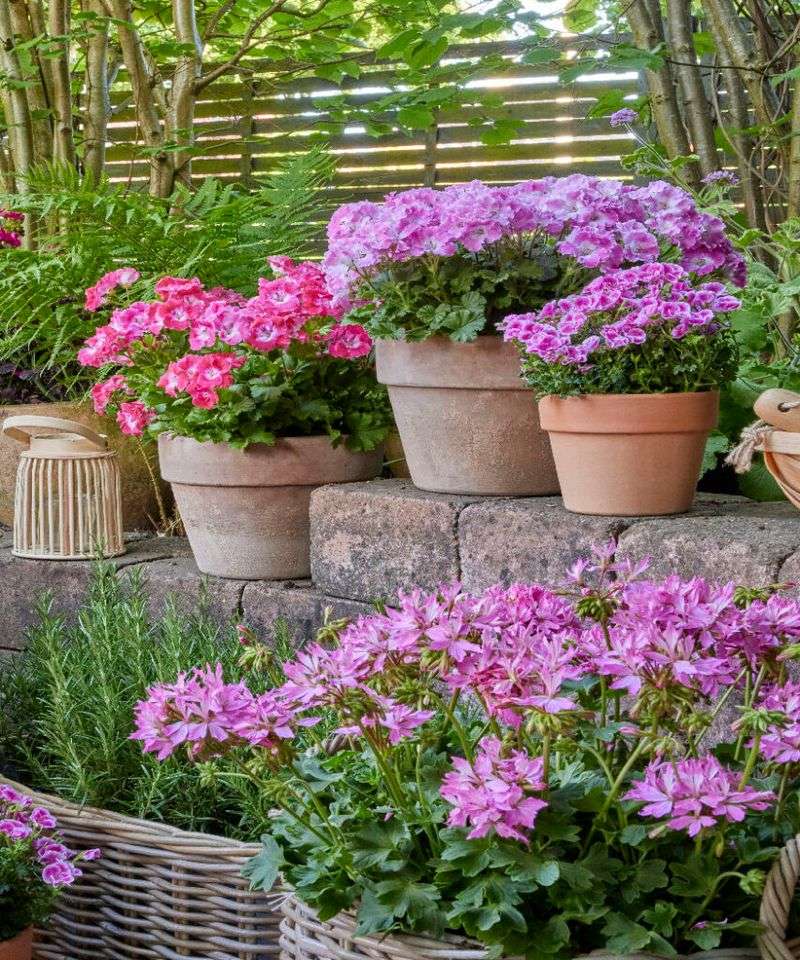
Geraniums need real light to flower well. Most extension sources recommend around six hours of direct sun for good bloom production, and moving a struggling plant into deep or all-day shade is likely to reduce flowering further, not restore it.
The goal during a heat wave is not to eliminate sun exposure but to remove the most punishing part of it.
Afternoon sun in July and August, particularly between 1 p.m. and 5 p.m., carries the highest heat load of the day. Temporary protection from that window, whether from a patio umbrella, a sheer cloth, the shade of a taller plant, or simply relocating a container to a spot with morning sun and afternoon shelter, can meaningfully lower the temperature the plant experiences without cutting off its light budget.
UC IPM recommends some shade for geraniums in very hot temperatures, framing it as a protective measure rather than a permanent relocation.
Ivy-leaf geraniums deserve particular attention here. Clemson Cooperative Extension recommends morning sun and afternoon shade for ivy-leaf types when temperatures exceed 85 degrees Fahrenheit, noting that they are more sensitive to high heat and moisture fluctuations than many zonal varieties.
If you are growing ivy-leaf geraniums in a south- or west-facing container, afternoon protection is especially worth trying.
Regal or Martha Washington geraniums are even more heat-sensitive and are sometimes better treated as cool-season plants in hot climates. If you are growing one of those and it has stopped blooming in August, recovery before fall may be limited regardless of what you do.
Iowa State Extension notes that geraniums need bright light for good flowering and that this requirement does not go away under heat stress. Filtered light, bright indirect exposure, or morning direct sun with afternoon protection strikes a better balance than shade alone.
Move the plant back to fuller exposure once the extreme heat passes.
Delay fertilizer and save pruning for the right plant
Reaching for a fertilizer bottle when your geraniums stop blooming is a natural impulse, but during a heat wave it is the wrong move. When a plant is heat-stressed, dry, or wilted, its normal physiological processes slow down significantly.
Applying fertilizer under those conditions does not stimulate growth; it adds salt load to a root zone that is already under pressure and can pull moisture away from roots through osmosis, making a stressed plant worse. Iowa State Extension advises avoiding fertilizer during extreme heat for exactly this reason.
Rutgers Extension guidance on managing heat stress in landscape plants similarly recommends withholding fertilizer while plants are under acute heat stress and waiting until conditions moderate and active growth resumes before feeding. When you do resume, follow the product label for rate and frequency.
A balanced, water-soluble fertilizer applied at label rates after the plant has been rehydrated and is producing new leaves is a reasonable choice for garden geraniums in active growth.
Pruning is a separate question, and it should be approached with more caution than fertilizer timing. Routine deadheading, which you have already done, is not the same as a cutback.
A cutback involves removing significant lengths of living stem to reshape or rejuvenate the plant, and it makes sense only under the right conditions.
Georgia Extension recommends pruning long geranium stems by one-half to three-quarters in late summer for plants that have become leggy, sparse, or badly depleted over the season, cutting just above a node and providing shade during the recovery period before returning the plant to full sun as nights cool. That is a useful revival method for the right plant at the right time, but it is not a universal emergency fix.
A plant that is severely stressed from heat, drought, or possible disease should receive moisture correction and heat relief before you cut it back substantially. Pruning removes leaf area the plant uses to gather energy, and a weakened plant may struggle to push new growth from the cuts.
Assess the plant’s condition honestly: if it is leggy but otherwise healthy and the worst heat has passed, a measured cutback can help. If it is still wilted, barely hanging on, or showing any of the warning symptoms from section two, hold off and address those issues first.
Let cooler conditions show whether the reset worked
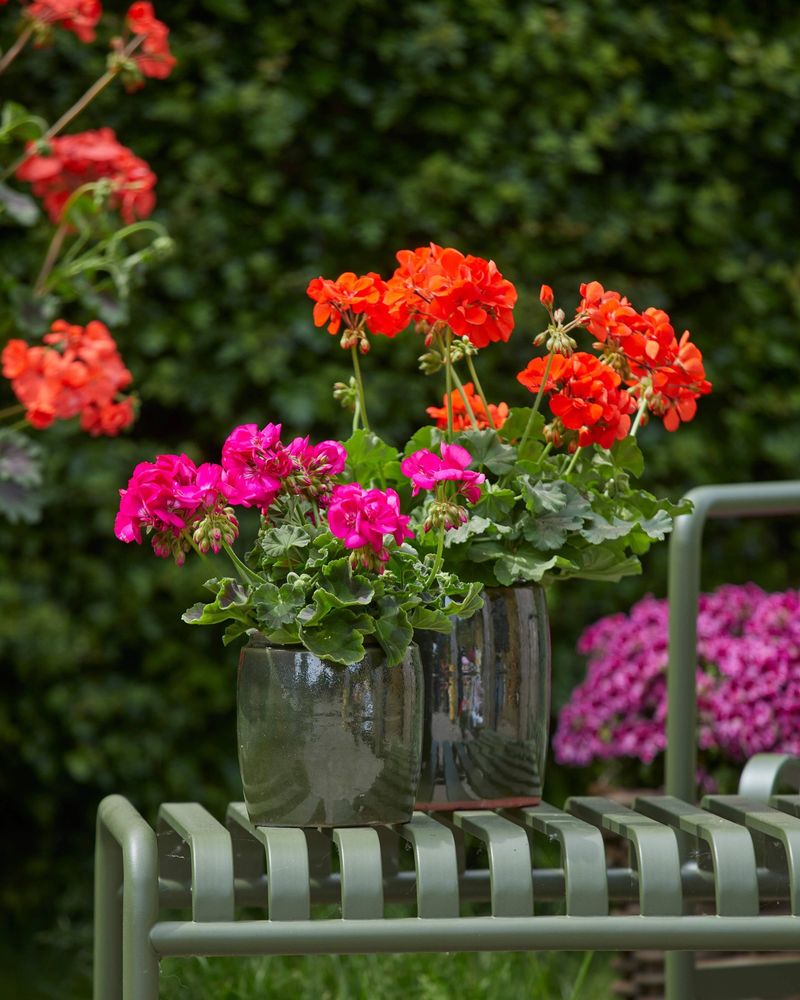
Recovery from a summer bloom slowdown is not an overnight event. After you have cleaned the plant, corrected moisture, and reduced peak afternoon heat exposure, the most important thing you can do is give the plant time.
Pelargoniums are not dormant during a heat pause; they remain physiologically active and can respond when conditions improve. The key variable is temperature, particularly overnight temperature.
As nights begin to cool in late summer and early fall, many garden geraniums resume stronger flowering on their own. University of Arkansas Extension notes that zonal geraniums can rebound and produce good fall color once summer heat moderates.
That rebound may come in September for gardeners in the northern half of the country, where nights cool earlier, or later in the season for those in the Southeast, Gulf Coast, or desert Southwest, where summer heat lingers well into fall.
Arkansas Extension also notes that severely stressed or damaged plants may not recover before frost arrives. A plant that went through prolonged drought, root damage, or disease on top of heat stress has a longer road back than one that simply paused during a hot spell.
That is worth acknowledging honestly rather than expecting the same outcome for every plant in every yard.
Watch for new leaf growth as your first signal that the plant is responding. Iowa State Extension confirms that renewed active growth is the right trigger for resuming fertilizer and evaluating whether a cutback would help a leggy plant.
If warning symptoms from section two persist or worsen after the reset, revisit the possibility of a root or disease problem rather than continuing to treat it as a heat issue. A geranium that holds its color through summer and then blazes in September is a satisfying payoff for a little patient, well-timed care.