
Why North Carolina Gardeners Should Never Rake Away The Leaf Litter That Box Turtles Use To Survive Winter

Every fall, North Carolina gardeners fire up their leaf blowers and rake their yards down to bare soil, not realizing that a box turtle might already be settling in beneath those leaves for the winter. Eastern box turtles rely on undisturbed soil and leaf cover to stay alive through cold months, and a well-intentioned cleanup can disturb habitat these animals genuinely need.
That does not mean every rake stroke threatens a turtle or that yards must look wild and unmanaged. Knowing where to leave leaves and where to clear them gives you a plan that protects wildlife and keeps your yard functional all season.
Preserve habitat instead of stripping the yard bare
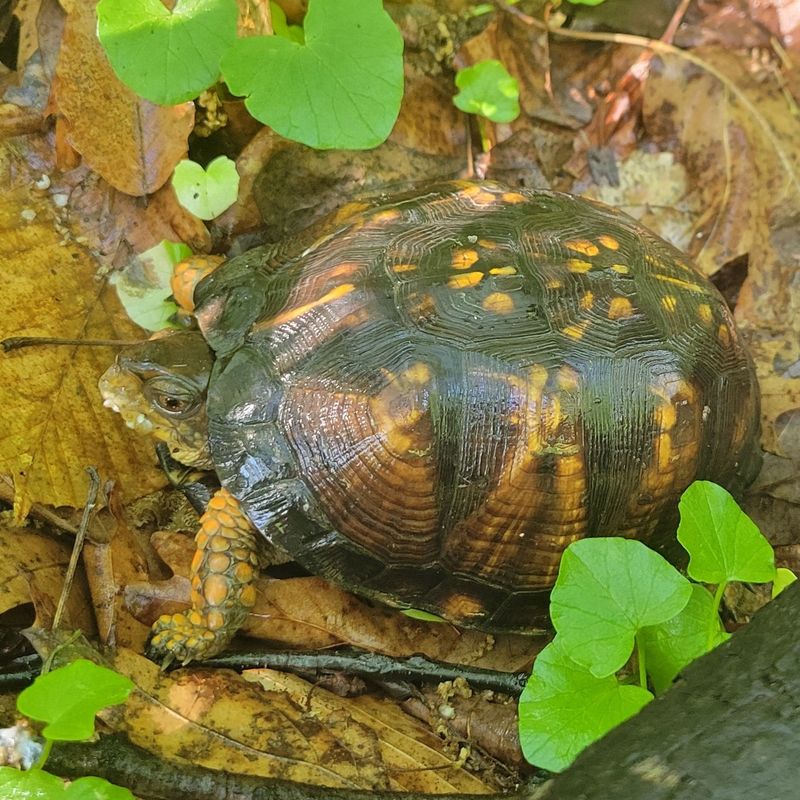
Eastern box turtles live across all of North Carolina, turning up in fields, forest edges, and suburban yards from the Coastal Plain to the mountain foothills. NC Wildlife Resources Commission describes them as nongame wildlife and flags population-level concerns, noting that habitat loss and road mortality continue to pressure the species statewide.
These are not rare, distant animals. They are the turtles your neighbors photograph crossing the driveway, the ones your kids spot near the fence every summer.
When cold weather arrives, eastern box turtles do not migrate or find a sheltered building. They move into the ground, settling just a few inches beneath the soil surface and often under a layer of deciduous leaves.
Research on overwintering site selection found that turtles favor spots with soft, friable soil and thicker deciduous leaf cover, suggesting that a naturalized bed with undisturbed leaves and loose earth is genuinely useful habitat, not just yard debris. A West Virginia thesis on eastern box turtle hibernacula documented this preference in detail, and the broader body of evidence from the species’ eastern range supports the same pattern.
The headline framing of “never rake” is too absolute, and the research does not show that every raked pile contains a turtle or that ordinary residential raking predictably causes death. What the evidence does support is a more targeted correction: stripping naturalized areas, wooded edges, garden beds, and shrub borders down to bare soil during fall and winter can disturb the kind of cover these turtles depend on.
The practical goal is protecting likely habitat, not abandoning all yard maintenance. Field research on thermal environments of overwintering eastern box turtles confirms that soil and leaf litter together moderate temperature swings in ways that matter for a dormant animal.
That is the biological case for selective stewardship, not a blanket ban on fall cleanup.
What leaf litter does for a turtle in winter
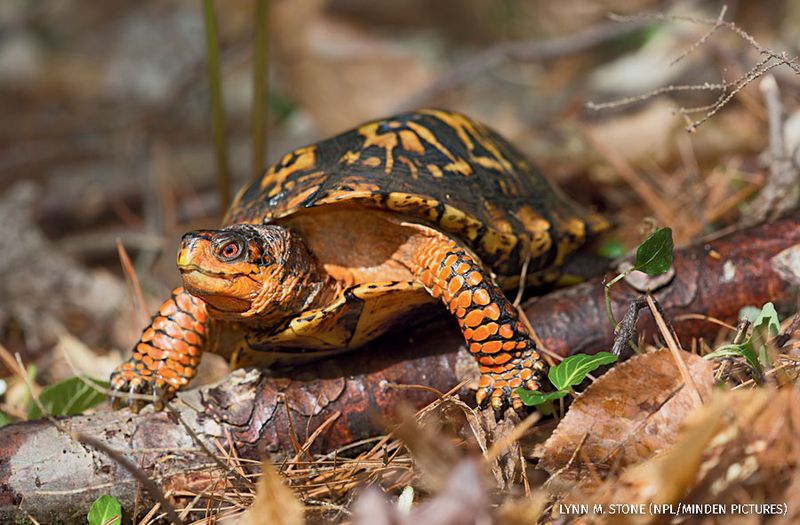
Around the time nights turn reliably cold, eastern box turtles begin entering a dormant state that biologists sometimes call brumation, a winter slowdown distinct from the deep hibernation that mammals like bears experience. The turtle’s metabolism drops dramatically, and it stops feeding and moving.
It needs to stay in a place where temperatures remain stable enough to avoid freezing, and it may stay there for months without any ability to relocate if conditions change around it.
Soil and leaf litter work together as insulation. A study tracking 21 eastern box turtles across three winters in Maryland found that temperatures at overwintering sites stayed above freezing during most periods when air temperatures dropped below freezing, with the authors attributing that buffering effect specifically to the soil and leaf litter sitting between the cold air and the turtles below.
That is not a trivial finding. A dormant turtle cannot shiver, burrow deeper, or seek warmth.
The insulating layer it chose before dormancy is the only protection it has.
Leaf litter is one important component of that shelter, not a guaranteed blanket sitting directly over every turtle. Box turtles also use depressions, fallen logs, brush piles, root channels, and other sheltered microhabitats.
Eastern box turtle guidance from Massachusetts wildlife authorities describes overwintering as generally beginning in late October or November and ending in March or April in northern populations, though that calendar does not transfer uniformly to North Carolina’s warmer Coastal Plain or its colder mountain elevations. The Maryland research is biologically relevant to North Carolina’s eastern box turtle population, but the specific temperatures measured there should not be read as exact predictions for every region of the state.
What translates clearly across the range is the principle: undisturbed, layered cover over soft soil helps a dormant turtle stay within a survivable temperature range through winter.
Preserve quiet cover in the parts of your yard that can support it

Translating field biology into a practical yard plan starts with identifying which parts of your property can hold undisturbed leaf cover without creating a safety or drainage problem. Wooded corners, garden beds, the ground beneath shrubs, the soil around tree trunks, and the quieter stretches along fence lines are all reasonable candidates.
These are the spots where a turtle would logically look for soft soil and shelter, and they are also the areas where whole leaves left in place cause the least household inconvenience.
Research on eastern box turtle hibernacula site selection found turtles favoring areas with thicker deciduous leaf cover and softer soil, which maps directly onto the naturalized edges most homeowners already leave a little less managed. You do not need to assign a specific leaf depth or cover every square foot.
The practical move is to identify connected, low-traffic patches where leaves can accumulate naturally and remain undisturbed through the cold months.
When leaves pile up on a path or lawn area that genuinely needs clearing, move them rather than bagging them. Relocate that material to a garden bed, a wooded edge, or a designated habitat corner of the yard.
University of New Hampshire Extension guidance on leaving leaves for wildlife supports this approach, recommending that homeowners create designated leaf areas so the material stays on the property as habitat and mulch rather than going to the curb. University of Georgia Extension’s leave-the-leaves guidance echoes the same point: the goal is retaining connected cover somewhere on the property, not managing every corner of the yard identically.
Your yard does not need to look unmanaged to provide meaningful winter habitat.
Selective cleanup protects habitat and household function
Keeping a yard safe and functional does not require stripping every surface bare. Sidewalks, front steps, drains, fire-safety clearance zones, and high-traffic turf areas all have legitimate reasons to stay clear of heavy leaf accumulation.
Wet leaves on steps and walkways create slip hazards. Leaves blocking drains cause standing water.
Thick mats over turf can smother grass by cutting off light and airflow, especially through a wet winter. These are real maintenance needs, and the stewardship guidance for box turtles does not ask you to ignore them.
The practical distinction is between surfaces that need clearing and naturalized areas that do not. A path through the yard and the wooded bed beside it are different situations requiring different decisions.
University of Georgia Extension’s leave-the-leaves resource makes this separation explicit, noting that selective management serves both household function and wildlife habitat without requiring a whole-yard choice one way or the other. Clear what genuinely needs to be cleared, and leave the rest.
One additional note on method: in wildlife habitat beds, try to avoid aggressive leaf blowing or shredding when you can. Whole leaves provide more physical cover than shredded fragments, and UNH Extension’s wildlife leaf guidance warns that shredding can destroy overwintering insects and their egg masses and pupae hiding in the litter.
That evidence speaks to insects and invertebrates broadly, not specifically to box turtle mortality, so the recommendation is best understood as general wildlife stewardship rather than a proven box-turtle safety measure. Still, if you have a designated wildlife bed, a gentle rake is a better choice than a shredder or a high-powered blower aimed at ground level.
Selective management, applied thoughtfully across different parts of the yard, is what makes this approach both protective and realistic for a working residential property.
Delay major disturbance without relying on a universal cleanup date
One of the most common instincts in fall gardening is to work from a fixed calendar: rake in October, clean up beds in November, and consider the yard put to rest by December. Box turtle overwintering does not follow a single schedule across North Carolina.
The mountains, the Piedmont, and the Coastal Plain experience meaningfully different temperature patterns, and turtles respond to local conditions rather than a statewide date. Northern wildlife guidance on eastern box turtles places overwintering onset around late October to November and emergence in March or April for that region, but applying those dates directly to, say, a yard in Brunswick County or Buncombe County would be an oversimplification.
A more useful approach is to delay major disturbance of naturalized beds when practical, especially during extended cold stretches, and to inspect carefully before moving leaf piles, logs, brush, or other ground cover. Before lifting a pile, look and listen.
Shift the top layer gently before committing to a full removal. This precaution benefits box turtles but also applies to the broader community of animals that overwinter in leaf litter and soil, including salamanders, native bees, and overwintering moth pupae.
The Maryland overwintering study also reported that some turtles returned to the same or nearby overwintering areas in successive years. That is a notable finding, but it applies specifically to some individuals in that study population and should not be read as a universal North Carolina rule or as proof that preserving a particular pile in your yard will demonstrably improve a turtle’s survival odds.
What it does suggest is that quiet, undisturbed habitat areas may hold value across multiple seasons, which is one more reason to treat designated wildlife corners of the yard as lasting features rather than annual cleanup targets. UNH Extension’s wildlife leaf resource supports delaying bed cleanup until spring as a reasonable general practice for this reason.
Leave a box turtle alone unless it is clearly injured
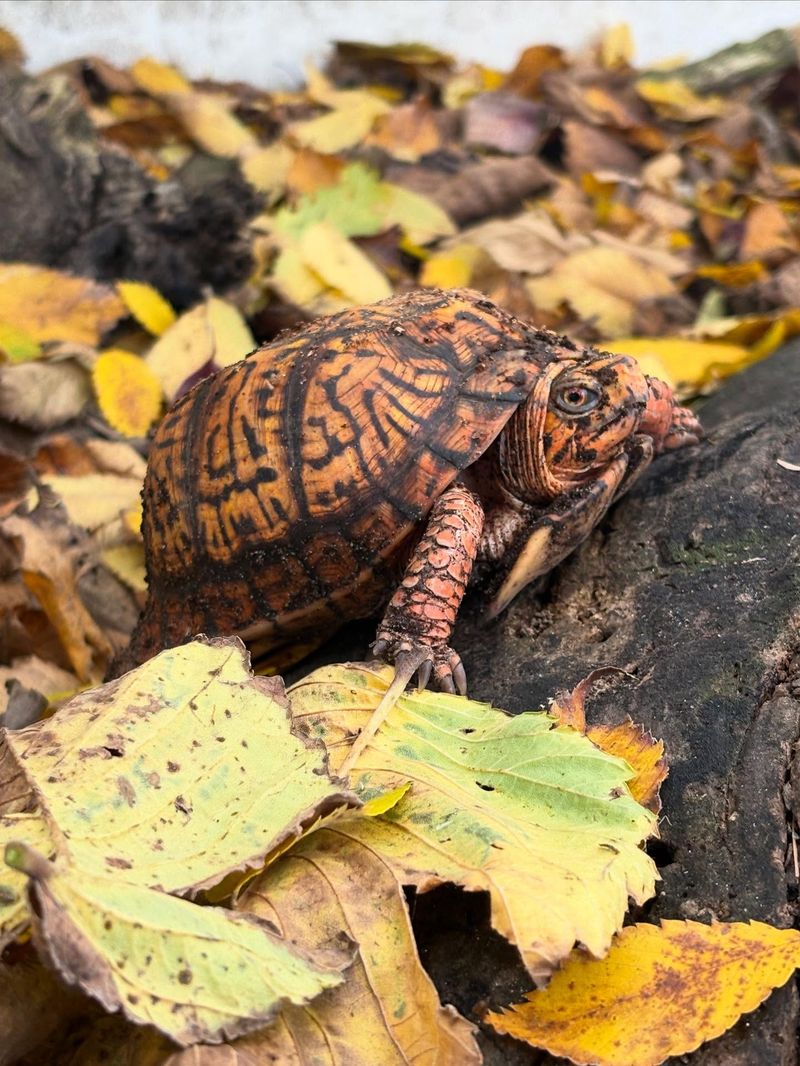
Encountering a box turtle during fall cleanup is more common than many gardeners expect. A turtle settling into dormancy may appear completely motionless, and it is easy to mistake that stillness for injury or death.
Before doing anything else, give the animal space and time. A motionless turtle is not necessarily in distress.
NC Wildlife’s injured and orphaned wildlife guidance advises that captivity is stressful for wild animals and that most have a better chance when left where they are.
The default response to finding a box turtle is to leave it alone entirely. Do not pick it up to examine it, bring it indoors for safekeeping, attempt to feed or hydrate it, or relocate it to a park, wooded lot, or another part of town.
Eastern box turtles have small home ranges and strong homing instincts. NC Wildlife’s eastern box turtle profile is explicit on this point: taking a turtle home or releasing it in a different location can be harmful even when the new site looks more natural.
A turtle moved away from its established territory may spend dangerous energy trying to navigate back, sometimes crossing roads it would never have otherwise encountered.
If a turtle is sitting in the path of a lawnmower, at the edge of a busy road, or in another spot where immediate harm is unavoidable, you can move it, but keep it short. NC Wildlife recommends moving the turtle only the shortest practical distance, ideally less than 50 feet, and placing it in the direction it was already heading.
Do not choose the destination based on what looks better to you.
A turtle with a visibly cracked shell, active bleeding, a missing limb, or other clear physical damage is a different situation. That animal needs professional help.
Contact a licensed reptile rehabilitator rather than attempting home treatment or setting up an indoor overwintering enclosure. NC Wildlife’s injured wildlife page includes contact resources for finding a rehabilitator in your area.
Home care without professional direction can cause more harm than the original injury.
Choose a winter refuge over a bare-yard routine
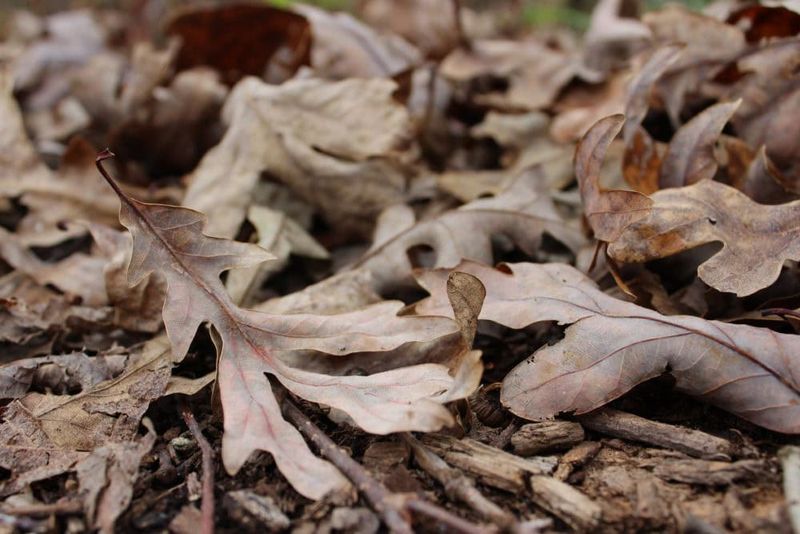
The stewardship rule that comes out of all this evidence is straightforward: preserve quiet leaf-and-soil cover where it fits the yard, move excess leaves to a habitat area instead of removing all cover from the property, and keep essential household surfaces clear. NC Wildlife’s eastern box turtle guidance and the available field research both point toward the same practical middle ground: protect likely habitat, maintain what genuinely needs to be maintained, and avoid treating the entire yard as a surface to be stripped clean each fall.
The goal is to reduce disturbance to possible overwintering sites, not to guarantee that a turtle is under every leaf pile, prohibit all fall cleanup, or suggest that a single yard decision determines whether a turtle survives the season. Leaving leaves in designated habitat areas also benefits the broader community of overwintering insects, native bees, salamanders, and other wildlife that share the same soil and litter layer as box turtles.
A yard with one clear path and one quiet wooded corner left to its own devices through winter is not a neglected yard. The research on overwintering thermal environments shows that the insulating work of undisturbed soil and leaves is real and measurable.
Choosing where to rake and where to leave things alone is one of the simplest, lowest-cost contributions a North Carolina homeowner can make to the wildlife already living in the yard.