
What It Really Means When A Gray Treefrog Starts Calling From Around Your North Carolina Yard
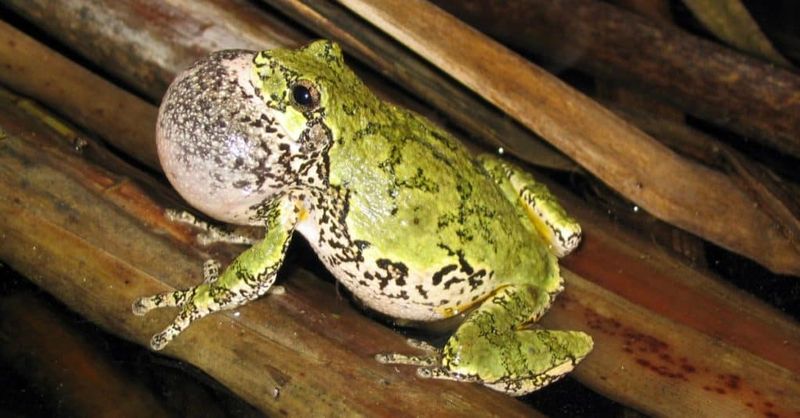
On a warm evening in late spring, a loud, buzzy trill erupts from somewhere in your trees, and you have no idea what made it. That sound belongs to one of North Carolina’s most fascinating native amphibians, and understanding it can change the way you see your yard.
Knowing who is calling, why, and what your yard can realistically offer that animal makes you a better steward of the backyard ecosystem you already have.
Start with what the trill can—and cannot—identify
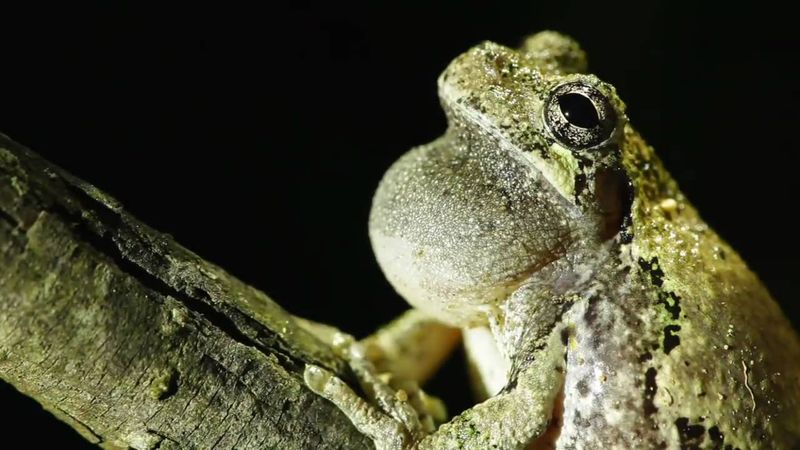
A loud, pulsing trill drifting out of the canopy on a warm April evening is one of North Carolina’s most recognizable frog sounds, and if it matches the description of a gray treefrog-type call, the most likely source is a male Cope’s gray treefrog. NC Wildlife Resources Commission records show that Cope’s gray treefrog calls from April through August across most of the state, making it the default candidate when a homeowner hears that trilling sound from their trees during those months.
The word “likely” matters here. An informal description like “loud trill” is a useful starting point, but it is not a confirmed identification.
Several other frog species native to North Carolina produce trills or buzzy calls that can sound similar to an untrained ear, especially at a distance or through a screen door.
Before treating the identification as settled, record the call on your phone and compare it against a reference such as the North Carolina Parks amphibian species accounts, which include audio recordings for each species. You can also share your recording with a local naturalist group, a state extension agent, or a wildlife educator.
A confident ID from a reliable source is worth more than a confident guess, especially if you plan to make changes to your yard based on what you heard.
The conditional framing is not a dodge. It is the honest starting point that lets you move forward with accurate expectations and avoid misreading a perfectly normal frog call as something it is not.
Use the call—not the color—to separate the two gray treefrogs
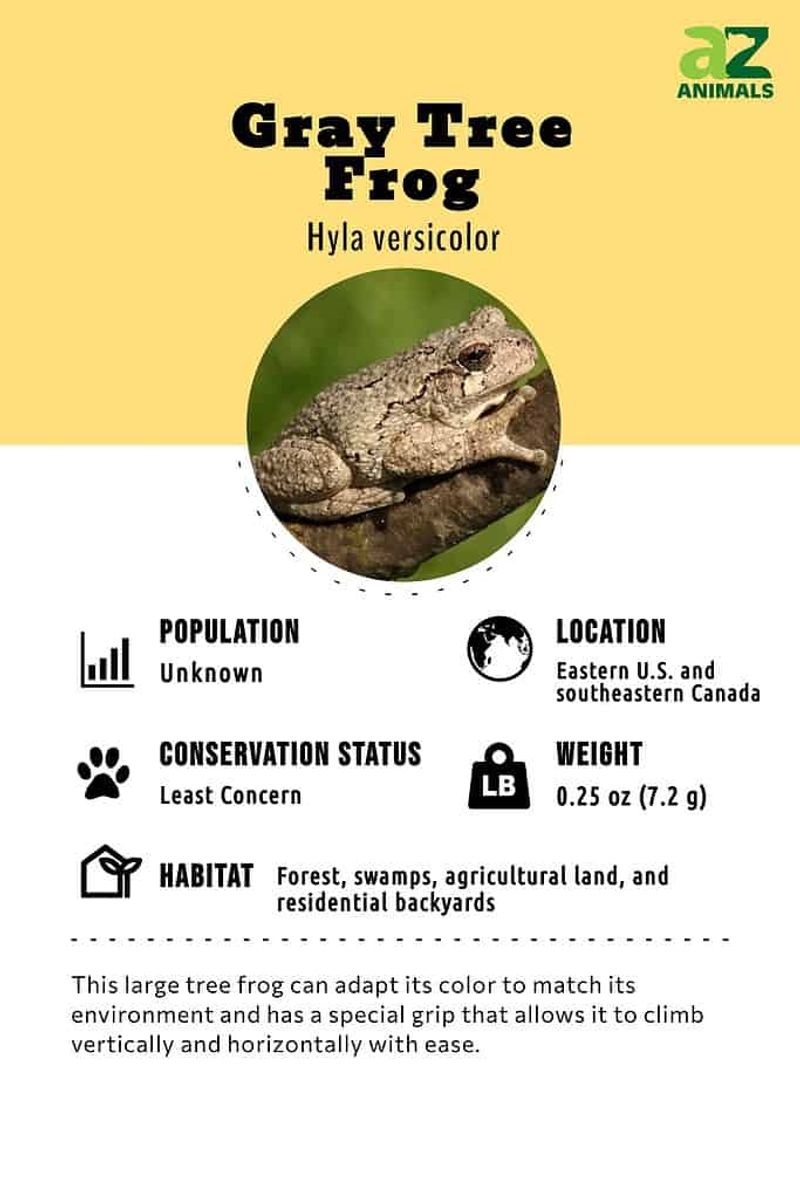
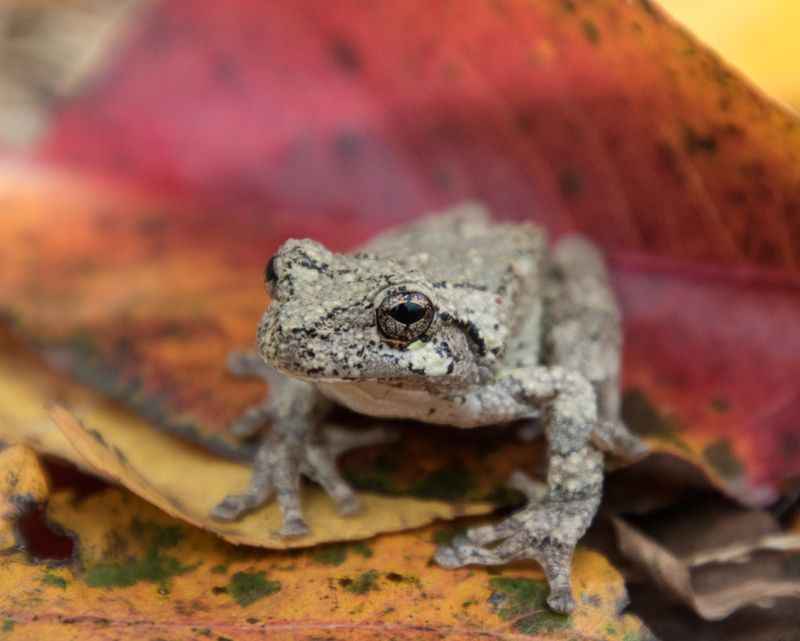
North Carolina is home to two species that share the common name “gray treefrog,” and they look so alike that even experienced field biologists cannot reliably separate them by sight alone. Both Cope’s gray treefrog and the northern gray treefrog display the same mottled gray or greenish-gray skin, bright orange or yellow patches on the inner thighs, and large adhesive toe pads.
Trying to tell them apart by color, pattern, or size is a guessing game with no reliable winner.
The call is the practical field tool. NC Wildlife guidance on both species describes the acoustic difference clearly: Cope’s gray treefrog produces a faster, harsher trill with a higher pulse rate, while the northern gray treefrog has a slower, more melodic trill that sounds more musical to most listeners.
If you can record the call and count the pulses, or simply compare it to reference recordings, you are using the same method wildlife biologists rely on.
Geography also narrows things down. Cope’s gray treefrog is the gray treefrog you are most likely to encounter across the Piedmont, Coastal Plain, and much of the mountain region.
The NC Parks account for the northern gray treefrog documents its confirmed distribution primarily in Warren and Caswell counties, and the state lists it as a species of special concern. That restricted range means most North Carolina homeowners who hear a gray treefrog-type call are almost certainly not hearing the northern species.
Knowing which species you are dealing with matters if you want to report a sighting to a wildlife database, or if you are ever uncertain about local regulations. For most casual observers, the practical takeaway is simple: listen, record, and compare before concluding anything.
Weather may encourage calling, but the frog is not diagnosing your yard
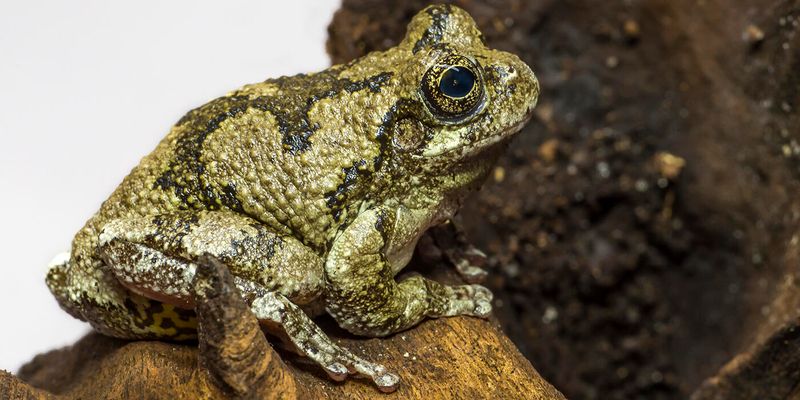
Warm temperatures, high humidity, and recent rainfall can all nudge a male gray treefrog into calling more frequently or more loudly. That pattern is real and well-documented.
The NC Parks species account for Cope’s gray treefrog notes that calling activity is tied to seasonal and environmental cues, and research on treefrog calling behavior confirms that temperature and moisture conditions influence when and how often males call.
Rain is not always required, though. University of Central Florida research on treefrog calling shows that treefrogs can call on warm, humid nights without active rainfall, and that chorus conditions, nearby calling males, and proximity to breeding sites also play a role.
A frog calling from your oak tree on a muggy June night may simply be responding to the broader neighborhood environment, not to something specific about your property.
The tempting interpretation is that the call signals your yard has achieved an ideal moisture-and-insect balance. That reading goes further than the evidence supports.
One calling frog cannot certify the condition of your soil moisture, the density of invertebrates in your garden beds, the quality of nearby water, or the absence of contaminants in your yard’s runoff. The 2025 North Carolina Wildlife Action Plan identifies amphibians as sensitive to habitat fragmentation, pollution, and aquatic habitat loss, which means their presence is encouraging but not a clean bill of ecological health.
Enjoy the call for what it clearly is: a sign that conditions in the area are currently usable for at least one male gray treefrog. That is genuinely good news, even without the grander ecological certification some articles suggest it carries.
The caller may use your trees while breeding somewhere nearby
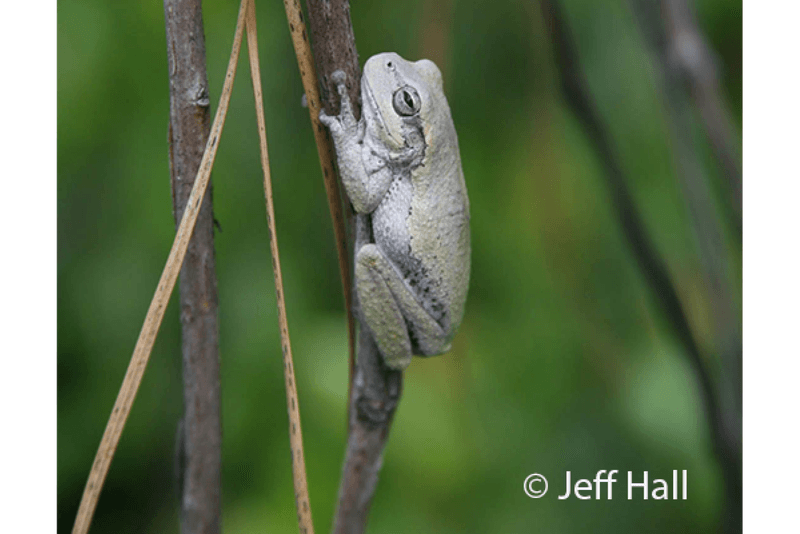
Hearing a gray treefrog call from your yard does not mean your yard contains a breeding pond. Adults spend the warmer months in trees, cavities, bark crevices, and canopy cover, where they rest, thermoregulate, and hunt for prey.
The NC Parks species account describes this arboreal lifestyle in detail: gray treefrogs are well adapted to life above the ground, using their adhesive toe pads to cling to bark and leaves through much of the season.
Reproduction is a different matter entirely. NC Wildlife documentation confirms that both Cope’s and northern gray treefrogs breed in aquatic habitats, including temporary pools, ponds, ditches, and wetlands.
A male may call from a branch in your yard, advertising his fitness to females, and then travel after dark toward a breeding site that could be a neighbor’s retention pond, a roadside ditch, an ephemeral woodland pool, or a wetland edge several hundred feet away.
This separation between daytime shelter and nighttime breeding habitat is important for two reasons. First, you should not assume that because a frog is calling from your yard, tadpoles are developing in your yard.
Second, the quality of the surrounding landscape matters as much as what happens on your property. NC Wildlife wetlands and ponds guidance emphasizes the value of connected habitat corridors that allow amphibians to move safely between upland shelter and aquatic breeding sites.
Trees, shrubs, and ground cover near the edge of your yard can serve as important movement corridors and daytime refuges, even if your property has no standing water at all. The frog calling from your dogwood is not lost.
It may be right where it needs to be.
A gray treefrog supports the food web without replacing pest control
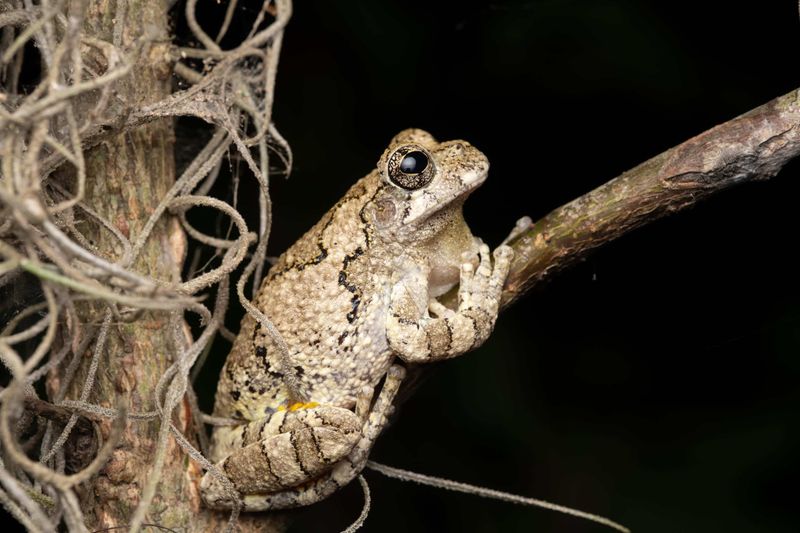
Gray treefrogs are active hunters, and their menu is impressively varied. The NC Parks species account lists moths, mites, spiders, plant lice, harvestmen, and snails among the invertebrates that gray treefrogs consume.
That range of prey makes them genuinely useful members of a backyard food web, connecting the insect and arachnid layers to the broader chain of predators and scavengers that keeps a yard’s ecology moving.
That feeding role is real, and it is worth appreciating. A single adult gray treefrog foraging through your garden shrubs on a summer night is eating real insects and spiders, and over a season, a small population of treefrogs can consume a meaningful quantity of invertebrates.
U.S. Fish and Wildlife Service guidance on backyard amphibians acknowledges this contribution and encourages homeowners to support native amphibians partly for this reason.
Where the story gets overstated is in the leap from “eats insects” to “controls ticks and mosquitoes.” Available research does not establish that one or even several gray treefrogs will produce a noticeable reduction in the tick or mosquito populations around a residential yard. Ticks and mosquitoes have complex ecologies, and the frogs’ diet, while broad, does not map neatly onto the specific pest species that concern most homeowners.
The honest framing is that gray treefrogs may contribute to natural pest regulation as one part of a functioning food web. That contribution is worth supporting, but it is not a substitute for other pest management strategies you may already use.
Think of the frog as a beneficial neighbor, not a service provider with a guaranteed contract.
Improve shelter and prey habitat before adding anything
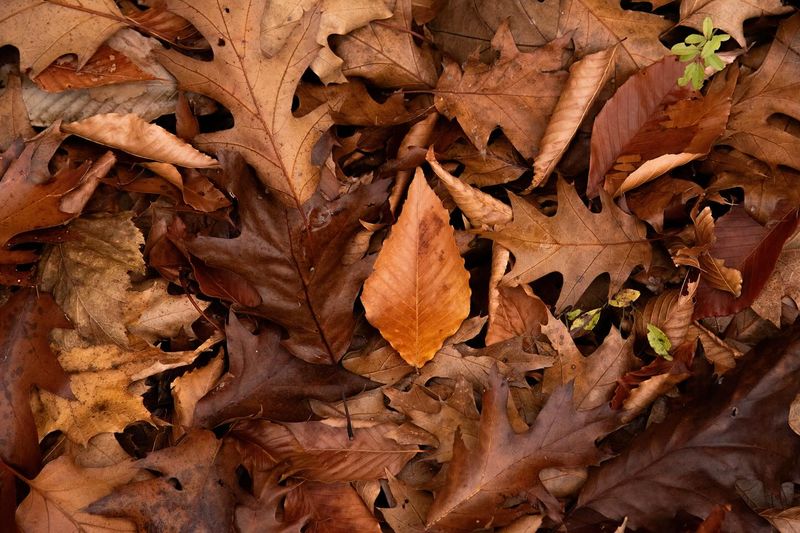
The most effective thing most homeowners can do for a visiting gray treefrog costs nothing and requires no new purchases. Retaining leaf litter under shrubs and along fence lines gives frogs moist, sheltered resting spots and supports the invertebrate prey base they depend on.
Logs, snags, and brush piles serve a similar function, offering cool, damp microhabitats that frogs use during dry spells and hot afternoons. Federal wildlife guidance on backyard amphibians specifically recommends these features as practical steps homeowners can take to support native amphibians.
Reducing the footprint of highly manicured lawn is another low-effort improvement. Closely cropped grass offers little cover, few invertebrates, and almost no moisture retention compared to a native plant bed or a naturalistic shrub border.
Swapping even a small section of lawn for native groundcovers, shrubs, or wildflowers adds structural complexity that benefits frogs and the insects they eat. NC Wildlife habitat conservation guidance frames native landscaping as a stewardship strategy, not a guaranteed frog-attraction technique, which is the right expectation to carry into any planting project.
Pesticide reduction deserves special attention, particularly near drains, rain gardens, damp areas, and any standing water. Amphibians absorb substances through their permeable skin and encounter contaminants both as adults in the terrestrial environment and as larvae in aquatic habitats.
USGS research on insecticide and herbicide interactions in amphibian habitats documents measurable effects on amphibian communities, and a separate USGS survey of pesticides in amphibian habitats found pesticide detections across sites throughout the United States.
Routine yard fogging, broadcast insecticide applications, and herbicide use near wet areas all carry risks that a “wildlife-friendly” product label alone cannot resolve. Reducing chemical pressure in and around damp habitat is one of the most direct ways to make your yard safer for the animals already using it, without requiring any new construction or planting.
Add or protect water only when the whole habitat fits
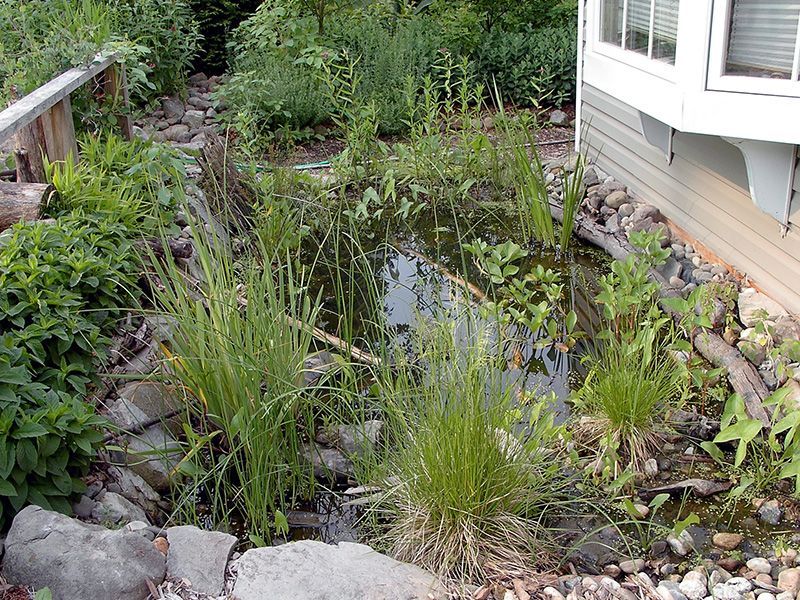
If you already have a seasonal wet area, a low spot that holds rainwater, or a small drainage feature on your property, the best first step is to protect it rather than alter it. Temporary pools and seasonal wetlands are often more valuable to breeding amphibians than permanent ornamental ponds, because many species evolved to use water that fish have not colonized.
Draining, grading, or “cleaning up” a muddy low spot can remove breeding habitat that took years to establish.
NC Wildlife guidance on supplemental water explains that a small, shallow, fish-free pool can be more suitable for some breeding amphibians than a stocked pond, because fish actively prey on frog eggs and tadpoles. This is a counterintuitive point for many homeowners who assume a larger, more permanent water feature is always better.
Habitat quality depends on more than water volume.
The factors that actually matter include hydroperiod (how long the pool holds water), surrounding vegetation and leaf litter, water quality, terrestrial cover within reach of the water’s edge, and connectivity to other habitat patches. NC Wildlife wetlands and ponds resources walk through these variables for landowners considering water habitat improvements.
Before excavating, lining, or substantially altering any wet area, check with a professional and confirm whether a permit is required. Wetland alteration is regulated in North Carolina, and some actions that seem minor can have legal implications.
NC State Extension’s guide to pools for amphibians offers practical construction and siting advice for homeowners who want to add a small breeding feature responsibly, including guidance on size, depth, and vegetation. A well-planned, appropriately sited pool can be a genuine asset.
A poorly placed one can create more problems than it solves.
Protect the frog by leaving it wild
Cats are one of the most direct threats a backyard gray treefrog faces, and the fix is straightforward. Keep cats indoors or in an enclosed outdoor structure, and keep pets away from dense vegetation near breeding pools and damp habitat edges.
U.S. Fish and Wildlife Service guidance identifies free-roaming cats as a major danger to native wildlife, and frogs, with their relatively slow movements on the ground at night, are easy targets.
Handling is another area where restraint is the right call. Amphibian skin is highly permeable, which means chemical residues from sunscreen, lotion, insect repellent, or simply dry hands can be absorbed directly and cause harm.
Avoid picking up frogs unnecessarily. If you find one in a dangerous spot, such as near a road, a pool drain, or an area where a pet is about to reach it, the appropriate response is a minimal move to nearby cover.
Use clean, wet hands or a clean wet container, move the animal only a short distance to adjacent safe habitat, and do not transport it to another property, a different pond, or any location away from where you found it.
Routine capture, relocation, raising tadpoles indoors, or stocking a pond with frogs or tadpoles collected from elsewhere are not practices to take up casually. Moving amphibians can spread chytrid fungus and other pathogens, and it may place animals in unsuitable habitat.
NC Wildlife classifies gray treefrogs as nongame species subject to state regulation, so contact the North Carolina Wildlife Resources Commission before any intervention that goes beyond a brief, immediate safety move.
Pesticide and runoff exposure round out the major threats. USGS research linking clothianidin exposure to changes in tadpole behavior illustrates how common agricultural and garden chemicals can affect amphibians at early life stages, and related USGS mesocosm research shows that combined pesticide and environmental stressors compound those effects.
Reducing runoff from treated lawn areas and avoiding chemical applications near wet habitat edges are practical steps any homeowner can take this season.
The trill you hear on a warm evening is a male advertising for a mate, responding to the season and the conditions around him. Enjoy it as evidence that your corner of North Carolina is usable habitat, not as a command to irrigate, redesign, or intervene.
The most respectful response is often the simplest one: listen, watch, and leave the yard a little wilder than you found it.