
What It Really Means When Carpenter Bees Start Drilling Into Your North Carolina Yard
Spotting a big, buzzing bee boring into your porch railing or hovering near your shed can send a homeowner straight to the pest-control aisle. Before you reach for a spray can, though, it helps to know what that bee is actually telling you about your yard.
Carpenter bees are native solitary bees, not a uniform pest category, and their presence is more of a mixed clue than a clear alarm. Understanding what they are doing and where they are doing it puts you in a much better position to protect both your home and the pollinators working your garden.
A carpenter bee is a clue, not an ecological verdict
When a carpenter bee shows up in a North Carolina yard, the temptation is to read it as proof of something grand, either a thriving ecosystem or an impending infestation. The reality is more specific and more useful.
According to NC State Extension’s guide to bee residents, “carpenter bee” actually describes two very different groups of insects with almost nothing in common when it comes to the damage they can cause.
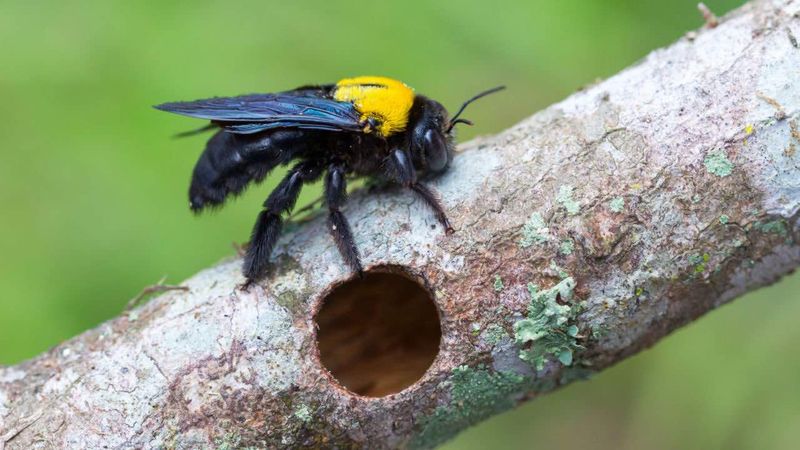
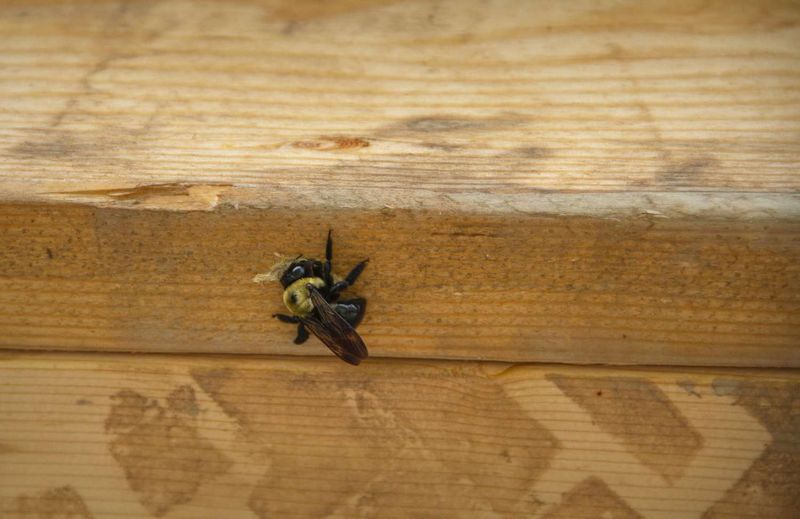
Large carpenter bees, belonging to the genus Xylocopa, excavate tunnels in exposed, unpainted wood. Think deck boards, fascia, porch columns, and fence rails.
Small carpenter bees in the genus Ceratina are a fraction of that size and tunnel into already-damaged or pithy plant stems; they have no ability to chew through the wood on your house. Treating both as the same threat leads to wasted effort and, sometimes, unnecessary pesticide use.
A bee may have found accessible flowers nearby, suitable nesting material on your property, or both, but its presence alone does not prove that every resource comes from your yard. NC State’s stinging insect resource is clear that carpenter bees are solitary insects, not colony-forming hive builders.
Several females may share a piece of wood, but that is not equivalent to a honey-bee colony with thousands of defenders.
A bee drilling into a deck board is evidence that the wood is accessible and suitable for nesting. It is not a scorecard for soil health, pesticide history, or native-plant diversity.
USGS research on eastern carpenter bee nest structure confirms that large carpenter bees frequently select human-built wood precisely because it is exposed and easy to excavate, not because the surrounding landscape has passed some ecological test. The practical balance here is straightforward: value these native bees for what they contribute, and investigate tunneling in vulnerable wood on its own merits.
Identify the bee before you judge the damage
Not every bee you see near your fence or flower bed is the same animal, and the difference matters enormously before you decide to act. Large carpenter bees are hard to miss: robust, often close to three-quarters of an inch long, with a shiny, relatively hairless black abdomen that sets them apart from bumblebees, which have a fuzzy, yellow-banded body.
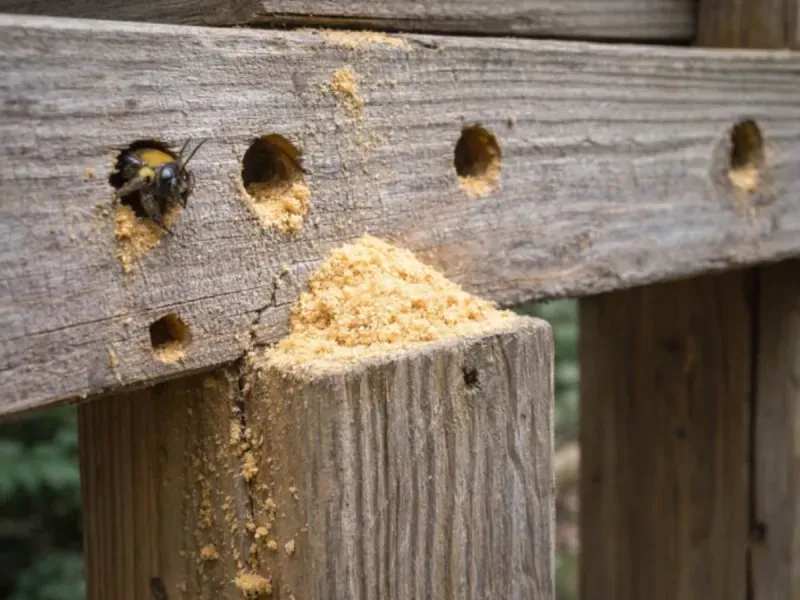
When a large carpenter bee is nesting, look for a roughly circular entrance hole about the diameter of a finger, usually accompanied by a small pile of coarse sawdust or yellowish frass beneath the opening.
Small carpenter bees present an entirely different picture. NC State Extension’s bee hotel resident guide describes Ceratina species as much smaller, often sporting a metallic blue-green sheen.
They nest in the soft pith of hollow or broken plant stems, including elder, sumac, rose, blackberry, and raspberry canes. If you spot a tiny, iridescent bee disappearing into a cut rose stem, that is a small carpenter bee doing what small carpenter bees do.
There is no deck damage to worry about.
Seasonal timing gives another layer of context, though it should be read as a general guide rather than a fixed calendar. NC State’s non-honey bee stinging insect resource notes that large carpenter bees commonly emerge in April and May across North Carolina, while small carpenter bees may be active year-round, with especially notable activity from June through September.
Weather patterns and the differences between the Piedmont, Coastal Plain, and mountain regions can shift those windows in either direction.
The practical takeaway: before concluding that a bee is chewing into your home, get a close look. A small, jewel-toned bee working a raspberry cane in August is a stem-nesting solitary bee going about normal behavior.
A large, robust bee hovering near a fresh hole in an unpainted fascia board in May is a different situation entirely, one that warrants a proper inspection of the wood rather than a blanket spray of the yard.
Their pollination role matters, but it has limits
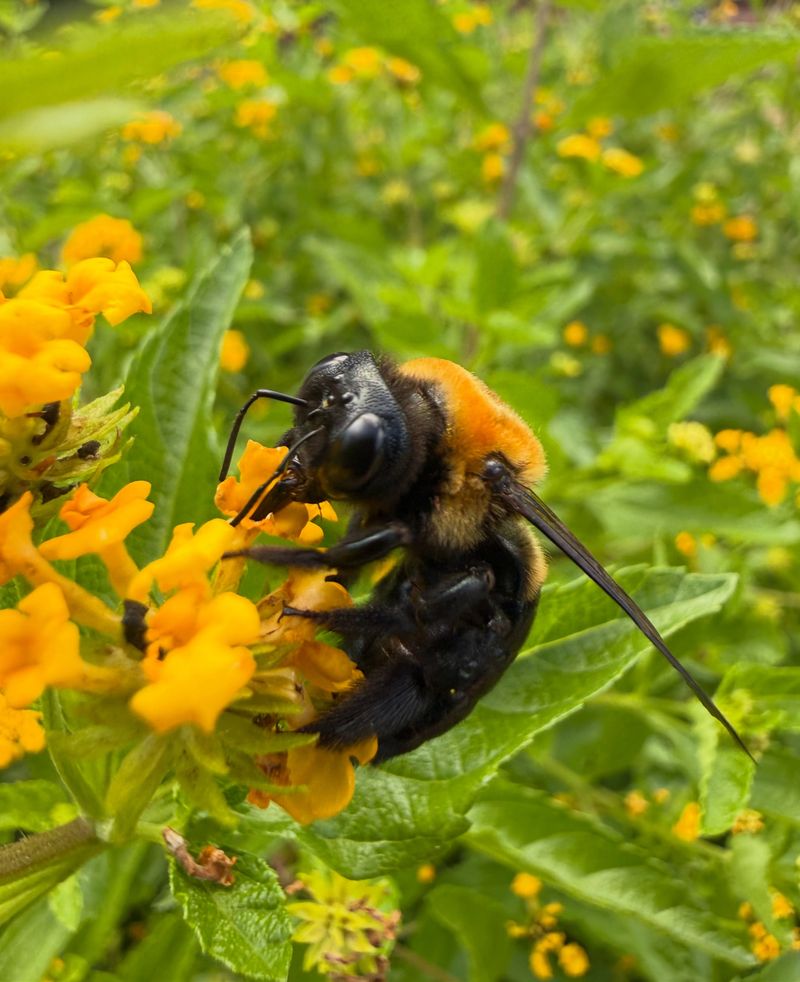
Eastern carpenter bees earn genuine credit as native pollinators. They are broad-ranging floral visitors, and a study in Environmental Entomology on wild bees pollinating crops in Virginia documents native bee species, including carpenter bees, visiting crop flowers across the growing season.
That kind of consistent, season-long presence in flowering plants has real value for gardens and small-scale agriculture in North Carolina.
Their contribution comes with honest limits, though. Carpenter bees have relatively short mouthparts, and on some long-tubed flowers, they bypass the normal entry point entirely.
Instead of contacting the reproductive structures that would transfer pollen, they chew a small hole at the base of the flower tube and drink the nectar without delivering any pollination benefit. USDA NRCS pollinator guidance acknowledges this nectar-robbing behavior as a recognized part of carpenter bee ecology.
Saying they “can pollinate many plants” is accurate; saying every flower visit improves fruit or seed set is not.
Their foraging habits also mean that a carpenter bee nest on your property is not a reliable indicator of what your yard contains. USGS documentation of eastern carpenter bee behavior shows these bees range widely and readily visit cultivated, weedy, or nonnative flowers.
A bee nesting in your shed may be foraging on a neighbor’s garden, a roadside patch of clover, or ornamental flowers that have no native-plant credentials at all.
The NC State Extension Gardener Handbook chapter on native plants makes the broader point well: native plants improve habitat quality, but a bee’s presence alone cannot diagnose what the surrounding landscape contains. Treating a carpenter bee as proof of a biodiverse, pesticide-free yard misreads what the bee is actually doing.
Value their pollination work where it happens, note the nectar-robbing exception, and resist the urge to turn a single visiting bee into an ecological report card for the whole property.
Inspect a tunnel without treating every bee as an emergency
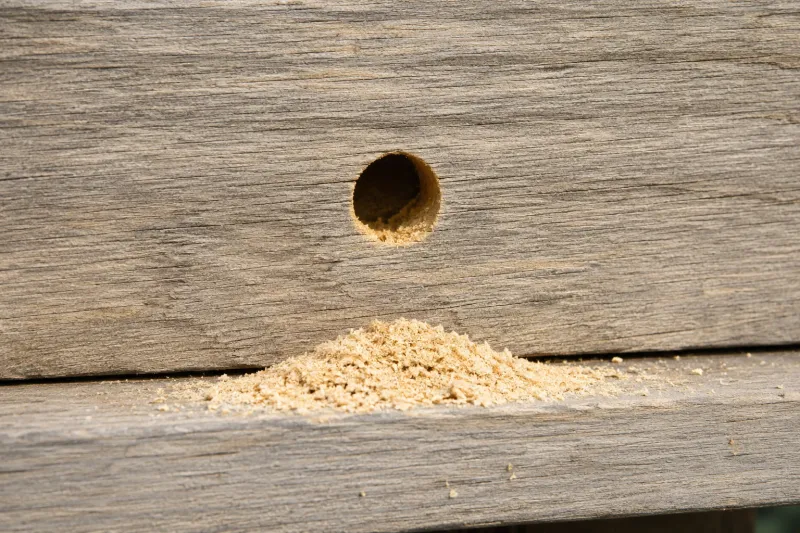
Four observations cover nearly every carpenter bee situation a North Carolina homeowner will encounter, and each one calls for a different response. A bee visiting flowers is simply foraging; no action on the wood is needed.
A bee hovering near a structure may be a male patrolling a nesting territory, which looks alarming but carries no sting risk since males cannot sting. An active tunnel with fresh sawdust below it means a female is actively excavating, and that specific piece of wood deserves a closer look.
Repeated tunneling in the same structural member over multiple seasons is the scenario that warrants the most attention.
Utah State University Extension’s carpenter bee fact sheet explains that a single tunnel is usually a localized concern. Over time, however, galleries can branch and extend, weakening the surrounding wood, creating entry points for moisture, staining the surface below the hole, and drawing woodpeckers that enlarge the damage further while searching for larvae.
The cumulative picture across several seasons can become significant, particularly in weather-exposed or load-bearing wood.
Carpenter bees are solitary insects. Several females may choose the same attractive piece of wood, but that clustering is not a colony in any social-insect sense.
Penn State Extension’s carpenter bee resource notes that the number of visible bees does not by itself establish a dangerous infestation. A handful of bees working one fascia board is a maintenance issue, not a structural crisis, though it still deserves follow-up.
On sting risk, NC State’s stinging insect guide is direct: males often hover near people near nesting areas as a territorial display, but they are physically incapable of stinging. Females can sting when handled, trapped, or directly threatened, so avoid grabbing or swatting at bees.
Anyone with a known bee-sting allergy should be especially cautious around active nest sites and keep appropriate medication accessible.
Protect exposed wood with a proportional response
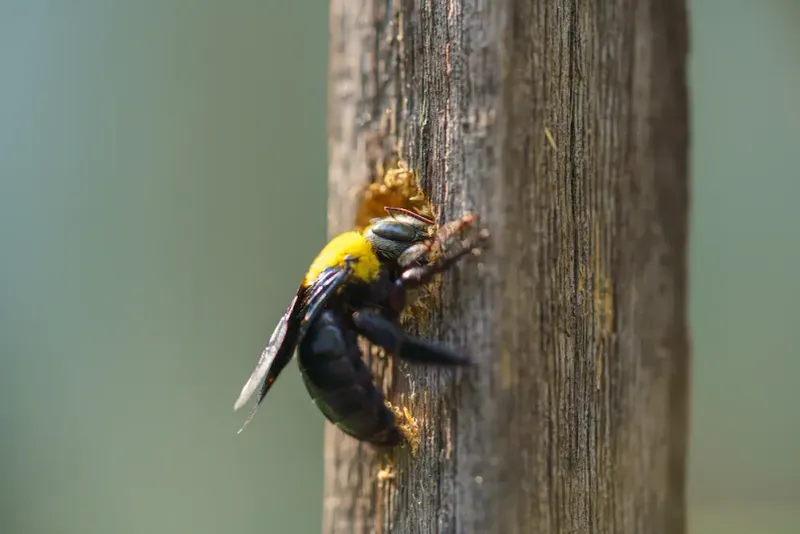
When a tunnel appears in noncritical wood and the damage is genuinely minor, coexisting with the bee through the current season is a reasonable choice. Monitor the area, keep people from handling the bees, and plan to address the wood surface after the active nesting period rather than trying to eliminate every bee in the yard at once.
NC State Extension specifically warns that spraying hovering bees is neither sensible nor particularly safe; it wastes pesticide, risks unnecessary exposure, and does not address the nest itself.
Prevention is a more durable strategy than reactive spraying. Painting or applying an appropriate exterior finish to exposed, bare wood makes it less attractive to new excavations.
Penn State Extension’s eastern carpenter bee guide confirms that surface treatments can deter new activity, while also being clear that paint does not remove bees already living inside established tunnels and may not prevent every future attempt under all conditions. For vulnerable structural areas such as porch columns, soffits, or deck framing, composite or synthetic materials can reduce the appeal for future nesting.
When the wood is critical, repeatedly attacked, or in a location that is hard to monitor and repair, a targeted pesticide application may be appropriate. USDA Forest Service bee guidance and the 2026 NC Agricultural Chemicals Manual both reflect a consistent principle: reserve pesticides for genuine structural problems, use only a product labeled for the specific site and pest, follow the label completely, and take care to avoid drift onto flowering plants or water.
For nests located in eaves, enclosed soffits, high deck framing, or other difficult-to-reach spots, a licensed pest-management professional is the safer choice. Homeowners should never casually inject pesticides into inaccessible cavities or seal active holes without following a proper treatment sequence.
Any sealing of entrance holes should wait until the bees have been addressed according to label guidance or professional direction, so emerging bees are not trapped inside the wood where they may cause additional damage trying to exit.
Build habitat for a wider pollinator community
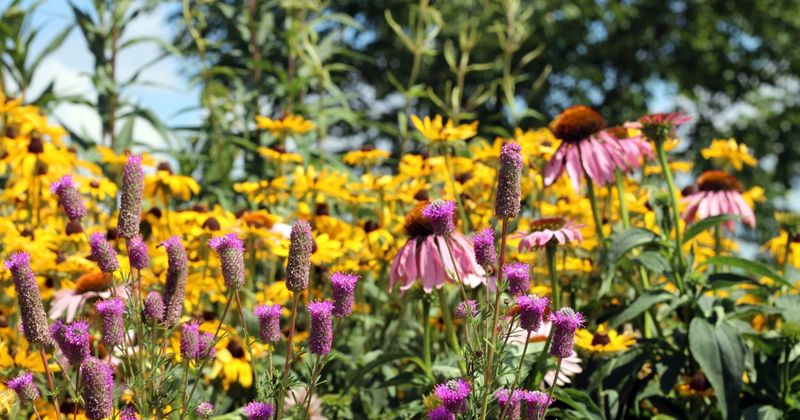
Shifting focus from damage control to active stewardship opens up better long-term outcomes for both the yard and its pollinators. Continuous flowering resources are the foundation.
NC State Extension’s guide to common insects in wildflower plantings highlights a range of native options suited to North Carolina conditions, including bee balm, mountain mint, butterfly milkweed, buttonbush, blueberry, goldenrod, purple coneflower, Joe-Pye weed, ironweed, blazing star, and golden Alexander. The goal is staggered bloom times that carry something in flower from early spring through fall.
These plants support a broad community of native pollinators, not just carpenter bees. The NC State Extension Gardener Handbook’s native plants chapter emphasizes matching species to the yard’s specific light, moisture, and regional conditions.
A mountain garden in Buncombe County and a Coastal Plain yard near New Bern have different plant palettes, and selecting accordingly gives native plants the best chance of establishing and thriving.
A separate and complementary practice involves how you handle plant stems at the end of the season. NC State Extension’s garden cleanup guidance for pollinators recommends trimming perennial stems to 12 to 24 inches in the first winter rather than cutting them to the ground.
Leaving suitable hollow or pithy stems standing through winter and into early spring provides nesting material for stem-nesting solitary bees generally; small carpenter bees may use appropriate stems when they find them. This guidance applies to stem-nesting species, not to the large Xylocopa bees that excavate decks and house trim.
Standard bee hotels deserve a realistic assessment. NC State Extension is straightforward that large carpenter bees are not frequent residents of typical bee hotels and are unlikely to be lured away from spacious nesting sites in decks, porches, or sheds by a small wooden structure hung on a fence post.
Bee hotels can support other cavity-nesting species and are worth including in a pollinator-friendly yard, but they should not be marketed to yourself as a carpenter-bee diversion tactic.
Match the response to the bee and the wood
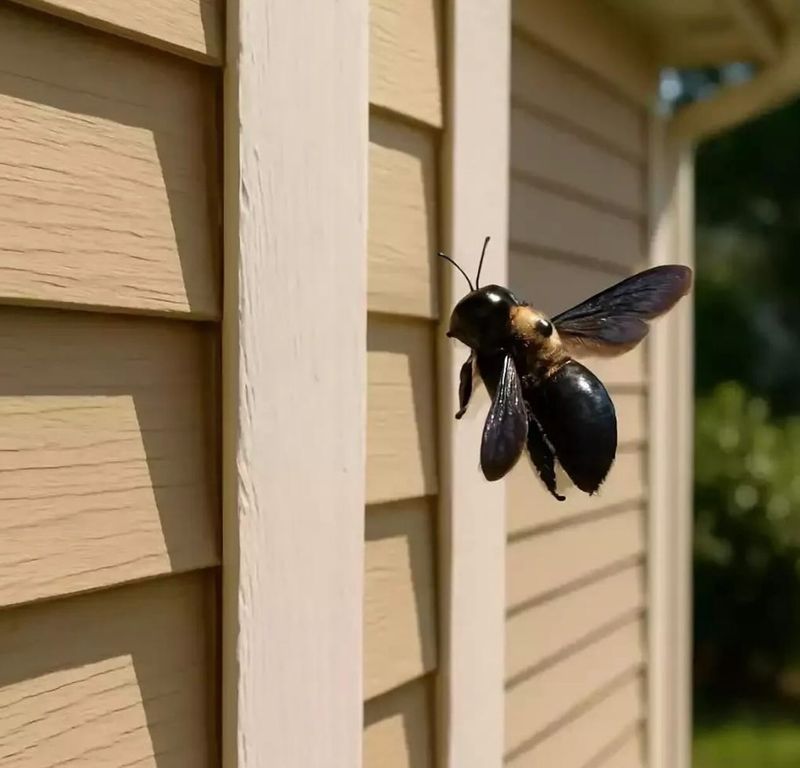
A clear decision sequence makes carpenter bee management much less stressful. Start by identifying the bee: large and robust with a shiny abdomen near exposed wood, or small and metallic near plant stems.
Then determine what it is doing. A bee working a flower is foraging, full stop.
A bee emerging from or entering a round hole in bare wood is nesting, and that specific location deserves inspection.
Once you locate the nesting substrate, assess it honestly. Is the wood critical to the structure or repeatedly attacked across seasons?
Penn State Extension and NC State Extension both support monitoring and coexistence when damage is minor and the wood is noncritical. When tunneling is recurring or the wood is load-bearing, weather-exposed, or hard to repair, maintenance or professional help is the proportional next step.
Penn State’s eastern carpenter bee resource frames this well: the bee is not automatically a pest, and the wood is not automatically doomed.
Carpenter bees in a North Carolina yard may reveal accessible forage nearby, a nesting opportunity on the property, or both. They do not deliver a simple ecological verdict in either direction.
Good stewardship means protecting the pollinators that contribute to your garden while keeping a practical eye on the exposed wood that gives them a foothold. A yard that manages both is better for the bees and better for the home.