
What It Really Means When A Carpenter Bee Keeps Hovering Around Your North Carolina Porch
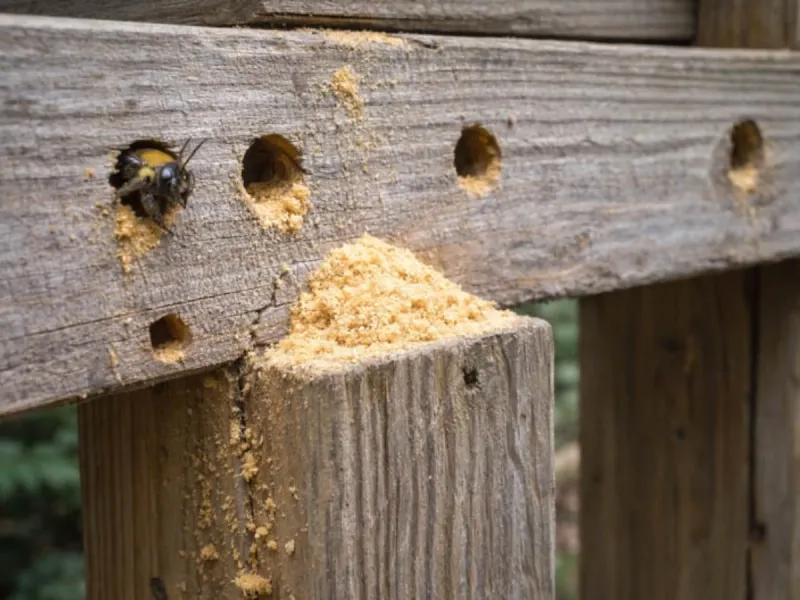
That big black bee buzzing back and forth across your porch is hard to ignore, especially when it darts straight at your face. Most North Carolina homeowners assume the worst, but the story behind the hovering is more interesting than alarming.
Understanding what that bee is actually doing can help you protect your porch, stay safe, and make smarter choices for the wildlife in your yard.
The Bee on the Porch Is Probably an Eastern Carpenter Bee
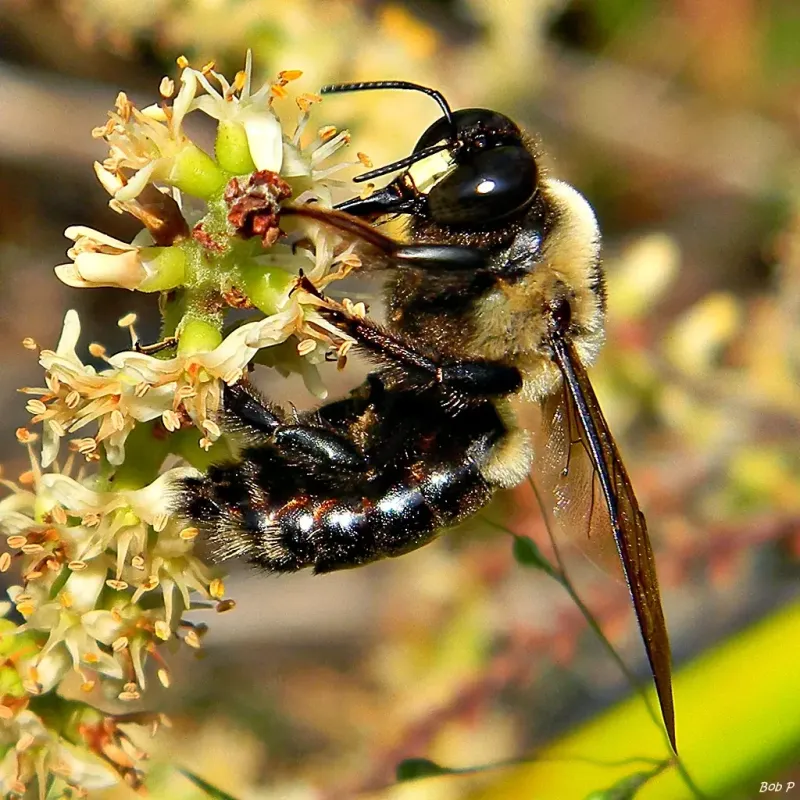
Most large black bees patrolling a North Carolina porch turn out to be eastern carpenter bees, known scientifically as Xylocopa virginica. Getting a good look at the bee before reaching for any product is the most useful first step you can take.
A few physical details make identification surprisingly straightforward once you know what to check.
Eastern carpenter bees run about three-quarters to one inch long. The thorax, the middle section just behind the head, is covered in dense yellowish or black fuzz.
The abdomen, the large rear section, is shiny and almost entirely without hair. NC State Extension’s Union County guide to carpenter bees notes that this smooth, hairless abdomen is one of the clearest field marks separating them from bumblebees, whose abdomens are covered in hair from front to back.
If the bee hovering near your railing looks velvety all over, you are probably watching a bumblebee rather than a carpenter bee.
Sex matters for identification, too. Male carpenter bees often have a pale yellow or whitish patch on the face.
Females generally have a black face and are the ones most likely to be in or near a wood surface. University of Maryland Extension’s carpenter bee resource confirms this face-color difference as a reliable way to tell males from females in the field.
One more distinction worth making: not every small black bee near wood is a carpenter bee of the porch-drilling kind. Small carpenter bees in the genus Ceratina are much tinier and nest in pithy plant stems rather than structural lumber.
NC State’s guide to small carpenter bees treats them as a separate group entirely, and the NC State bee hotel residents guide reinforces that CeratinaXylocopa bees should not be confused with the large species boring into your fascia. The presence of exposed, unpainted, or weathered wood on a porch or deck supports the eastern carpenter bee as the likely candidate, but wood alone does not substitute for actually looking at the bee.
Hovering Usually Means a Male Is Patrolling
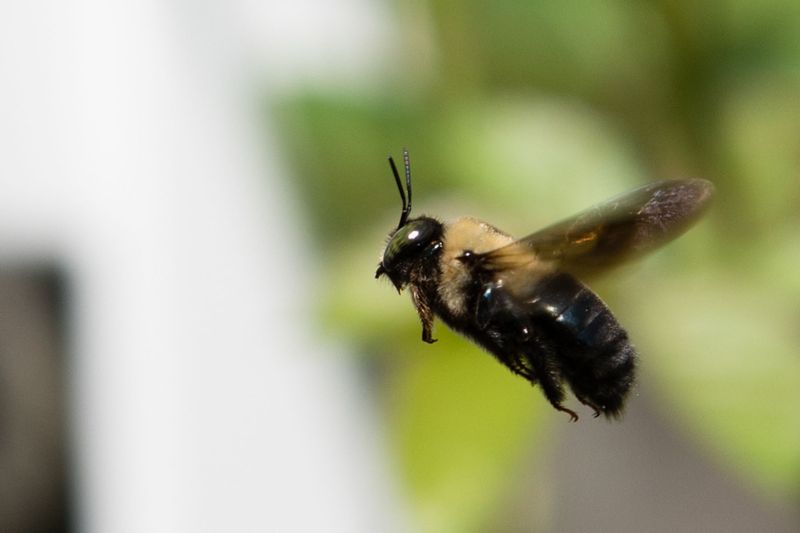
When a large bee repeatedly hovers at eye level, buzzes loudly, and darts toward anyone who walks by, the behavior reads as threatening. The reality is more mundane.
That performance almost certainly belongs to a male eastern carpenter bee working a territorial patrol, not staging an attack.
Males stake out a patch of airspace near a nesting area and defend it against rival males, other insects, and anything else that passes through. They hover, lunge, and buzz with real conviction.
NC State Extension’s guide to non-honeybee stinging insects explains that despite the intimidating display, male carpenter bees lack stingers entirely, which means every dart and buzz is a bluff. You can walk past without being stung by the hovering male, though startling reactions or swatting near your face are still worth avoiding.
The behavior also differs in an important way from what happens when you disturb a honey bee colony or a yellowjacket nest. Carpenter bees are solitary insects.
University of Maryland Extension notes that each female excavates or reuses her own individual gallery rather than sharing a large communal nest with thousands of workers. There is no colony to mobilize, no guard caste to recruit, and no alarm pheromone spreading through a crowd.
The male on patrol is acting on his own instinct, not coordinating a defense with hundreds of nestmates.
Females are a different matter. University of Georgia Extension points out that female carpenter bees can sting, and they will do so if handled, trapped, squeezed, or stepped on.
The practical guidance is straightforward: do not pick up a carpenter bee, block a tunnel opening with your hand, or walk barefoot in an area where bees are actively working near the ground. Give the females space and they typically ignore people entirely.
The Porch Can Offer a Nest, Not Proof of a Pollinator-Rich Yard
A carpenter bee circling the porch does carry information about the yard, but it pays to read that signal carefully rather than drawing a sweeping conclusion. The most accurate thing the encounter tells you is that the property offers something the bee can use: accessible, workable wood for nesting.
Whether the yard is genuinely rich in pollinator habitat is a separate question with a more complicated answer.
Female carpenter bees do not eat wood. They excavate or reuse tunnels to raise their young, then collect pollen and nectar from flowers to stock those tunnels as food for larvae.
University of Maryland Extension describes this provisioning behavior clearly: the wood is a nursery, and flowers are the grocery store. So a nesting bee does imply that floral resources exist somewhere within her foraging range.
That range can be fairly wide, which means the flowers she is visiting may be in a neighbor’s yard, a nearby garden, or a roadside planting rather than on your property.
NC State’s pollinator landscape management guidance makes a point that is easy to overlook: supporting pollinators requires both floral resources and nesting resources. A yard with plenty of blooms but no suitable nesting sites, or one with good nesting wood but almost no flowers, gives pollinators only half of what they need.
A hovering carpenter bee near a weathered fascia board or deck rail tells you that the nesting side of the equation is satisfied. It does not tell you much about bloom diversity, the number of flowering seasons covered, or whether the yard avoids pesticide use in areas where bees forage.
NC State’s stinging insect guide reinforces that carpenter bees are native pollinators tied to the broader landscape, not just a single yard. Treat the hovering bee as one useful clue rather than a pollinator-habitat report card.
The real assessment comes from looking at what the yard actually grows across all four seasons.
Look for Tunnels Before You Treat the Porch
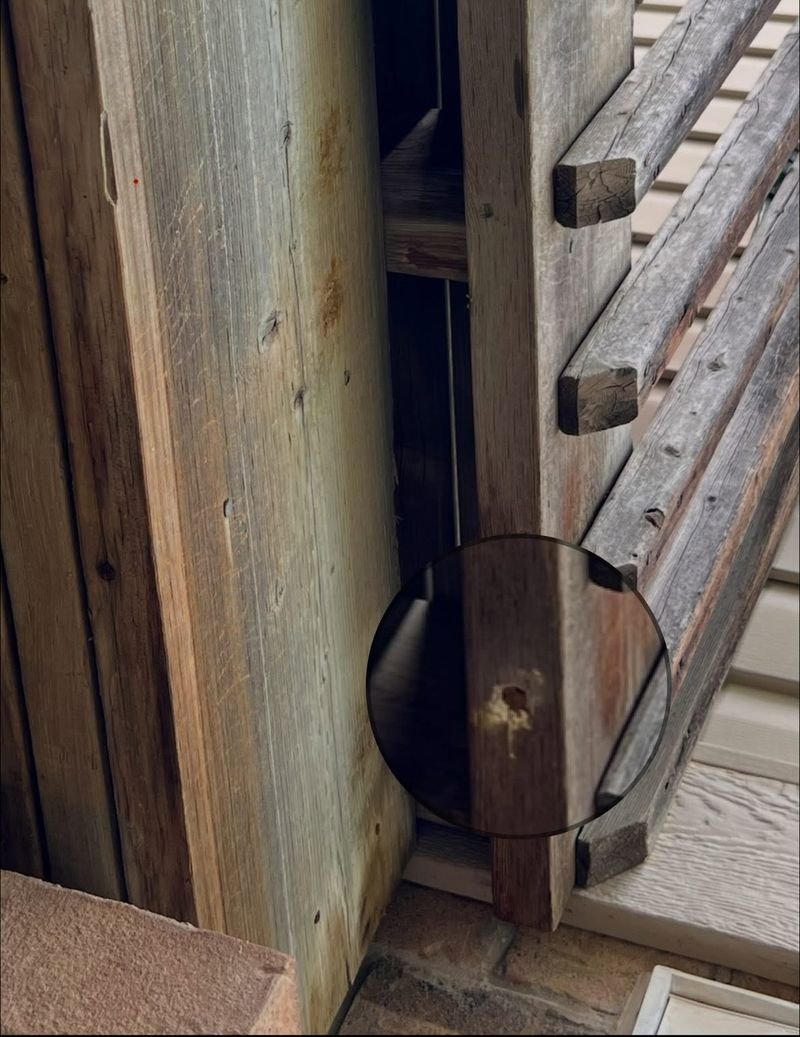
Seeing a carpenter bee near the porch is reason to look more closely at the wood, not reason to immediately treat anything. A short inspection gives you the information needed to decide whether there is an active nest, how much wood is actually involved, and what, if any, response makes sense.
Without that check, you are guessing.
Start at the most common target areas: porch rails, fascia boards, trim pieces, eave undersides, deck furniture, siding, and fence posts. NC State Extension’s guide to non-honeybee stinging insects in North Carolina describes the signs of active nesting clearly.
Look for nearly round openings about one-half inch wide, the diameter of a standard pencil. Below the hole, you may find coarse sawdust, sometimes called frass, that falls as the female excavates.
Near the entrance, yellow or dark staining from bee waste and pollen can mark the wood. Any one of these signs is worth noting; finding two or three together makes an active or recently used nest quite likely.
Timing matters for the inspection. In North Carolina, carpenter bees typically emerge from overwintering tunnels in April and May, though local weather and elevation can shift that window by a week or two in either direction.
A mountain yard at higher elevation may see bees a bit later than a Piedmont property at lower elevation. University of Maryland Extension notes that females become active in spring, begin excavating or reopening tunnels, and provision them through late spring and into summer before adults from that season’s eggs emerge later in the year.
Putting the damage in proportion is just as important as finding it. A single nest, even a fresh one, generally causes limited structural harm.
The greater concern develops over several years when females return to the same boards, deepen existing galleries, and add side chambers. Thin wood is more vulnerable than thick lumber.
Repeated reuse can eventually weaken a board enough that moisture, fungi, woodpeckers probing for larvae, or other insects find their way in, compounding the original damage. One hole discovered early is a manageable situation.
A cluster of holes in the same rail that has gone unnoticed for several seasons deserves a more careful look at the wood’s condition before deciding on next steps.
Sound Wood Protects the Porch Without Targeting Bees
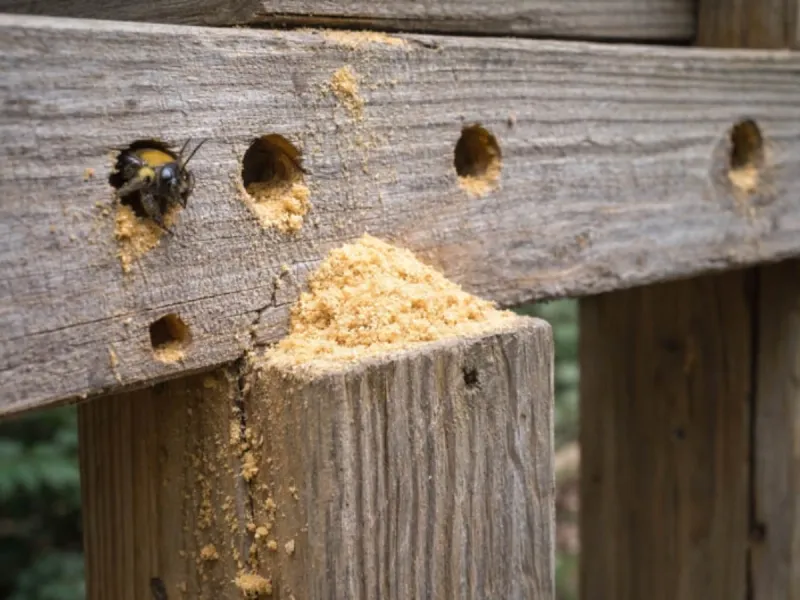
Once an inspection confirms which boards are vulnerable or already showing signs of nesting, the most proportionate response is not a pesticide. Maintaining the wood itself reduces the conditions that attract carpenter bees in the first place, and it protects the structure regardless of what the bees decide to do next season.
Painted and well-finished wood is less preferred by female carpenter bees looking for a place to excavate. University of Maryland Extension and NC State’s Union County carpenter bee guide both recommend keeping exposed wood surfaces painted or stained and sealed as a first-line deterrent.
Cracks, nail holes, and open end grain are particularly inviting to bees because they give a female a starting point for excavation. Filling those gaps with exterior caulk and touching up bare spots in the finish removes easy entry points and makes the surface less appealing overall.
Boards that are already badly damaged, heavily tunneled, or structurally compromised are worth replacing rather than patching. Bees tend to return to wood that has been used before, partly because old tunnels lower the effort needed to establish a new gallery.
Swapping out a deteriorated rail or fascia section removes that history along with the weakened wood.
One qualification matters here: no finish is a permanent guarantee. NC State’s pollinator program guidance on bees near structures notes that there is no research-backed method for completely preventing carpenter bees from using a structure.
Bees may still probe weathered, cracked, or otherwise compromised surfaces even after maintenance work. Think of painting, sealing, and replacing damaged wood as reducing new nesting opportunities and managing structural risk over time rather than as a one-season fix that closes the issue permanently.
A Bee-Friendly Yard Needs Flowers and Nesting Habitat
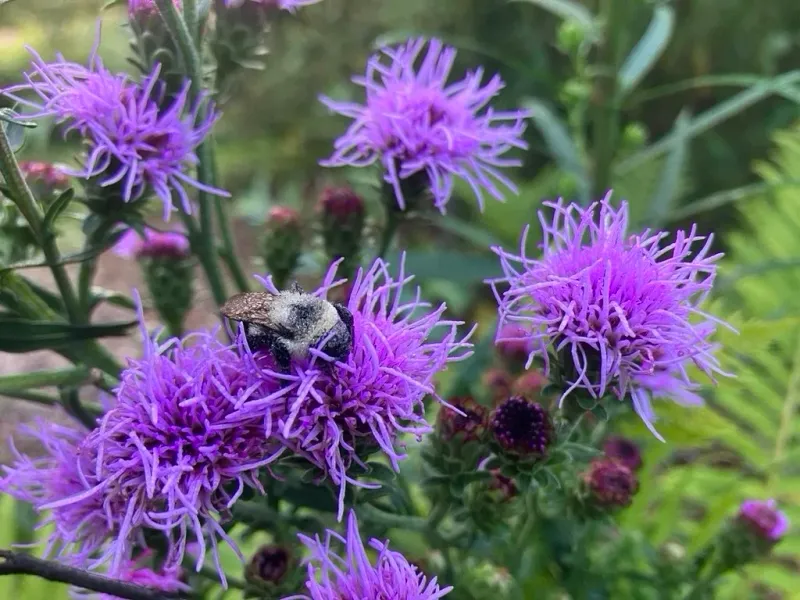
Spotting a carpenter bee near the porch is a reasonable moment to think about what the rest of the yard actually offers pollinators. The encounter points to nesting habitat, but a genuinely supportive yard does more than provide wood.
Flowers, pesticide-free foraging areas, and nesting resources all belong in the picture together.
NC State’s landscape management for pollinators guidance emphasizes that planting flowers alone is not the whole answer. A yard that blooms only in May and then goes quiet through August and September leaves pollinators without food during much of their active season.
Providing bloom across multiple seasons, from early spring through fall, gives a wider range of bee species something to forage on throughout the year. NC State’s pollinator support guidance connects consistent bloom diversity directly to stronger pollinator presence over time.
Carpenter bees contribute to pollination, but their value varies by flower type. Utah State University Extension’s guide to native bees notes that large carpenter bees work open or disk-shaped flowers effectively, while deep, tubular flowers can be harder for them to access given their mouthpart length.
They also sometimes cut a slit at the base of a tubular flower to reach nectar directly, bypassing the bloom’s reproductive parts entirely. University of Georgia Extension describes this nectar-robbing behavior as a real trade-off: the bee gets food, but the flower may not get pollinated in the process.
Pesticide choices shape the habitat as much as plant choices do. EPA pollinator protection guidance recommends avoiding pesticide applications when bees are actively foraging and steering clear of treatments on or near blooming plants unless the product label specifically permits it.
A yard with diverse native blooms but routine broad-spectrum spraying near those plants undermines the habitat it appears to offer. Treating the porch bee encounter as a prompt to evaluate the yard’s full combination of floral resources, nesting options, and pesticide practices gives a more accurate read of where the habitat stands.
Safe Control Starts With What You Do Not Spray
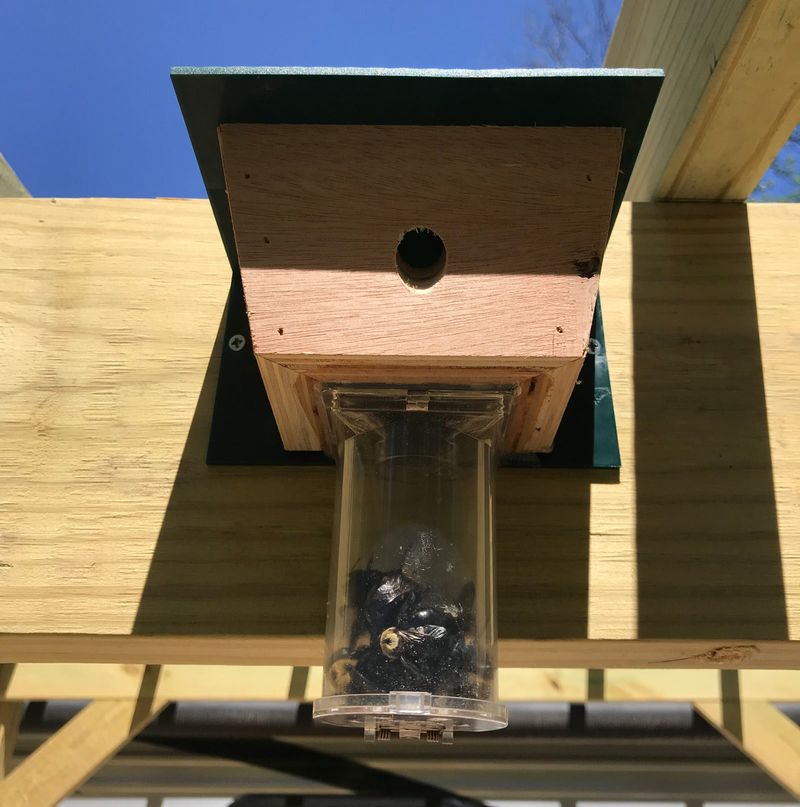
Before reaching for any product, a few actions are clearly off the table. Swatting at a hovering bee near your face increases your risk of a startled sting reaction and accomplishes nothing for the wood.
Spraying a bee in flight wastes pesticide, puts the chemical where it does not need to go, and does not address the nest. NC State Extension’s stinging insect guide states plainly that spraying hovering carpenter bees is not a sensible or particularly safe use of pesticide.
Broad applications across a flowering yard carry their own serious problems. EPA pollinator protection guidance advises avoiding pesticide applications when bees are foraging, keeping treatments away from blooming plants unless the product label specifically allows it, and preventing drift onto areas where pollinators are active.
EPA label guidance makes clear that every approved use, precaution, and restriction is product-specific. There is no universal ingredient, concentration, or schedule that applies across all carpenter bee situations.
Following the exact label of any product you choose is a legal requirement, not optional guidance.
Extension recommendations on control are not fully uniform. NC State’s pollinator program acknowledges that no solid research-based method exists for completely eliminating or repelling carpenter bees from structures.
Other extension resources describe targeted dust or aerosol applications directed into tunnel openings, along with sealing those openings after treatment, as options for managing active nests. University of Maryland Extension frames chemical treatment as damage management rather than eradication, which is the proportionate way to think about it.
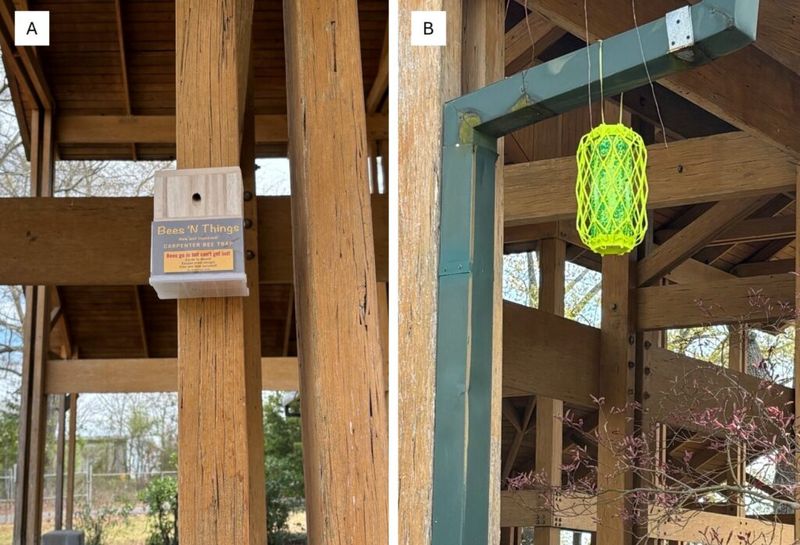
Traps marketed for carpenter bees catch some individual bees, but Caldwell County NC State Extension questions whether they provide meaningful control across the whole property. They are not a substitute for addressing the wood conditions that attract bees in the first place.
For nests in overhead locations, inside walls, or anywhere that requires ladder work or confined-space access, professional pest management is a safer option than improvised treatment. The goal in every case is managing structural damage to the porch, not eliminating every carpenter bee from the surrounding landscape.
Read the Hovering as a Clue to Your Yard
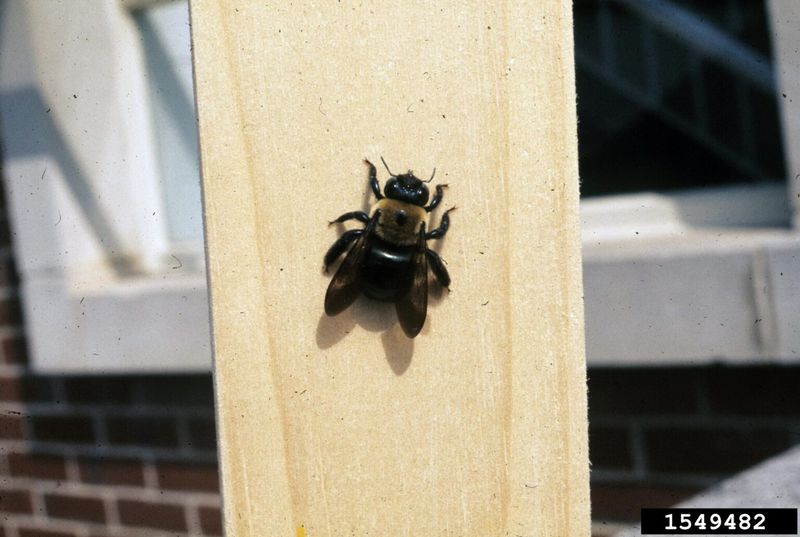
The next time a large black bee holds position outside your porch door, the most useful response is to watch rather than react. Check whether the bee is male by looking for a pale face and a shiny abdomen, then give the wood a close look for round entry holes, sawdust, or staining.
NC State Extension and NC State’s pollinator program both point toward observation and targeted maintenance as the starting point, not broad intervention.
A hovering male signals territorial behavior, not an attack. A bee near the porch suggests usable nesting wood and possibly nearby flowers, but it is a clue about the yard’s conditions rather than a grade on its overall pollinator value.
NC State’s pollinator landscape guidance reminds homeowners that both floral diversity across seasons and suitable nesting resources together define a supportive yard. Protecting the porch and protecting native pollinators are not competing goals.
A well-maintained surface, a pesticide-free garden, and a clear-eyed look at what the yard actually provides across the seasons accomplish both at once.