
What It Really Means When Bats Start Circling Your North Carolina Yard At Dusk
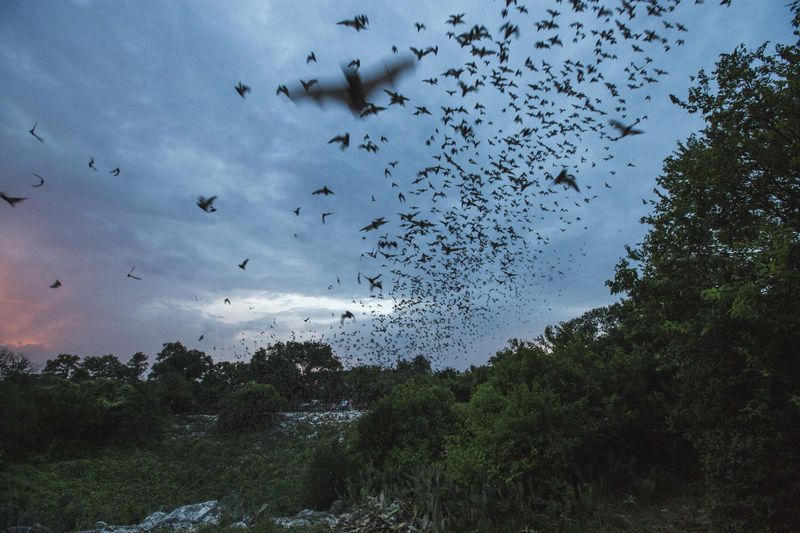
Spotting a bat swooping and zigzagging over your yard just after sunset can catch you off guard the first time. Those quick, erratic loops are actually a sign that a native North Carolina animal is doing exactly what it evolved to do: hunting insects in the fading light.
Understanding what pulls bats into your airspace helps you make smarter decisions about mosquitoes, yard care, and the wildlife sharing your neighborhood.
Dusk Circling Usually Means a Bat Is Hunting
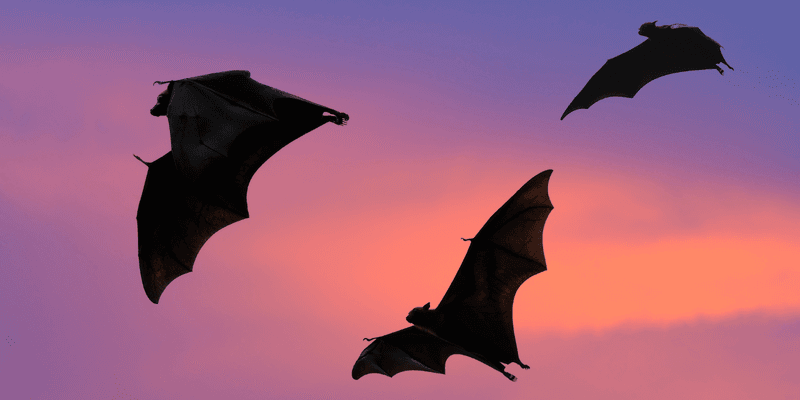
Every evening across North Carolina, from the mountain coves of the Blue Ridge to the flat coastal neighborhoods near Wilmington, bats leave their roosts and take to the air in search of food. The swooping, unpredictable loops you see over your yard reflect a highly tuned hunting system at work.
Using echolocation, bats send out rapid pulses of sound and listen for the echoes bouncing back from nearby insects, adjusting their flight path in fractions of a second to intercept moving prey. USGS explains that this chase behavior produces exactly the erratic, banking flight pattern that looks so dramatic from the porch.
North Carolina is home to 17 bat species, and NC Wildlife Resources Commission notes that these animals are primarily nocturnal but commonly forage in the early evening and again around dawn. Four of those species carry federal threatened or endangered status, and others hold state conservation designations, so the bats over your yard may belong to populations that wildlife managers are actively working to protect.
Nothing about normal dusk activity signals a problem with the bat or a threat to you. A bat flying purposefully through the air at twilight is behaving exactly as it should.
The flight is not random panic, and the animal is not confused or sick. Bats that appear to be chasing insects around the yard, swooping low over a lawn or pond edge, or circling repeatedly under a streetlight are simply working a productive hunting route.
Recognizing that behavior for what it is, a native predator efficiently doing its job, makes it much easier to appreciate rather than fear.
What Your Yard May Be Offering Bats
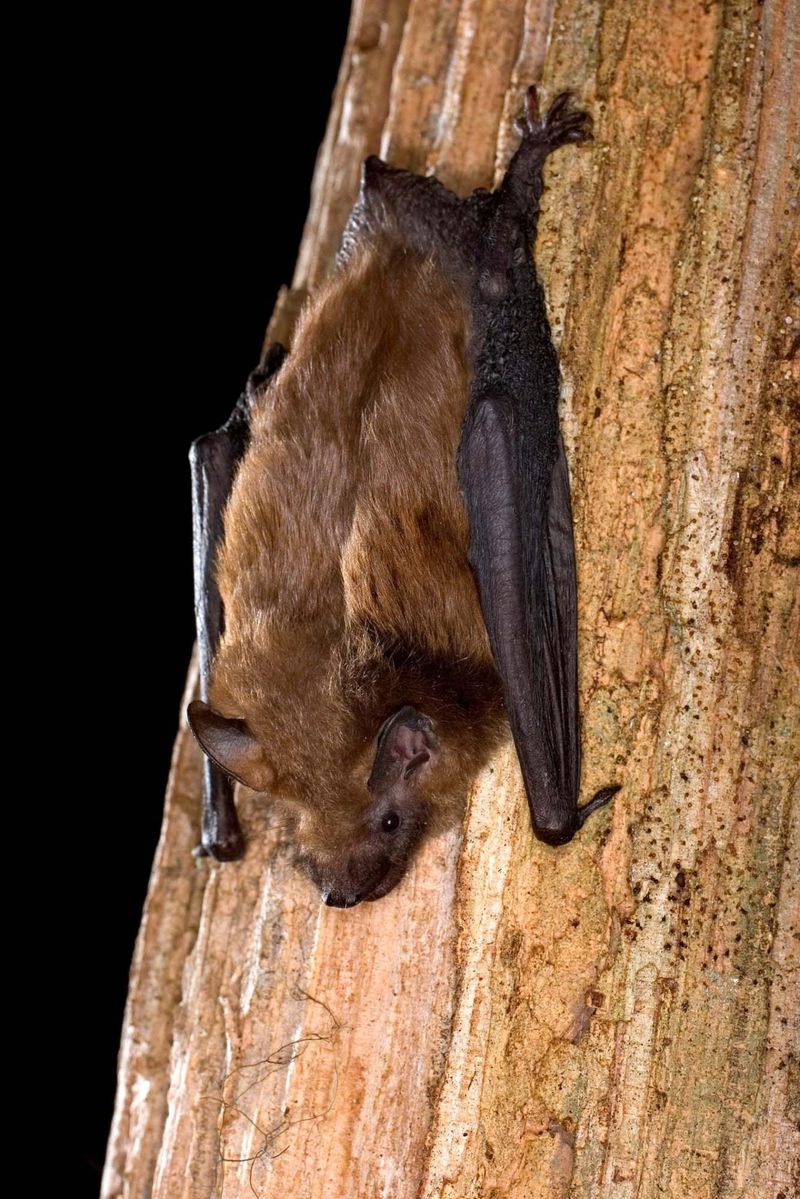
Bats do not appear over a yard at random. Something in or near the space is making it worth a visit, and identifying that something gives homeowners useful information about their property.
The most common draws are flying insects, accessible water, tree cover that creates sheltered flight corridors, open edges where bats can maneuver freely, and artificial lights that concentrate prey. Any one of these, or a combination, can turn a suburban lot into a regular stop on a bat’s nightly circuit.
Water is a particularly strong attractor. USGS research on insectivorous bat foraging found that bat activity closely tracks the availability of aquatic flies, which emerge from ponds, streams, and wet areas in large numbers.
A backyard pond, a drainage ditch, or even a low-lying area that holds water after rain can support insect emergence that bats exploit. NC State Extension’s bat resource notes that permanent wet areas can supply both drinking opportunities and a consistent insect source for foraging bats.
Forest edges and open spaces matter too. Bats often follow the boundary between wooded cover and open lawn because that transition zone concentrates insects and gives the animals room to maneuver without colliding with branches.
Outdoor lights add another layer: moths, beetles, and other insects gather around porch lights and streetlamps, and bats learn quickly where reliable prey clusters appear each night.
What bat activity cannot tell you is whether your yard scores well on every measure of ecological health. USDA Forest Service research on bat habitat use makes clear that bats can exploit fragmented, disturbed, or partially developed landscapes as long as prey and flight corridors are available.
Seeing bats overhead is a reasonable sign that the airspace is usable for feeding, drinking, or travel at that time of day. It does not independently confirm high native-plant diversity, low pesticide exposure, or strong overall biodiversity across the property.
Are the Bats Actually Solving Your Mosquito Problem?
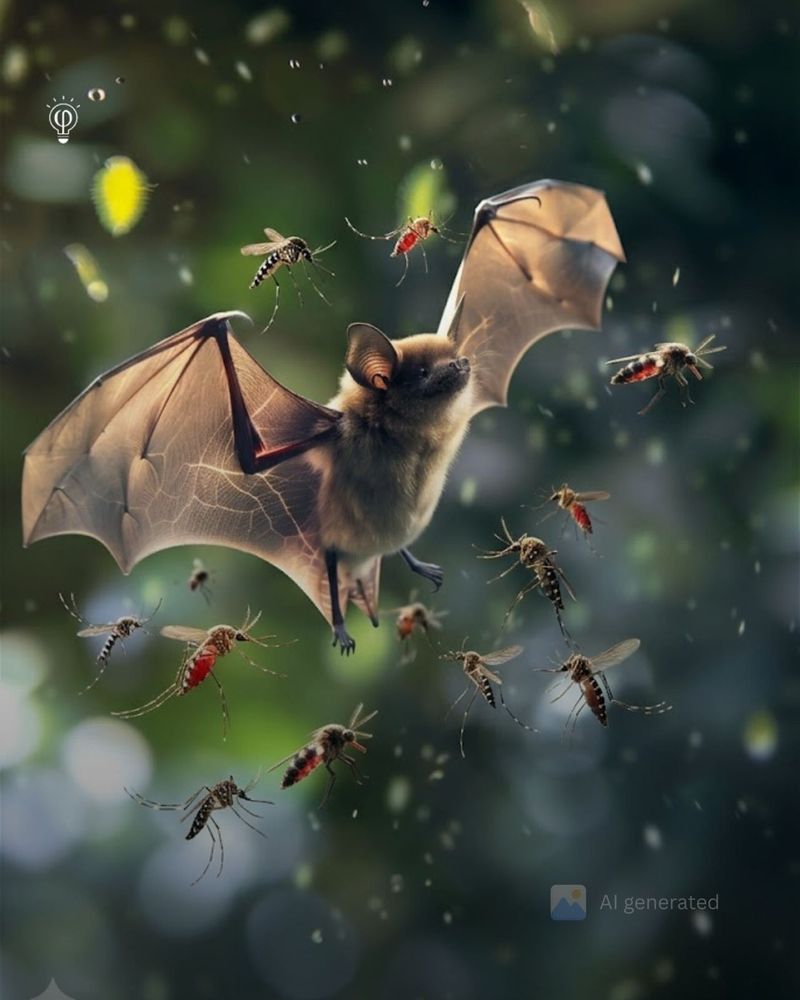
Bats genuinely eat mosquitoes. That part of the popular story is true, and it is worth saying plainly before getting into the complications.
Bats are opportunistic hunters, and mosquitoes are flying insects that share the same airspace bats patrol at dusk. Some consumption of mosquitoes is happening when bats circle your yard.
The complication is that mosquitoes are only one item on a long menu. Bats also pursue moths, beetles, midges, gnats, aquatic flies, and many other insects, and the mix shifts depending on what is available locally.
A peer-reviewed analysis of bat pest consumption found strong evidence that bats eat many insect pests, while also noting that direct effects on pest abundance vary considerably by bat species, prey type, and setting. A bat hunting near your Piedmont pond on a June evening may be eating far more aquatic midges than mosquitoes, simply because midges are more abundant at that moment.
Timing creates another gap in the mosquito-control story. Several mosquito species that bite people most aggressively in residential areas, including the Asian tiger mosquito common throughout North Carolina, are daytime feeders.
Bats are roosting when those mosquitoes are most active. The bats that appear at dusk are hunting during a window that does not align with peak biting time for some of the worst offenders.
NC State Extension’s mosquito-control guidance states directly that bats and birds generally do not reduce mosquito populations enough to provide significant mosquito control. The same message appears in the NC State Extension mosquito-control publication.
Bats offer some natural insect predation, and that predation has real value. Treating their presence as a stand-alone solution to a biting-mosquito problem, though, leads to unmanaged breeding sites and continued frustration.
The most accurate reading is that bats are helping with general insect loads, while mosquito management still requires direct action from you.
Control Mosquitoes Without Undermining the Yard

Because bats alone cannot carry the load of mosquito control, the most reliable approach combines appreciating what bats do with taking direct steps to cut mosquito breeding. The good news is that the most effective actions cost nothing and take only a few minutes each week.
CDC guidance on home mosquito control consistently points to standing water removal as the foundation: tip out containers, empty plant saucers, dump low spots in tarps or furniture covers, and clean gutters so water does not pool in debris.
Birdbaths and pet water dishes need fresh water at least once a week because mosquito eggs hatch in stagnant water within days. NC State Extension’s neighborhood mosquito-management resource notes that even a bottle cap of standing water can serve as a breeding site during warm months.
Drainage corrections, such as regrading low spots in a lawn or adding a French drain to a persistently wet corner, address the structural causes that refill themselves after every rain.
For water that genuinely cannot be emptied or covered, such as a rain barrel, an ornamental pond, or a slow-draining area, EPA-registered Bti products offer a larvicide option when applied according to label directions. Bti (Bacillus thuringiensis israelensis) targets mosquito, blackfly, and fungus-gnat larvae specifically and does not affect fish, birds, or the bats you want to keep hunting in the area.
Broad insecticide spraying at dusk is a different matter. NC State Extension’s mosquito-control publication cautions against treatments that expose non-target wildlife, and the EPA’s overview of mosquito-misting systems acknowledges concerns about pesticide exposure and limited evidence of effectiveness for residential systems.
Spraying during peak bat-foraging hours can reduce the insect food supply bats depend on and expose foraging animals to chemicals. Removing breeding water solves the problem at its source without those trade-offs.
A Bat House Supports Conservation, Not Guaranteed Mosquito Control
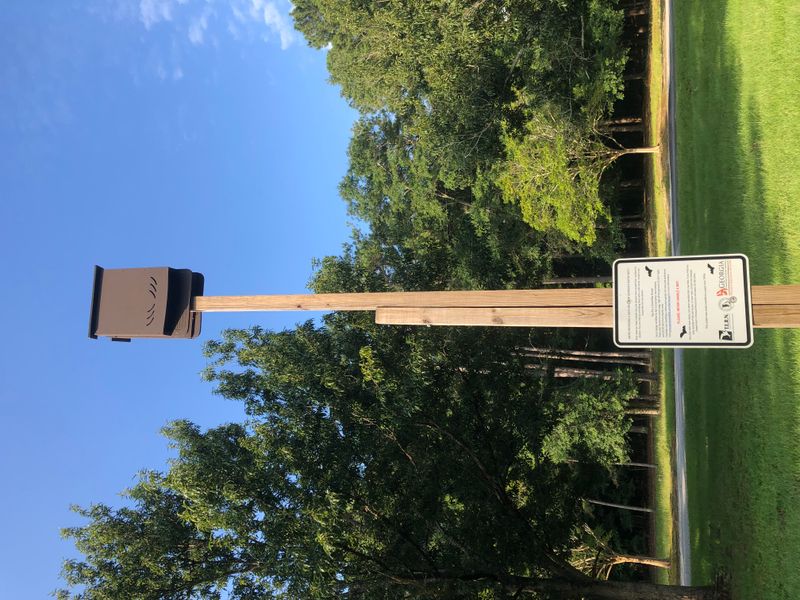
Bat houses have become popular additions to wildlife-friendly yards, and the idea behind them is sound: provide a safe roosting structure and give bats somewhere to shelter close to your property. The conservation value is real, particularly as natural tree cavities and old buildings that bats historically used continue to disappear across North Carolina.
Where a bat house succeeds in attracting a colony, it can become a genuine asset for local bat populations.
The limit to set clearly is this: a bat house does not guarantee occupancy, and it should not be sold to yourself as a mosquito-control device. Published research on bat houses and pest suppression finds stronger evidence for bat pest consumption in agricultural and natural systems than for measurable mosquito reduction around an individual suburban yard.
The peer-reviewed work referenced earlier on bat pest consumption reinforces that the effect varies by species and setting. A bat house in a yard with few insects nearby may sit empty for years.
Siting matters enormously when a bat house does attract residents. Bat Conservation International’s bat-house guidelines recommend mounting the house on a building or a pole rather than on a tree, because trees offer too much predator access and too much shade.
The structure needs substantial open space below the exit so bats can drop into flight without obstruction, and it needs protection from climbing predators like raccoons and snakes. In warm southern climates like the North Carolina Piedmont and Coastal Plain, overheating is a serious risk that can kill pups; an east-facing location that gets morning sun but avoids intense afternoon heat is often a better choice than a south-facing mount that bakes through summer afternoons.
One firm rule from Bat Conservation International: do not catch bats and place them in the house. Bats locate new roosts by exploring on their own, and handling wild bats creates unnecessary risk for both the animal and the person.
Put the house up correctly, be patient, and let bats find it on their own schedule.
When Bat Activity Becomes a Home-Entry Problem
Outdoor bats flying at dusk are not a safety concern. A bat swooping over the patio or circling above the garden is doing exactly what it should, and its presence in open air poses no risk to people watching from a reasonable distance.
The situation changes when a bat ends up inside a living space or when someone has direct physical contact with one.
Any bat found on the ground, unable to fly, unusually easy to approach, active during daylight, or inside a room where people sleep should not be handled with bare hands. CDC guidance on bats and rabies prevention explains that bat bites can be extremely small and may go unnoticed, which is why direct contact, even contact a person is unsure about, requires prompt public-health attention.
Most bats do not carry rabies, but the consequences of an unaddressed exposure are serious enough to treat every contact as worth reporting.
If a bat is found in a room where someone was sleeping, where an unattended child was present, or where a person cannot reliably say whether contact occurred, do not release the bat before contacting animal control or the local health department. CDC rabies diagnosis guidance for health providers and NC DHHS rabies control information both address these situations and can help you determine whether the bat needs to be tested.
Releasing it before getting that guidance removes the option of testing.
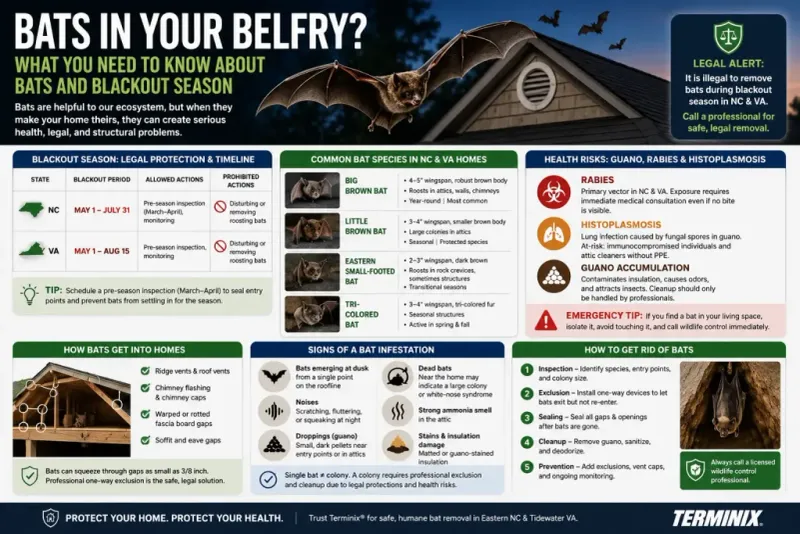
If bats are roosting inside a home or attic, exclusion is the appropriate long-term fix, but timing matters under North Carolina law. NC Wildlife’s guidance on bat pupping season and NC Wildlife’s bat species page both confirm that evictions are prohibited from May 1 through July 31 because nonflying pups cannot escape on their own and will die inside the sealed structure.
Sealing entry points during that window is both harmful to the animals and illegal. Plan exclusion work for late summer or fall after pups are flying, or complete it before May 1.
Large accumulations of bat guano inside a structure create a separate concern. Dried guano can release particles that cause respiratory problems when disturbed.
NC Wildlife’s bat disease resource recommends leaving significant accumulations undisturbed until you have appropriate guidance or professional help for safe cleanup.
The Right Reading of Bats at Dusk
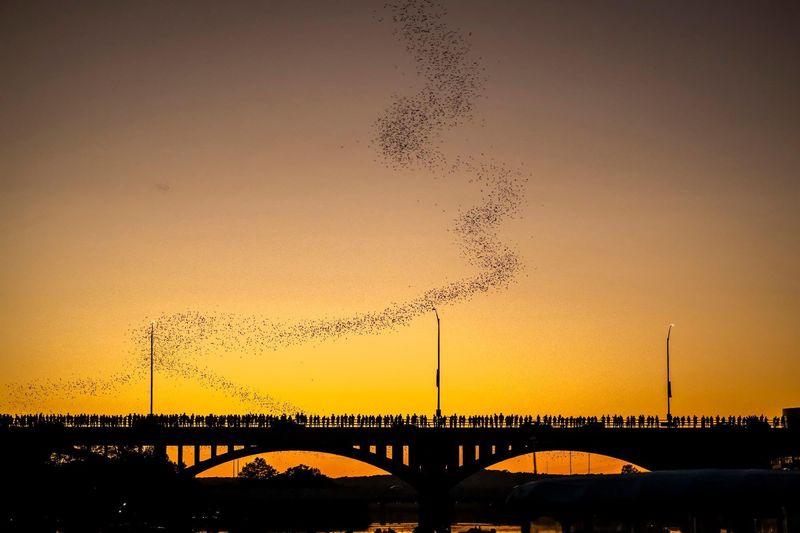
Circling bats at dusk carry a straightforward message: the airspace around your yard offers enough prey, water access, or travel connection to make it worth a nightly visit. That is a reasonable thing to know about your property, and it reflects something genuinely useful about the local habitat, even if it does not tell you everything about the yard’s ecological condition.
The two-part response that follows from that reading is practical and complementary. Let bats hunt undisturbed outdoors, where they belong and where they pose no concern.
At the same time, manage mosquito breeding water directly, because NC State Extension’s mosquito guidance is clear that bat predation alone does not reliably reduce residential mosquito populations. CDC’s home mosquito-control recommendations and NC Wildlife’s bat resources point toward the same conclusion from different directions: protect the bats, remove the breeding water, and do not expect one action to substitute for the other.
A bat looping over your yard at dusk is a native North Carolina animal using your corner of the landscape as part of its nightly routine. That is worth appreciating on its own terms, separate from any mosquito math.