
What It Really Means When A Praying Mantis Sets Up In Your North Carolina Garden Beds
Spotting a praying mantis frozen on your tomato cage or peering out from a pepper plant is one of those garden moments that stops you in your tracks. These insects look deliberate, almost watchful, and it is tempting to read their presence as a sign that your yard has somehow earned good ecological standing.
Before you start congratulating your garden, though, the real story behind that sighting is more specific and more useful than the popular myth suggests. Understanding what a mantis actually tells you about your beds, and which mantis you are looking at, gives you practical guidance that a simple “it is good luck” never could.
A mantis signals opportunity, not a balanced garden
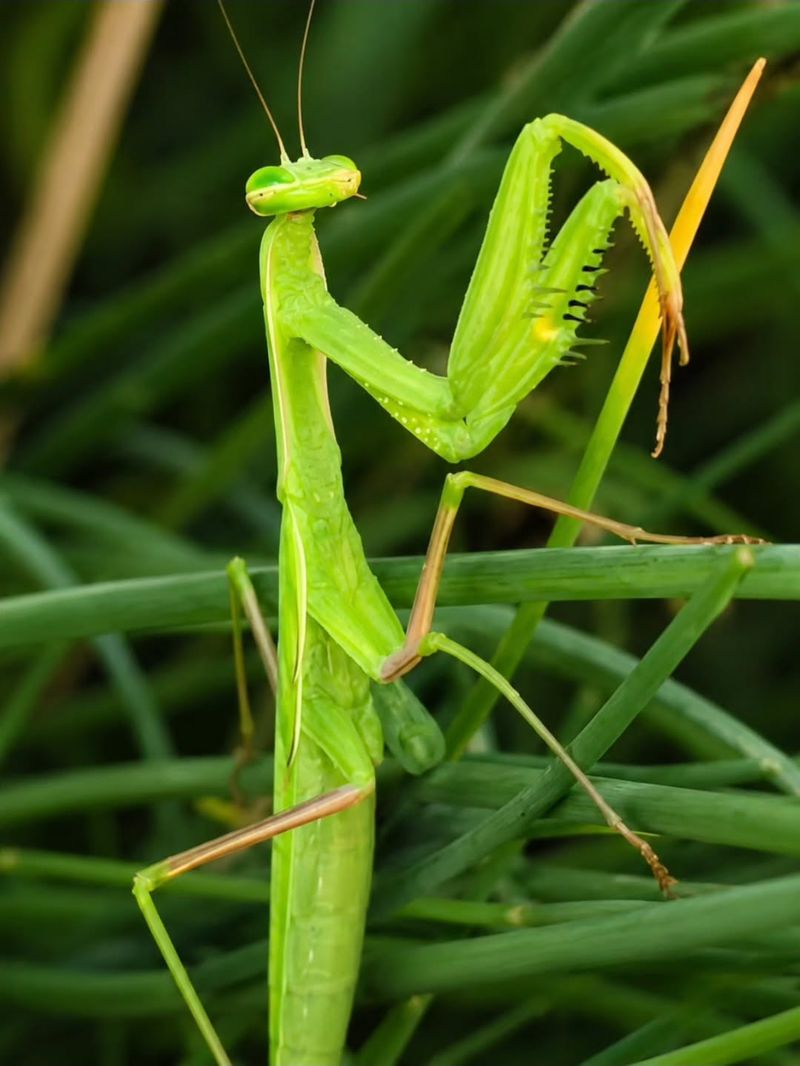
Seeing a praying mantis perched on a stem in your garden bed is genuinely interesting, but the ecological message it carries is narrower than most people expect. What the mantis has found is opportunity: a usable perch, enough foliage to break up its outline, and at least some insects or other small arthropods moving through the area to make waiting worthwhile.
That is the defensible reading of its presence, and it is worth holding onto precisely because it keeps your next decisions grounded.
What the sighting does not tell you is that your garden has achieved a healthy pest balance, that insect diversity in your yard is especially high, or that natural pest control is quietly working in the background. NC State Extension guidance on biological control is clear that mantises are nonselective predators with no demonstrated value as reliable pest-management tools.
One visible predator cannot measure the ratio of pests to beneficials, and it cannot audit the health of the soil food web, the pollinator community, or the plant canopy above it.
For a North Carolina homeowner, this distinction matters because it shapes what you do next. If you assume the mantis proves your garden is thriving, you might skip monitoring for actual pest pressure or feel overconfident about skipping other integrated pest management steps.
Lee County Cooperative Extension frames the mantis as a garden hunter, not a garden guardian, and that framing is the right starting point.
The sighting does matter, just more modestly. It confirms that your beds have enough physical structure and enough insect activity to attract and hold a sit-and-wait predator.
That is a real observation about your yard’s current conditions, and it is the right foundation for the questions that follow: which mantis is this, what is it eating, and does it warrant any response at all?
The garden bed gives an ambush predator what it needs
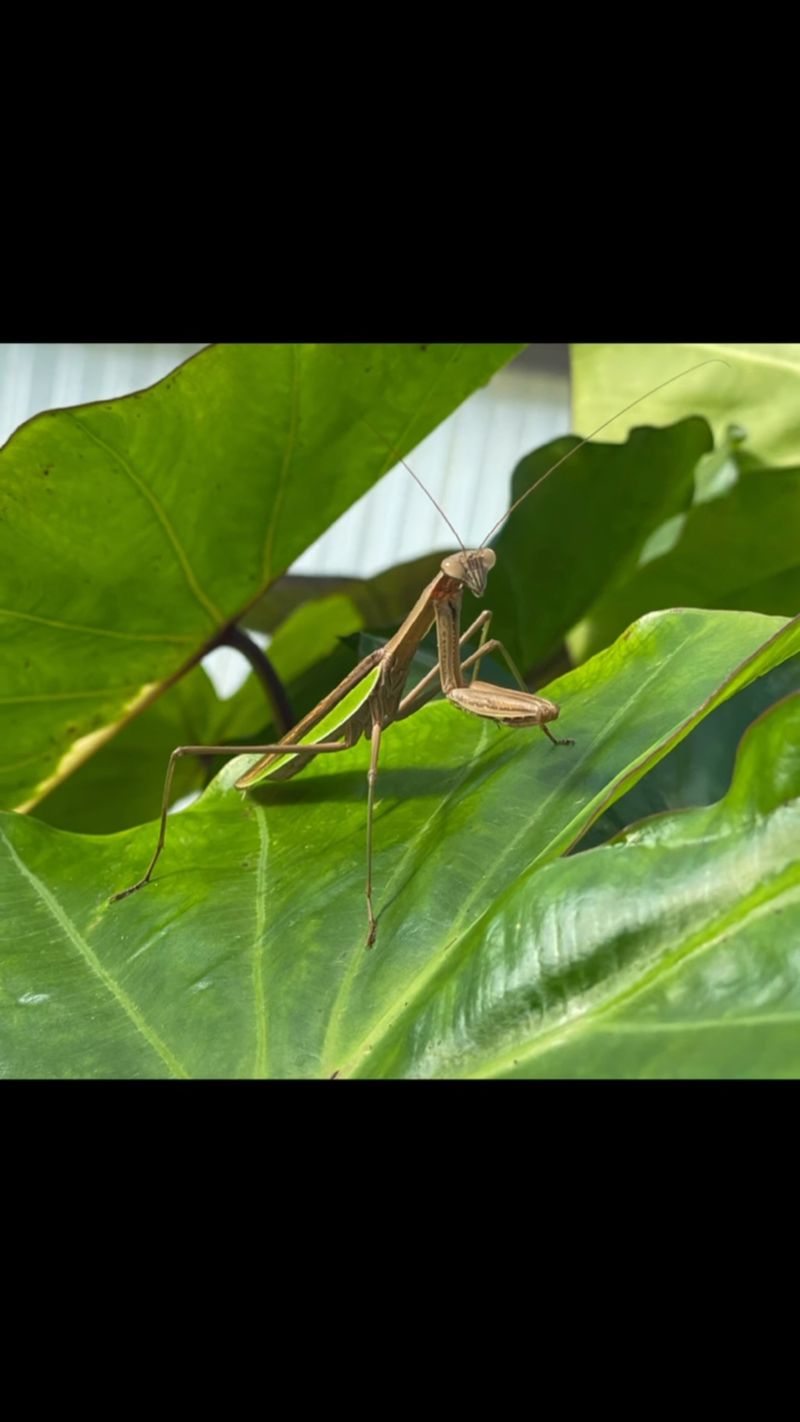
A mantis does not patrol your beds the way a ladybug works through an aphid colony. Instead, it picks a spot on a stem or leaf and waits, sometimes for hours, until prey moves within striking distance.
That sit-and-wait strategy is the key to understanding why a particular bed attracted one in the first place.
Residential garden beds tend to offer exactly what an ambush predator needs. Vertical structure from tomato cages, bean poles, or tall pepper plants gives the mantis elevated perches with good sightlines.
Dense foliage breaks up the mantis’s outline, making it nearly invisible to approaching insects. And because garden beds concentrate flowering plants, fruiting crops, and decomposing mulch, they tend to generate steady insect traffic across multiple feeding guilds, from pollinators visiting blooms to small beetles moving through the soil surface.
NC State Entomology’s Carolina mantid profile describes the mantis as a generalist predator that seizes whatever prey comes within reach, which means any bed with active insect movement is a potential hunting ground.
NC State’s home gardener biological control guidance reinforces that mantises do not actively seek out specific pest species like aphids, caterpillars, or thrips. They simply wait for something catchable to pass by.
This means the physical features of the bed, not the particular crops you are growing or any specific gardening practice, are what made the site attractive.
Knowing this prevents a common mistake: assuming that planting a certain crop or following a certain routine will reliably bring mantises in or keep them there. The mantis found your bed because it offered structure and prey traffic, full stop.
That understanding sets more realistic expectations about what the insect will and will not do while it is resident.
Which mantis is standing in your North Carolina bed?
Identification is the most important step a North Carolina gardener can take after spotting a mantis. The state is home to more than one species, and the management advice that applies to a native Carolina mantid is meaningfully different from what applies to a large introduced species.
Getting this wrong, even with good intentions, can lead to either unnecessary intervention or a missed opportunity to act where action is actually warranted.
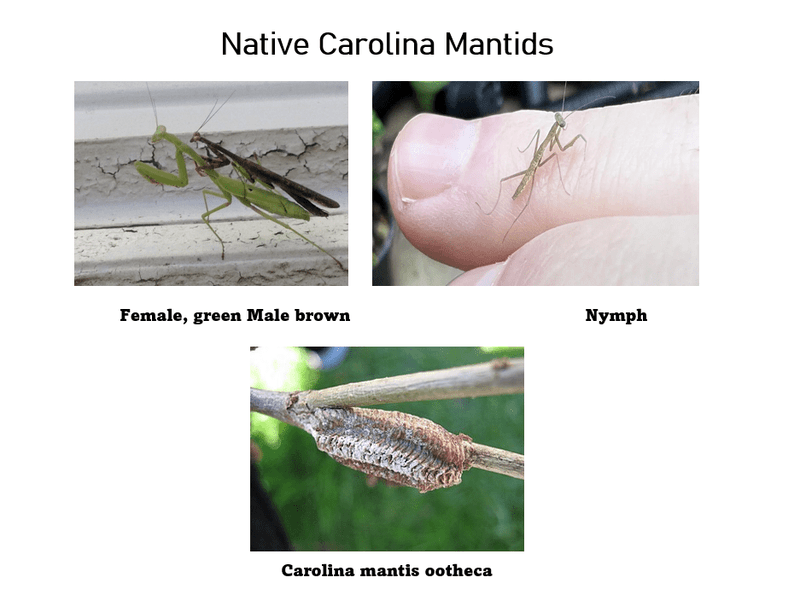
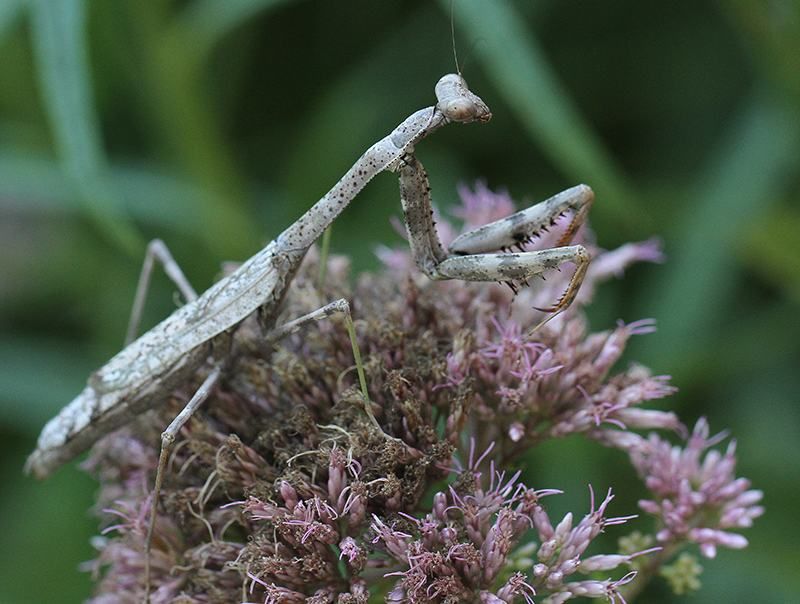
The native Carolina mantid, Stagmomantis carolina, is the species most likely to have been living quietly in North Carolina yards for generations. NC State’s Carolina mantid fact sheet describes it as roughly 2 inches long, with mottled coloring in gray, brown, or green that blends well into bark and foliage.
In females, the wings cover only part of the abdomen, a reliable field mark that distinguishes this species from most introduced mantises. The face plate tends to be relatively rectangular rather than square.
The Chinese mantid, Tenodera sinensis, is substantially larger, often reaching 3 to 5 inches. Its wings cover the full abdomen, the face is more square-shaped, and the wings sometimes show a pale or yellowish edge.
Lee County Extension identifies three mantis species commonly encountered in North Carolina, with the Chinese mantid being the largest. The European mantid carries a distinctive diagnostic mark: a black-ringed white spot on the inner surface of each foreleg, visible when the insect holds its forelegs in the characteristic raised position.
University of Maryland Extension’s mantid resource notes this spot as a reliable identification feature for that species.
A fourth species, the Japanese narrow-winged mantid, is present in North Carolina but uncommon enough that most gardeners are unlikely to encounter it. NC State’s small farms mantid guidance notes its presence while treating the Carolina and Chinese mantids as the primary identification priorities.
Size and color alone are not enough to settle identification with confidence, especially because both can vary with age, sex, and background coloration. If you are uncertain, photograph the mantis from multiple angles before deciding on any response.
Its menu includes pests and the insects you want to keep
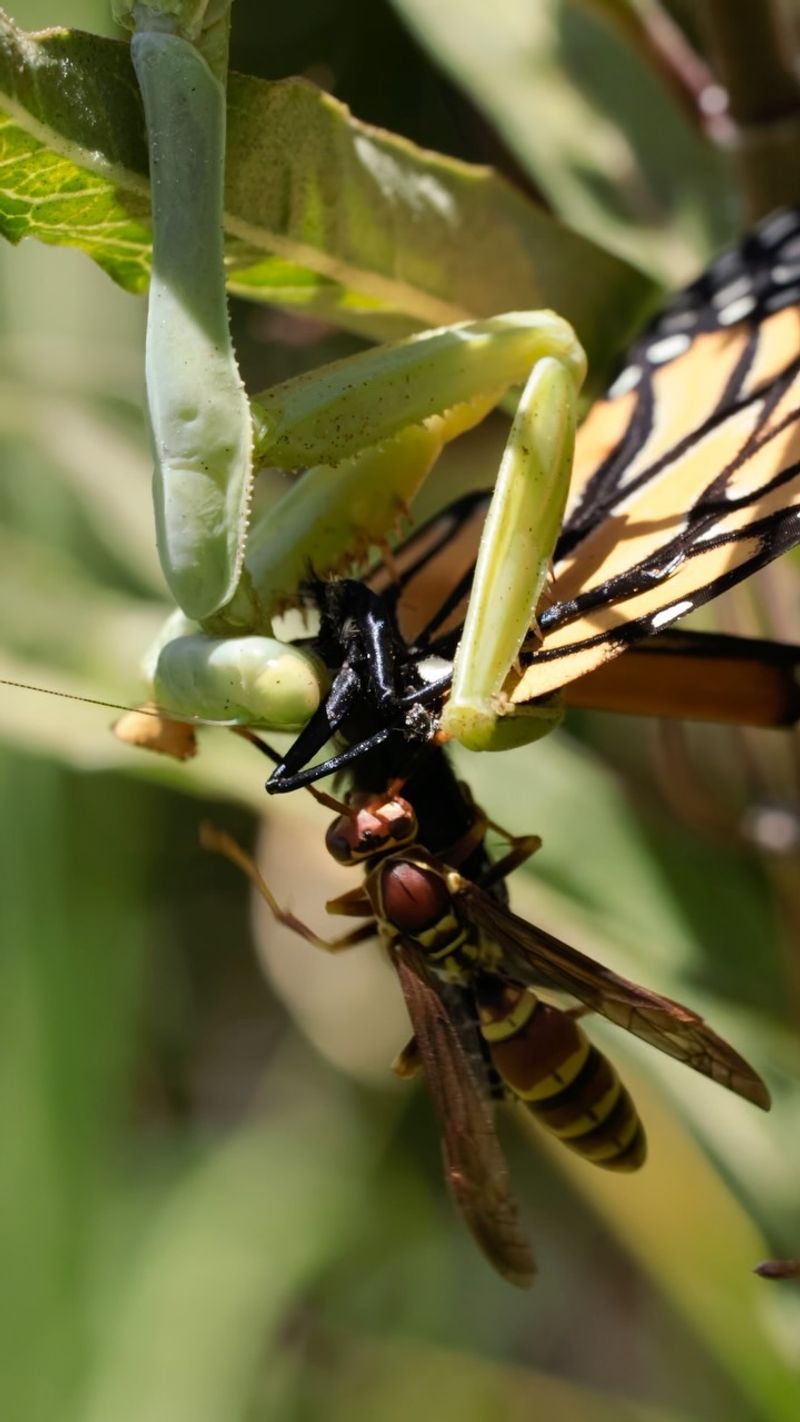
The popular shorthand that mantises are “beneficial insects” gives a misleading picture of what actually happens when one takes up residence in your beds. A mantis does not sort its prey into pest and non-pest categories before striking.
Whatever arthropod moves within reach and fits within its grasp is a potential meal, regardless of how valuable that insect might be to your garden or the broader ecosystem.
That list of potential prey is wide. A mantis can consume garden pests such as grasshoppers, crickets, and certain caterpillars, but it can just as easily take bees, butterflies, syrphid flies, parasitic wasps, and other predatory insects.
NC State’s Carolina mantid profile acknowledges that mantises eat beneficial insects alongside pests. UC ANR’s integrated pest management mantid page similarly describes them as generalist predators whose diet includes both pest and non-pest species.
This nonselective diet is why a single mantis in your garden demonstrates predation, not pest suppression. NC State’s biological control Q&A for home gardeners makes the practical implication clear: mantises should not be counted on to reduce aphid populations, knock back caterpillar pressure, or address a thrips infestation.
There is no evidence that a resident mantis will solve a specific pest problem, and expecting it to do so sets up a management gap that can allow real damage to go unaddressed.
Syrphid flies and parasitic wasps are particularly worth protecting because they are among the most effective naturally occurring pest regulators in a residential garden. NC State’s IPM handbook chapter emphasizes supporting naturally occurring beneficial insects through habitat rather than disrupting them.
A mantis that takes a parasitic wasp or a syrphid fly has effectively removed a pest-control ally, which is the opposite of the service the mantis mythology promises.
Keeping that trade-off in mind is more useful than any simple label of “good” or “bad.”
Leaving an adult alone usually fits the evidence
Finding a mantis on your pepper plant or squash vine does not require any immediate action. Observing it from a comfortable distance and going about your normal garden work is a reasonable response, and Lee County Extension notes that mantises do not bite humans, so there is no safety concern that makes removal urgent.
Watching where it positions itself, what it catches, and how long it stays gives you real information about your bed’s insect activity without disturbing the food web.
That said, “leave it be” is not blanket advice that applies to every mantis situation in every North Carolina yard. The species matters, and the situation that most changes the calculus is finding an egg case rather than an adult.
NC State’s 2025 small farms mantid guidance specifically recommends removing and destroying confirmed Chinese mantid egg cases in a pollinator garden to reduce predation pressure on bees and other beneficial insects. That recommendation does not apply to native Carolina mantid egg cases, which makes identification the essential first step before any egg case decision.
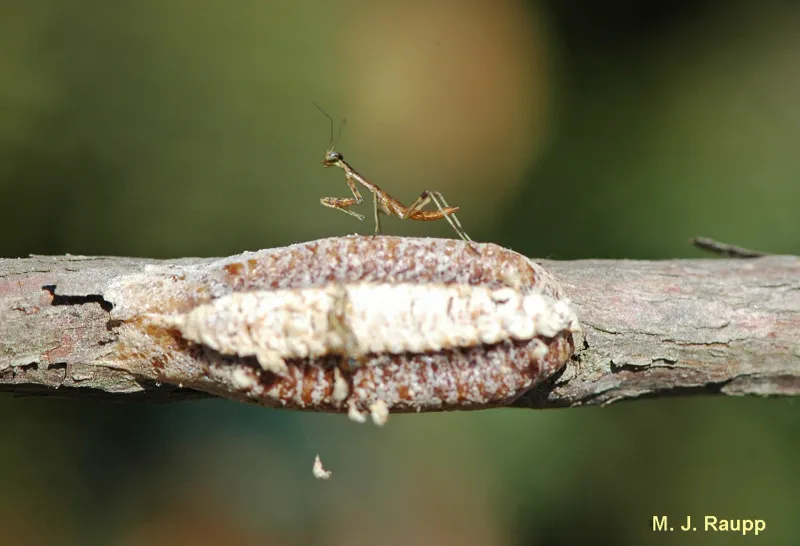
Egg cases, called oothecae, are laid in late summer or fall on stems, shrubs, fence posts, and similar surfaces, then overwinter and hatch in spring. Carolina mantid oothecae tend to be slender and elongated, often gray-brown with a lighter central ridge.
Chinese mantid oothecae are larger, paler, and more rounded or block-shaped. University of Maryland Extension’s mantid identification resource provides useful visual comparisons between the two.
Because the two can look similar enough to cause confusion, the safest approach to any unfamiliar ootheca is to photograph it clearly before touching it, then consult your local NC Cooperative Extension office or an online identification resource. Removing or destroying an egg case without that step risks eliminating a native species that arrived on its own and poses no special concern for your pollinator community.
Protect the wider food web around large mantises
Large mantises, particularly the Chinese mantid, interact with the food web in ways that go beyond the pest-versus-beneficial framing most gardeners use. Research published in peer-reviewed literature confirms that Chinese mantises can and do prey on bees.
A study in PLOS ONE found that Chinese mantises attacked bees in laboratory conditions and that bees showed avoidance behavior in areas where mantises were present, suggesting a real effect on pollinator movement even beyond direct predation.
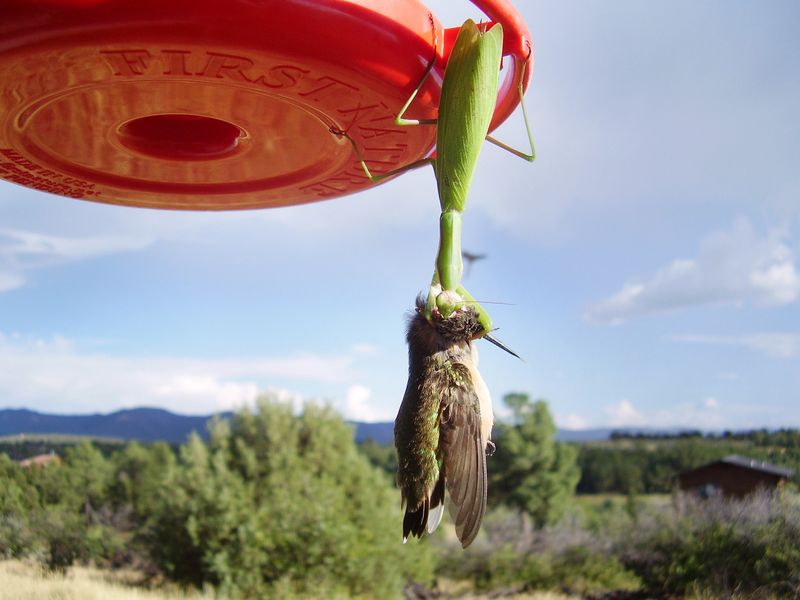
Hummingbirds add another layer of concern near large mantises. Documented incidents of mantises capturing hummingbirds exist in the scientific literature, and a review in The Wilson Journal of Ornithology advises caution with large mantises, especially non-native species, near hummingbird feeders or hummingbird-pollinated plants.
These incidents are rare and the review does not provide a measured frequency for North Carolina yards specifically, so the takeaway is proportionate caution rather than alarm. Moving a hummingbird feeder away from a location where a large, unidentified mantis is regularly stationed is a reasonable, low-effort step.
NC State Extension describes the Chinese mantid as invasive and ecologically problematic in North Carolina, a management position that informs the species-specific guidance around egg case removal in pollinator gardens. Other extension resources discuss introduced mantises in less categorical terms, so it is worth understanding that this framing reflects NC State’s position rather than a universally shared legal designation.
Practical stewardship around large mantises comes down to a few specific steps: identify any unfamiliar adult or egg case before acting, follow species-specific guidance if a Chinese mantid egg case is confirmed in a pollinator-heavy area, and avoid purchasing or releasing large non-native mantises as a pest-control measure. Proportionate responses, grounded in identification, protect both the insects you value and the accuracy of your yard’s ecological story.
Build habitat diversity instead of buying pest control

Commercially sold mantis egg cases are widely available online and in garden centers, often marketed as a natural pest-control solution. Purchasing and releasing them is a practice that NC State Extension guidance consistently discourages.
NC State’s biological control Q&A for home gardeners notes that commercially sold mantises are not effective, reliable pest-control agents and may be poorly suited to the conditions in a particular local garden. When those egg cases contain Chinese mantids, releasing them compounds the concern by adding a large, nonselective, non-native predator to a yard that may already support native pollinators and beneficial insects.
Habitat-based integrated pest management offers a more durable alternative. NC State’s IPM handbook chapter emphasizes supporting naturally occurring predators and parasitoids through planting diversity and by tolerating some pest presence as a food source that keeps natural enemies in the yard.
A yard that always eliminates every pest immediately removes the food supply that sustains the beneficial insects doing quiet, consistent work.
Native plants contribute to this system by supplying food, cover, and reproduction sites for a wider range of insects and wildlife. NC State’s native plant landscaping guide and the Extension Gardener Handbook’s wildlife chapter both frame native planting as a way to support broader insect and wildlife diversity rather than as a technique for attracting any particular predator.
The NC Wildlife Action Plan similarly frames habitat diversity as the foundation for supporting native species across the state.
The practical recommendation is straightforward: observe what arrives naturally in your yard, identify unfamiliar adults and egg cases before acting, and invest in planting diversity that supports the whole food web. Releasing purchased mantises bypasses all of that in favor of a shortcut that the evidence does not support.
What works is giving naturally occurring predators, parasitoids, and pollinators the habitat conditions they need to stay.
Read the mantis as one clue in a living yard
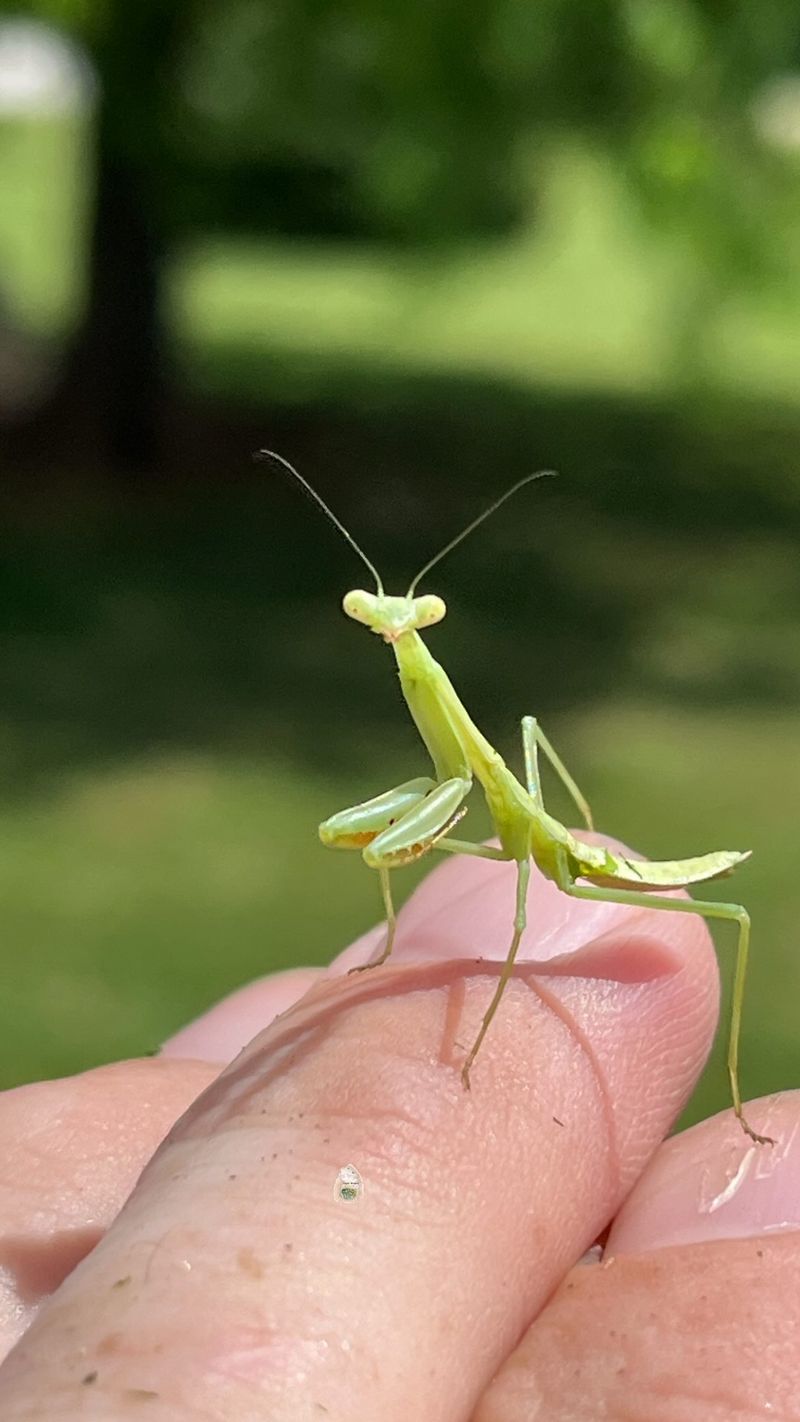
A praying mantis in your garden bed found a workable hunting site. That is the calibrated answer, and it is a genuinely useful one.
It tells you that your beds have enough vertical structure, foliage cover, and insect activity to support a sit-and-wait predator, which is real information about your yard’s current conditions. What it does not tell you is that pest pressure is under control, that insect diversity is high, or that the garden has earned some kind of ecological certification.
The next steps are practical and specific. Identify the adult or egg case before deciding on any response.
Leave an unidentified adult alone and observe it. If you find an egg case and suspect it belongs to a Chinese mantid, photograph it and consult your local NC Cooperative Extension office or follow NC State’s IPM guidance for species-specific management.
Never purchase or release mantis egg cases as pest control. Support the wider food web through habitat diversity and a tolerance for some pest presence.
The mantis is one thread in a living system that includes dozens of predators, parasitoids, pollinators, and decomposers working in your yard right now, most of them invisible. Treating it as a single clue rather than a verdict keeps your stewardship accurate and your garden decisions well-grounded.