
The North Carolina County Plant Bans And HOA Rules You Can Legally Push Back On This Fall

Plenty of North Carolina homeowners head into fall ready to put in native plants, pollinator gardens, or turf replacements, only to get a violation letter before the first seed goes in the ground. The rules blocking them range from recorded HOA covenants to local nuisance ordinances to state noxious-weed restrictions, and they are not all the same thing.
Knowing which authority is actually speaking, and whether it has the legal footing to back up its demands, is the difference between a garden that survives the season and one that costs you money.
Start with the HOA’s legal authority, not the planting season
Fall planting season carries real value for North Carolina gardeners, but the calendar does not hand homeowners any special legal right to plant whatever they choose. For planned communities governed by G.S. 47F-3-102, the association may adopt and amend rules, regulate common elements, and impose reasonable fines or suspend certain privileges after providing notice and an opportunity to be heard.
That authority flows from the recorded declaration, bylaws, and properly adopted rules, not from the board’s preferences or a property manager’s personal opinion.
The hierarchy matters. G.S. 47F-2-103 establishes that the declaration controls over any conflicting bylaw, the bylaws control over conflicting rules or regulations, and the rules control over conflicting guidelines.
A landscaping standard buried in an architectural guideline may carry less weight than a restriction written into the recorded declaration itself, and that distinction can matter when a homeowner is deciding whether to push back.
What does not carry legal weight on its own? A board member’s verbal objection, an email from a property management company saying a yard looks wrong, or a violation letter that cites no specific document.
None of those is the same as a recorded covenant or a validly adopted rule. Before accepting any landscaping restriction as final, ask what document it comes from and whether that document was properly recorded and adopted.
North Carolina does not create a seasonal or general right to plant native species, pollinator gardens, or replacement turf over an HOA restriction, so the starting question is always: where does the restriction actually live in the governing documents?
The document trail shows what the HOA can enforce

Before you plant anything or respond to a violation notice, find out exactly which legal framework applies to your property. Condominiums fall under Chapter 47C, while most planned communities fall under Chapter 47F.
One practical detail that surprises many homeowners: Chapter 47F generally does not apply to planned communities created after January 1, 1999, with 20 or fewer lots unless the declaration expressly makes the chapter applicable. If your community is small and newer, the statutory protections and procedures in Chapter 47F may not automatically be in play.
Once you know which framework applies, request the following in writing from the association: the exact covenant, bylaw, rule, or architectural guideline being enforced; the recording information for any recorded document; the date and method by which any rule was adopted; the specific facts the association claims violate the rule; the hearing and appeal procedure; the fine schedule; and the date fines allegedly began. This is not a hostile demand.
G.S. 47F-3-118 generally requires that association records be made reasonably available for examination by lot owners, so you have standing to ask.
The document trail also tells you whether a restriction is recorded or merely internal. G.S. 47F-2-103 is clear that the declaration, bylaws, and articles of incorporation form the legal foundation of the association’s authority.
A landscaping prohibition that appears only in an unpublished architectural standard, an email thread, or a property manager’s checklist is not automatically enforceable as if it were a recorded covenant. Spotting that gap is often the most useful thing a homeowner can do before spending time or money on a formal challenge.
Ambiguous landscaping language may support a covenant challenge
When a restriction does exist in a recorded document, the next question is whether it actually says what the HOA claims it says. North Carolina courts read covenant language according to its natural, ordinary meaning, and they do not enlarge restrictions by implication.
Two recent Court of Appeals volumes, NC-APP-257 and NC-APP-277, reflect this interpretive approach: courts examine what the words actually say, consider the whole document, and generally resolve genuine ambiguity in favor of the less-restricted use.
That principle creates a real, if limited, argument for homeowners whose landscaping is being challenged under vague terms. Words like “unsightly,” “incompatible with the neighborhood,” or “in the sole discretion of the architectural committee” are not self-defining.
If the covenant does not specify that native plants, pollinator gardens, or turf alternatives are prohibited, the HOA’s attempt to read that prohibition into broad language may be open to challenge. The argument is not a guaranteed win; courts will still enforce a covenant’s clear purpose even when the specific language is imprecise.
But ambiguity is a legitimate legal argument, not just a talking point.
A 2024 Court of Appeals decision, Schroeder v. Oak Grove Farm Homeowners Association, reinforced that courts look at the actual covenant language rather than accepting an association’s broad characterization of what the covenant means.
The case involved chickens, not plants, so it is not a direct native-garden precedent. Still, the principle carries over: the HOA’s interpretation is not automatically correct just because it appears in a violation letter.
Facts that strengthen a covenant-language challenge include evidence that the garden is deliberately maintained rather than neglected, that plantings have defined edges and clear access paths, that the HOA previously approved similar landscaping nearby, and that the board relied on an unpublished standard rather than any recorded language. A consistent line of North Carolina appellate authority holds that restrictions on land use are strictly construed, which means the burden is on the party seeking to enforce the restriction to show that the language clearly supports it.
Narrow state protections do not create a general garden right
A handful of specific state statutes can limit what an HOA may enforce, but each one covers a defined subject and nothing broader. Homeowners who understand the exact scope of these protections avoid both over-relying on them and missing them entirely.
Solar collectors are the clearest example. Under G.S. 22B-20, a covenant that prohibits or effectively prohibits a residential solar collector is generally void and unenforceable.
The HOA may still regulate the collector’s location or require screening, provided those conditions do not prevent reasonable use. What the statute does not cover: solar-powered garden lights, solar-powered water features, or any other landscaping equipment that happens to use solar energy.
The protection is specific to solar collectors as defined by the statute, not a general endorsement of energy-saving yard technology.
Irrigation during drought conditions is addressed separately in G.S. 47F-3-122, which limits HOA enforcement of landscaping-irrigation requirements during certain severe, extreme, or exceptional drought conditions when applicable governmental water-conservation measures are in effect. The statute covers lawns, trees, shrubbery, and ornamental or decorative plants.
Critically, it does not give homeowners the right to replace turf with a preferred plant palette, and it does not eliminate ordinary maintenance, appearance, nuisance, or safety requirements once drought conditions lift.
Flag and sign protections apply in narrower circumstances than many homeowners assume. Chapter 47F generally prevents planned-community restrictions from prohibiting an appropriately displayed U.S. or North Carolina flag up to four feet by six feet on property owned exclusively by the member, subject to specific statutory wording and notice requirements.
Common areas, easements, and rights-of-way are not covered. Political signs get separate treatment under G.S. 47F-3-121: an HOA generally cannot prohibit or regulate election-related signs unless the recorded restriction meets specific statutory wording requirements, though the HOA may limit display to no earlier than 45 days before an election and no later than seven days after.
Garden labels, wildlife signs, and ordinary yard decor do not receive the same protection as political signs.
State and local plant rules vary by species, place, and condition
One of the most common misconceptions about plant rules in North Carolina is that there is a uniform set of county plant bans covering the whole state. There is not.
What exists instead is a patchwork of state agency rules, municipal ordinances, zoning standards, and nuisance-abatement codes that vary significantly by jurisdiction, species, location, and condition.
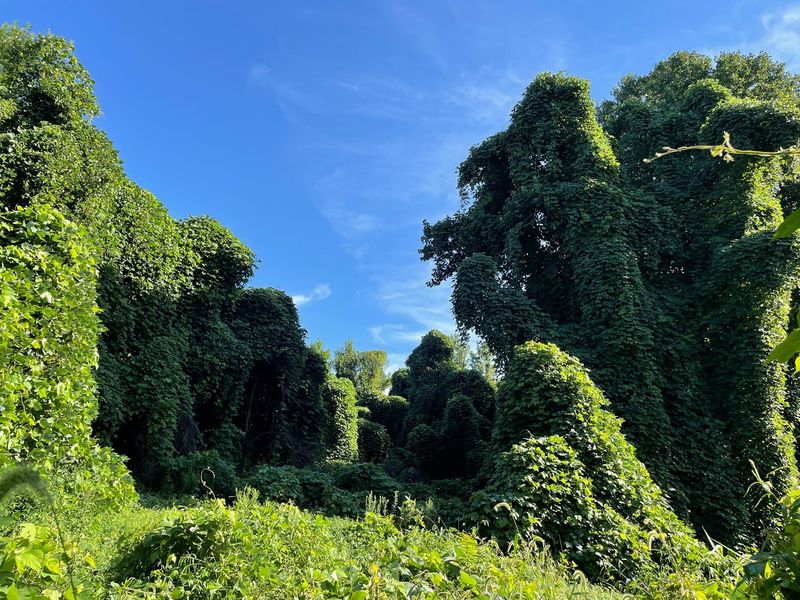
At the state level, North Carolina maintains an official noxious-weeds list that includes species such as beach vitex, oriental bittersweet, kudzu, and mile-a-minute weed. Under G.S. 106-421, the Department of Agriculture has authority over regulated articles, and noxious-weed regulations can restrict movement, handling, quarantine, and eradication of listed species.
But the noxious-weeds list is not a universal residential planting ban for every listed species in every backyard. Some restrictions target commercial handling, aquatic environments, or movement across county lines rather than ordinary home gardening.
The legal consequence depends on the specific plant, the regulated activity, the location, and the applicable rule.
Local governments add another layer. Wrightsville Beach, for example, prohibits planting beach vitex within town limits, a restriction tied to coastal erosion and ecosystem concerns specific to that community.
Cleveland County regulates uncontrolled rank vegetation and certain vines, including kudzu and honeysuckle, when they extend beyond the property or create health or safety concerns. Conover prohibits certain invasive species from counting toward specified landscaping requirements.
Forest City identifies prohibited invasive plants in its flood-damage-prevention landscaping provisions. None of these examples generalizes to all North Carolina jurisdictions.
A maintained pollinator garden with defined edges, labeled plants, and a clear access path is practically different from uncontrolled vegetation that blocks drainage or creates a fire or pest hazard. That distinction can matter in a nuisance or safety analysis.
But ecological intent alone does not defeat a local ordinance that focuses on condition and risk. Before planting this fall, verify the exact jurisdiction, zoning district, species, location, height, maintenance condition, and enforcement procedure for any rule you think might apply to your yard.
Build evidence for inconsistent or arbitrary enforcement

A landscaping challenge built only on personal preference rarely succeeds. One built on documented facts has a much better foundation.
If your HOA is enforcing a restriction against your garden while leaving comparable plantings on other properties alone, that difference in treatment may strengthen an argument that the enforcement is inconsistent or arbitrary rather than a neutral application of the rules.
Gathering that evidence starts before any formal dispute. Take dated photographs of your garden, including its defined edges, access paths, and overall condition.
Keep a maintenance log showing when you watered, weeded, trimmed, or otherwise tended the plantings. Document that the garden does not obstruct sidewalks, roads, sightlines, drainage infrastructure, utility access, or fire lanes, since addressing those concerns head-on weakens the HOA’s ability to rely on safety or nuisance rationales.
Courts applying covenant-interpretation principles, as reflected in NC-APP-257 and NC-APP-277, look at actual facts, not just the association’s characterization of the situation.
Photograph comparable properties in the same community where similar landscaping has not generated a violation notice. Request board meeting minutes, inspection reports, and prior written communications about your yard under G.S. 47F-3-118.
If the HOA previously approved similar landscaping nearby or sent written approval for your own planting, preserve that record. And if the board relied on an unpublished standard or a property manager’s personal checklist rather than any recorded document, note that specifically, as the Schroeder decision makes clear that courts look at the actual covenant language, not the association’s preferred reading of it.
Distinguishing a challenge to the restriction’s meaning from a challenge to how it is applied also matters strategically. You may have arguments on both fronts, but keeping them organized helps you present a coherent case at a hearing rather than a scattered objection.
Use hearings and appeals before fines accumulate

Getting a violation notice does not mean the HOA has already won. Under G.S. 47F-3-102, a covered association may impose reasonable fines only after providing notice and an opportunity to be heard.
That procedural requirement is not a formality you can skip, and neither is the appeal process that follows. Your first move after receiving a notice is to respond in writing, preserve every deadline stated in the notice, and formally request the hearing and appeal procedures in writing.
At the hearing, identify the specific document the association is relying on, challenge any gap between that document and the restriction being enforced, and present your maintenance records, photographs, and any evidence of comparable properties treated differently. If the board adopted a new restriction recently, check whether it followed the required process.
An amendment to a planned-community declaration generally requires approval from owners holding at least 67% of allocated votes, unless the declaration requires a larger percentage, and it must be recorded. Under G.S. 47F-2-117, a challenge to a recorded amendment generally must be brought within one year after recording, so timing matters if you believe the amendment itself was improper.
Voluntary prelitigation mediation is encouraged for disputes involving Chapters 47C and 47F, declarations, bylaws, and HOA rules under Chapter 7A. Mediation can resolve a landscaping dispute faster and at lower cost than litigation, and it preserves the relationship with the association if you plan to stay in the community.
One warning that cannot be overstated: do not stop paying fines or assessments without getting legal advice from a North Carolina attorney first. An unsuccessful challenge combined with unpaid fines or assessments can create additional legal and financial exposure, including liens on your property.
Preserve every notice, meet every deadline, and use the process before making any decision to withhold payment.
Make a rule-specific decision before planting this fall
A practical checklist makes the difference between a garden that survives the season and one that generates a fine. Before putting anything in the ground this fall, confirm the HOA’s recorded authority and validly adopted rules, check the local ordinance for your exact jurisdiction and zoning district, verify whether your chosen species appear on North Carolina’s noxious-weeds list or any applicable local prohibition, and identify any front-yard, setback, easement, drainage, or common-area limits that apply to your specific lot.
The strongest challenges target missing authority in the governing documents, ambiguous covenant language that does not clearly prohibit what the HOA claims it prohibits, skipped procedural requirements, inconsistent or arbitrary application, or a direct conflict with a specific statutory protection such as those in G.S. 47F-3-102 or G.S. 47F-2-103. A general belief that native or pollinator landscaping should be allowed is not, by itself, a legal argument.
House Bill 1212, which would limit HOA authority over edible and pollinator gardens, remained pending in a House committee as of August 20, 2026, and cannot be used as current legal authority. Homeowners facing accumulating fines or a serious dispute should consult a North Carolina attorney before the situation outgrows the hearing process.
The right plant in the right yard, backed by the right paperwork, is a far stronger position than enthusiasm alone.