
The One Thing North Carolina Hydrangeas Need In Late Summer Or The Brown Leaf Edges Take Over
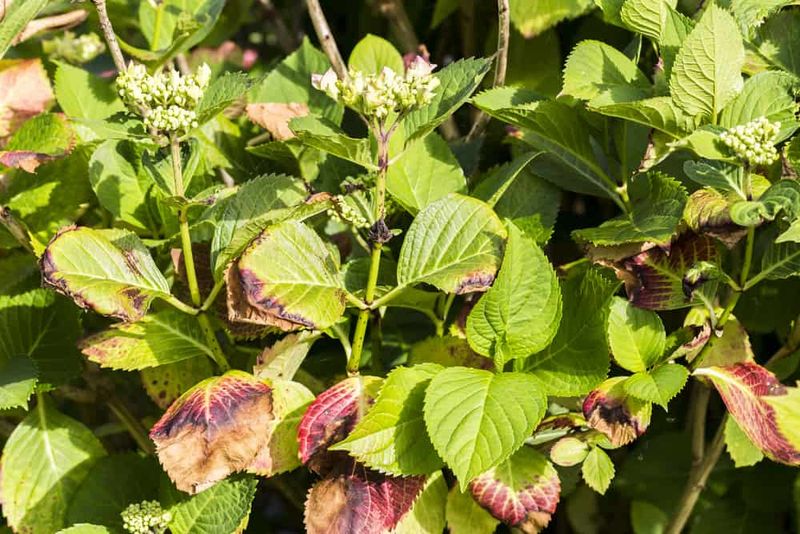
Brown edges creeping across hydrangea leaves are one of the most frustrating sights in a late-summer North Carolina yard. Many gardeners assume the fix is simple: water more.
But the truth is that brown margins are a symptom with several possible causes, and the right response depends on what is actually happening below the surface. Understanding the difference between a drying root zone, temporary heat stress, and a different problem entirely can save your plants and protect next year’s blooms.
Treat brown edges as a symptom, not a diagnosis
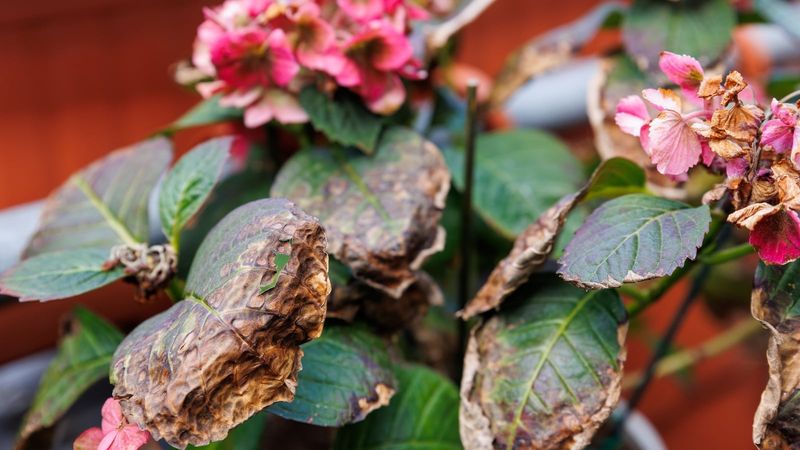
Brown leaf margins on a hydrangea can feel like an obvious signal, but the appearance alone does not tell you why it happened. Leaves develop scorched edges when they lose water faster than the roots can replace it, and late summer in North Carolina pushes that balance hard.
Heat, low rainfall, drying winds, and sun-baked soil all strain the plant’s ability to keep up with water demand.
What makes the situation more complicated is that several other problems produce the same-looking damage. Root damage from foot traffic, compacted soil, or recent digging can reduce the plant’s ability to pull water even when the soil is moist.
Poor drainage can cause roots to rot quietly underground, cutting off water supply despite wet conditions. Excessive fertilizer can burn root tips, and pesticide injury or disease can cause margins to die back in ways that look nearly identical to drought scorch.
According to NC State Extension’s woody ornamentals guidance, hydrangeas with large leaves are among the first shrubs to show drought stress, but the guidance also makes clear that marginal scorch has multiple possible origins. University of Maryland Extension’s hydrangea problem guide reinforces this, listing heat, sun exposure, root problems, compaction, and fertilizer injury alongside drought as causes of similar-looking damage.
Root-zone moisture management is the most practical first check because drying soil is genuinely common during North Carolina’s late-summer heat. But approaching it as a first check rather than a guaranteed explanation keeps you from adding water to a plant that does not need it or missing a different problem that is making things worse.
Start by looking below the surface before you reach for the hose.
Check below the surface before watering
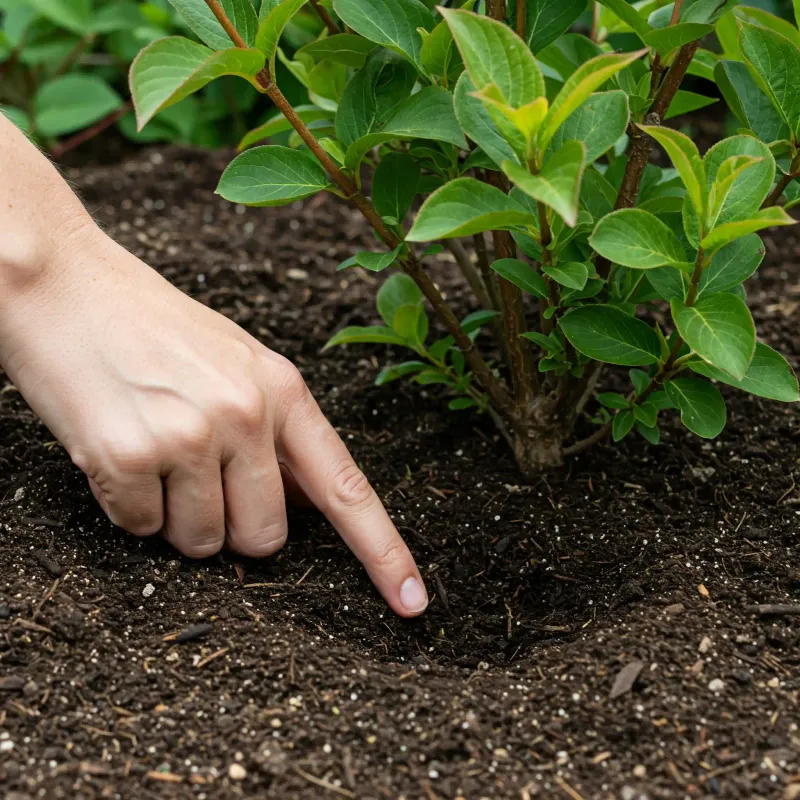
Reaching into the soil is the single most useful thing you can do before deciding whether to water. Push your finger or a small trowel about 3 inches below the surface near the plant’s root zone.
If the soil at that depth feels dry or barely damp, the root zone is likely running short on moisture and a deep watering is warranted. If it still feels cool and moist, the plant may be reacting to heat rather than drought, and adding more water will not help.
The distinction between heat stress and drought stress matters because they look similar from the outside but require different responses. A hydrangea that wilts during the hottest part of the afternoon but recovers fully by evening, with moist soil confirmed below the surface, is most likely reacting to high transpiration demand rather than a water deficit.
NC State Extension’s woody ornamentals chapter specifically notes that midday wilting that disappears by evening can reflect heat stress rather than dry soil, and that watering decisions should be based on soil moisture rather than the calendar or appearance alone.
Morning wilt paired with dry soil below the surface is a clearer signal that the root zone needs help. Wilt that persists into the evening alongside dry soil is more urgent.
In both cases, the soil check gives you the evidence you need to act with confidence rather than guessing. This approach also protects against overwatering, which can be just as damaging as drought in poorly drained spots across North Carolina’s varied soils.
Make the soil check a habit rather than a reaction to visible symptoms. By the time brown edges appear, some tissue is already dead and cannot recover.
Catching a drying root zone before margins scorch gives you a chance to correct the stress before it leaves a mark.
Water the root zone slowly and deeply
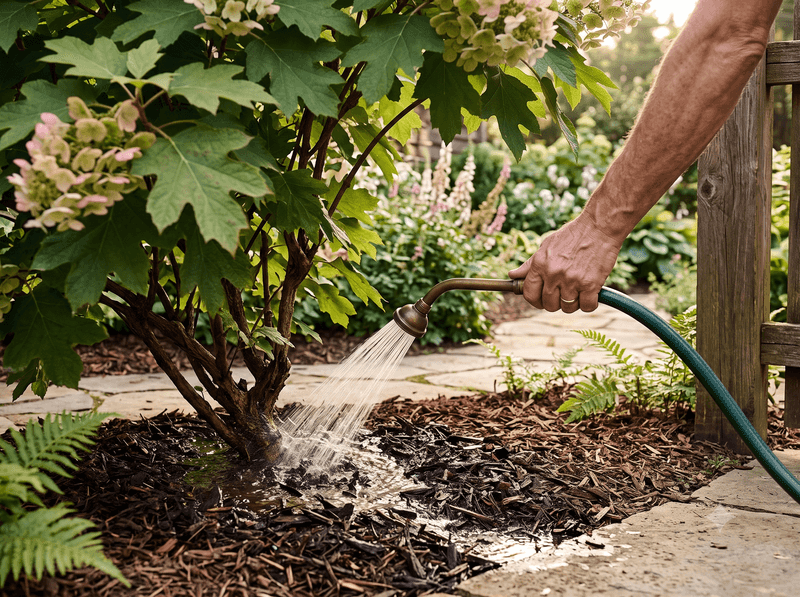
Once a soil check confirms the root zone is drying out, the way you water matters as much as whether you water. Apply water slowly at the base of the plant, directed toward the soil rather than the foliage.
A soaker hose, drip emitter, or a hose set to a gentle trickle works well because it gives water time to move down through the soil profile instead of running off the surface. The goal is to moisten the root zone thoroughly without leaving it saturated.
Morning is the best time to water. The soil absorbs moisture before midday heat drives evaporation, and any water that accidentally lands on foliage has time to dry before evening.
University of Maryland Extension’s hydrangea care resource recommends base watering specifically and cautions against overhead irrigation as a routine practice. Keeping leaves wet for extended periods during warm, humid weather creates conditions that favor leaf-spot diseases.
Spraying leaves to cool them during a heat wave may seem helpful, but University of Minnesota Extension’s leaf spot disease guide notes that prolonged leaf wetness is a primary driver of fungal and bacterial leaf spot spread on woody shrubs. A hydrangea dealing with heat stress does not benefit from wet foliage, and one already showing early signs of leaf disease can worsen quickly under repeated overhead watering.
Avoid setting a fixed daily schedule. How often and how much to water depends on your soil type, drainage, plant size, mulch coverage, recent rainfall, and the specific conditions of your site across the Mountains, Piedmont, or Coastal Plain.
A sandy coastal soil dries much faster than a heavier Piedmont clay, so frequency should follow what the soil actually tells you rather than a preset routine.
Use mulch to steady moisture and soil temperature
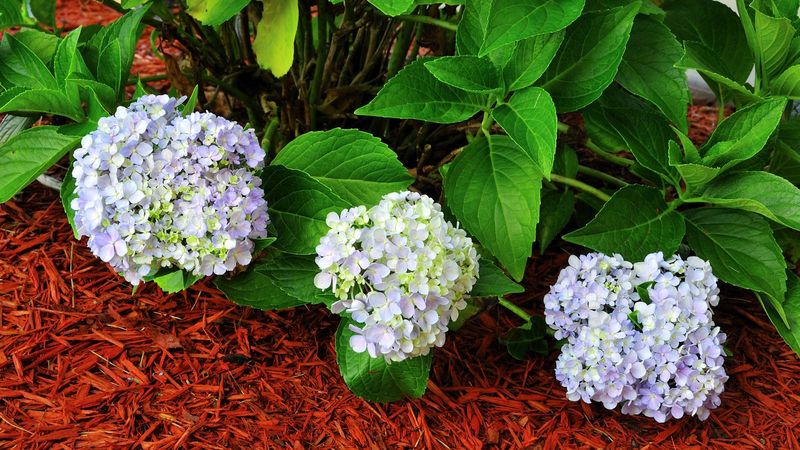
Organic mulch is one of the most effective tools for helping hydrangeas through late-summer heat, and it works around the clock without any extra effort once it is in place. A layer of shredded bark, wood chips, or pine straw over the root zone slows evaporation from the soil surface, buffers against rapid temperature swings, and reduces weed competition that would otherwise pull moisture away from the plant’s roots.
NC State Extension’s woody ornamentals guidance recommends roughly 2 to 3 inches of mulch around shrubs, spreading it out to and ideally beyond the canopy edge, with a clear space kept around the crown and base of the stem. UGA Cooperative Extension’s bigleaf hydrangea publication suggests a slightly deeper range of 3 to 5 inches.
A practical approach for most North Carolina yards is to stay within that combined range, using what is available and what suits your soil and drainage, and refreshing the layer as it breaks down.
Keep mulch pulled a few inches away from the crown and stem base. Piling it directly against the plant traps moisture against the bark, which can invite rot and pest damage over time.
Spread it outward rather than upward, covering as much of the root zone as is practical.
Mulch conserves what moisture is already in the soil, but it does not create moisture where none exists. If the root zone is already dry, mulching without watering first will not rescue the plant.
Apply it after a good watering when the soil is moist, and it will help hold that moisture much longer through the heat of the day.
Match afternoon protection to the species and site
Not every hydrangea handles afternoon sun the same way, and moving a plant into shade or blocking its light without considering the species can create new problems while trying to solve old ones. Species identity is the starting point for any decision about exposure.
Bigleaf hydrangea (Hydrangea macrophylla) is the most common type in North Carolina yards and also the most vulnerable to hot afternoon exposure. NC State’s bigleaf hydrangea plant profile recommends dappled light, partial shade, or deep shade and specifically flags afternoon sun as something to protect against.
UGA Cooperative Extension’s bigleaf hydrangea guide echoes this, recommending morning sun with afternoon shade and consistently moist, well-drained soil. In sites with harsh afternoon exposure, a shade cloth, a fence, a tall shrub row, or a nearby structure can reduce heat load without requiring the plant to be moved.
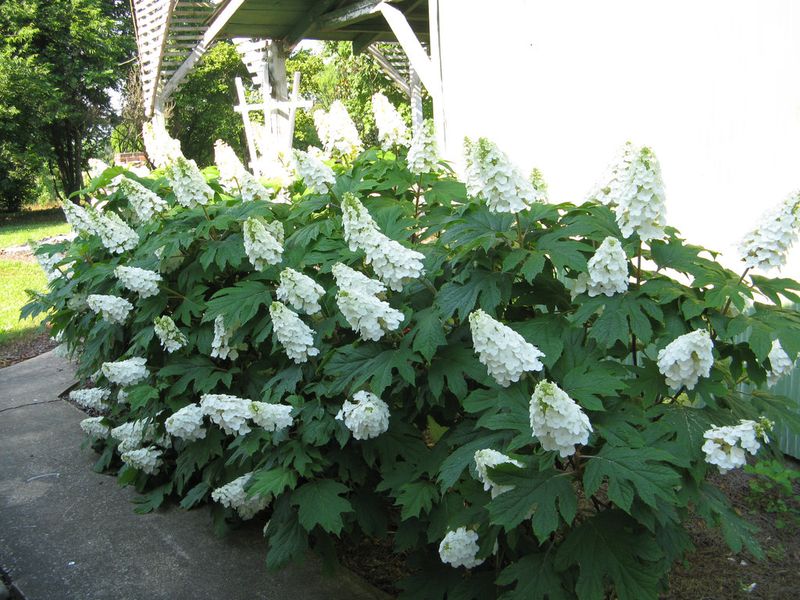
Oakleaf hydrangea (Hydrangea quercifolia) handles more sun than bigleaf types. NC State’s oakleaf hydrangea profile describes it as suited to full sun through part shade with medium moisture, and notes that it carries some drought tolerance.
Summer mulch still helps keep its root zone cool and moist, but shading an oakleaf hydrangea that is performing well in its current spot is unlikely to help and may reduce flowering.
Panicle hydrangeas (Hydrangea paniculata) generally tolerate the most sun of the three. University of Maryland Extension describes panicle types as suited to full sun through partial shade, and NC Cooperative Extension’s Beaufort County hydrangea planting article notes that panicle types can handle full sun.
Adequate moisture remains important, particularly during establishment or during stretches of prolonged heat, but adding shade to a panicle hydrangea as a first response to brown edges may not address the actual cause.
Across the Mountains, Piedmont, and Coastal Plain, the harshest conditions for any hydrangea tend to involve a combination of hot afternoon sun, drying wind, and reflective surfaces like concrete or light-colored walls. Any of those factors can intensify heat load regardless of region, so the site matters as much as the geography.
Avoid fixes that can deepen the problem
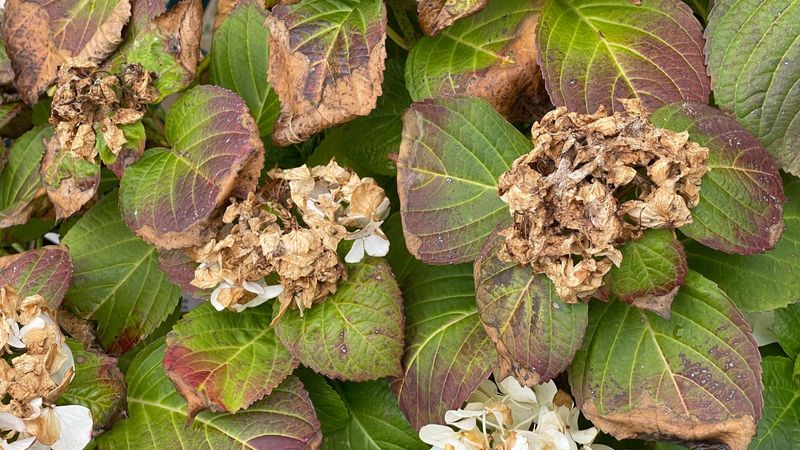
Brown edges can trigger a strong urge to do something, and that urgency sometimes leads to responses that make the situation worse. Knowing which common fixes to skip is as useful as knowing the right steps to take.
Adding more water when the soil is already wet is one of the most common mistakes. Moist or wet-looking soil does not guarantee that the plant is getting water.
Compacted soil, damaged roots, or roots that have begun to rot cannot supply leaves effectively even when moisture is present in the ground. NC State Extension’s woody ornamentals chapter notes that root problems and poor drainage can produce the same stress symptoms as drought, and that repeatedly watering a poorly drained site can accelerate root decline rather than reverse it.
If the soil stays wet for long periods between rain events, the problem may be drainage rather than deficit.
Fertilizer is another common overcorrection. Brown edges caused by heat, drought, or root stress will not improve with fertilizer, and applying it without evidence of a nutrient deficiency can injure roots or foliage further.
University of Maryland Extension and UGA Cooperative Extension’s bigleaf hydrangea guide both caution against excess fertilizer, noting that too much nitrogen in particular can reduce flowering and contribute to foliage problems.
Pruning is worth treating carefully in late summer. Already brown, necrotic tissue will not turn green again regardless of what you do, so removing it does not accelerate recovery.
More critically, bigleaf and oakleaf hydrangeas form next year’s flower buds in late summer, so broad pruning now can strip the plant of its blooms for the following season. NC State Extension’s pruning guide lists bigleaf hydrangea as a plant that blooms on old wood depending on cultivar, reinforcing the need for caution.
Limit any cutting to tissue that is clearly dead, and only if you are confident about the plant’s species and flowering habit.
Recognize patterns that point beyond simple scorch
Moisture management is the right first check for late-summer brown edges, but it is not the answer to every case. Some patterns on hydrangea leaves point toward a different problem, and recognizing the difference can save you from escalating irrigation when the root zone is not actually dry.
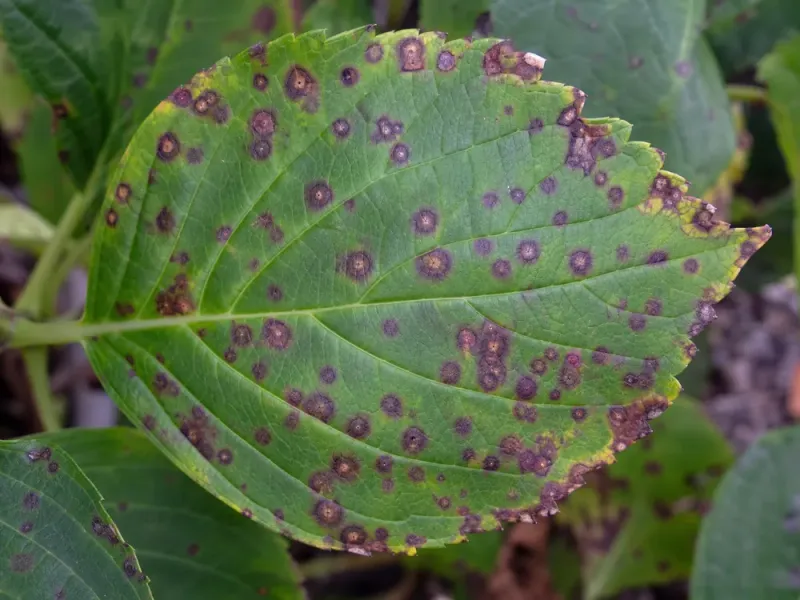
Marginal scorch from heat or drought tends to produce a relatively uniform browning along the outer edge of the leaf, often with a gradual transition or a subtle yellow-green zone between the brown margin and the green interior. Leaf-spot diseases look different.
University of Maryland Extension’s hydrangea problem guide describes fungal and bacterial leaf spots as discrete tan, brown, reddish, purple, or black lesions, sometimes with distinct halos or water-soaked borders, distributed across the leaf surface rather than confined to the edges. Oakleaf hydrangeas are particularly prone to bacterial leaf spot under warm, wet conditions.
University of Minnesota Extension’s leaf spot guide notes that leaf-spot pathogens spread most readily when leaves stay wet for extended periods, which is one more reason to avoid overhead watering as a cooling strategy. Pesticide drift or fertilizer splash can also create irregular brown patches or tip burn that mimics scorch.
When the damage pattern does not fit simple marginal scorch, or when moisture management has not improved the situation over a couple of weeks, reassess the whole picture. Check drainage around the root zone, look for signs of root compaction or recent soil disturbance, review any products applied recently, and consider whether extreme sun or reflected heat from a nearby surface might be amplifying the problem.
NC State Extension recommends consulting your local Cooperative Extension office when symptoms are unclear, rather than guessing at a treatment that could worsen an unrelated condition.
Make the next hot spell easier on the plant
A consistent routine before heat arrives is far more effective than scrambling to recover after brown edges appear. The sequence is straightforward: check the soil several inches below the surface, water slowly and deeply at the base only when that zone is drying out, keep a layer of organic mulch across the root zone and away from the crown, and adjust afternoon exposure based on the species and the specific demands of your site.
Following that sequence helps prevent new scorch when water stress is the driving factor. NC State Extension’s woody ornamentals guidance and UGA Cooperative Extension’s bigleaf hydrangea publication both point toward consistent root-zone moisture and mulch as the foundation of late-summer hydrangea care.
Neither source frames it as a single universal requirement, because the right response depends on species, soil, drainage, and the conditions specific to your corner of North Carolina’s mountains, Piedmont, or coast.
Tissue that has already turned brown will not recover. Correcting the conditions that caused the stress protects whatever healthy growth remains and gives the plant a better chance heading into fall.
A hydrangea that finishes summer with a stable root zone, adequate mulch, and appropriate exposure is simply better prepared for the next stretch of heat, whether that comes this season or returns next year. The goal is not a perfect plant by August; it is a plant that has what it needs to keep growing.