
If Your Clematis Barely Blooms Despite Piling On Vines, Here’s The Overlooked Cause Behind It
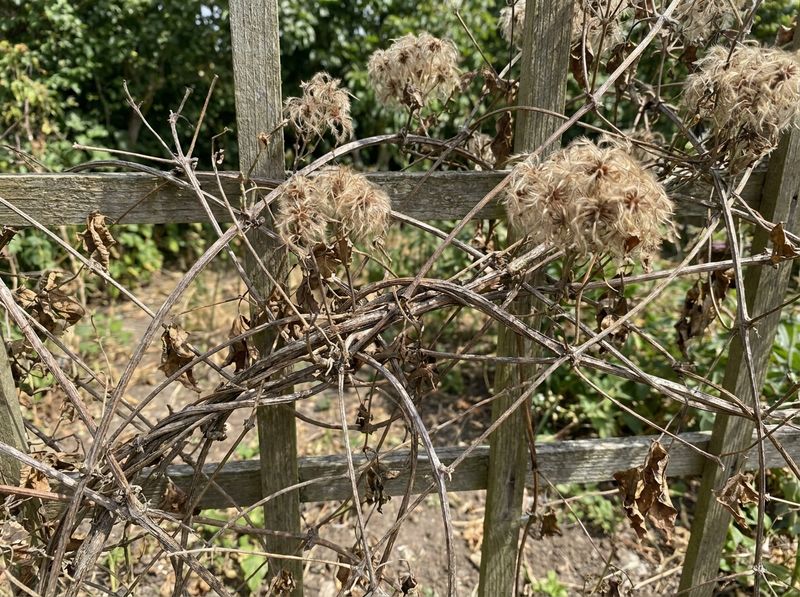
A clematis loaded with vines but almost no flowers is one of the most frustrating sights in a backyard garden. You have watered it, fed it, and watched it climb, yet the blooms just never show up the way they should.
The good news is that this problem usually comes down to something fixable, and once you know what to look for, you can stop guessing and start diagnosing.
Several causes can produce a leafy clematis with few flowers
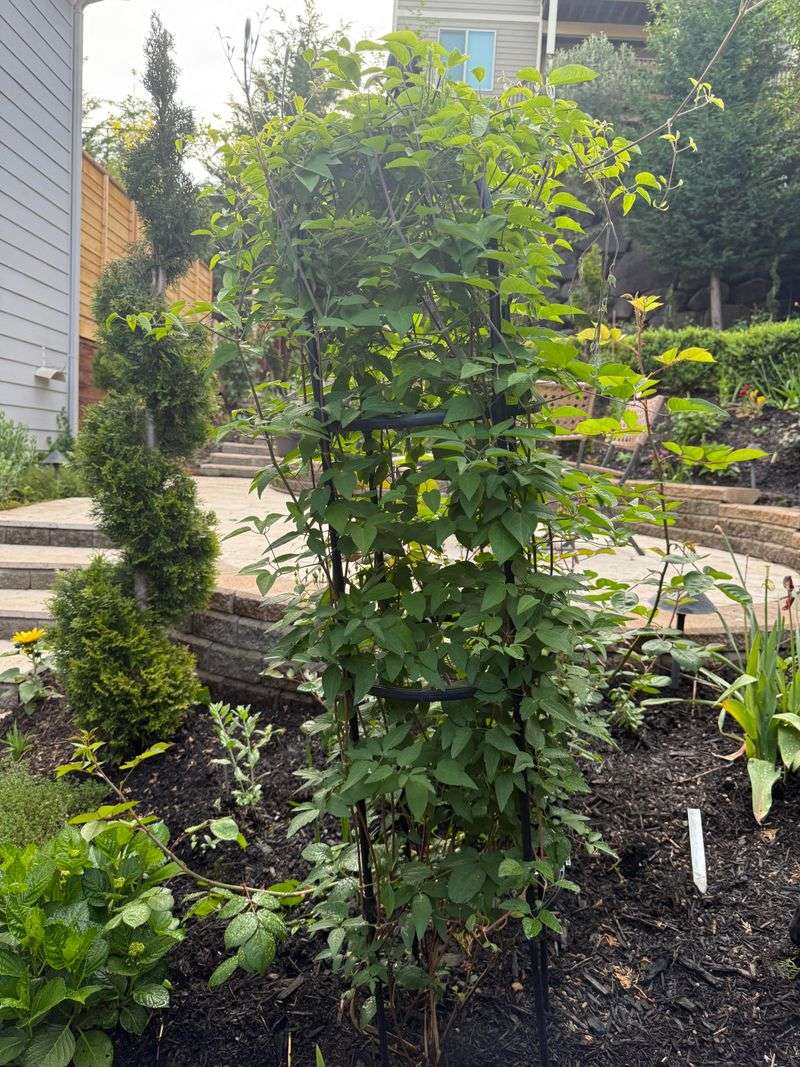
Abundant stems and lush foliage on a clematis do not automatically point to one hidden cause. Iowa State University Extension lists several documented reasons a clematis can produce vigorous growth while flowering poorly: incorrect pruning, insufficient light, excess nitrogen, winter damage, plant immaturity, and water stress.
Any one of these, or a combination, can leave you staring at a wall of leaves with barely a bud in sight.
Before assuming the plant needs more fertilizer or a special product, the most useful first step is to rule out a pruning-group mismatch. Clematis flower on old wood, new wood, or both, depending on the type.
A cut made at the wrong time of year can remove the very stems that were carrying this season’s flower buds, leaving the plant with plenty of energy to push new growth but nowhere to put its flowers.
This is not a reason to panic or assume the plant is beyond help. The Royal Horticultural Society’s clematis pruning guide makes clear that each pruning group has a distinct relationship with its flowering wood, so matching your pruning timing to the plant’s group is a logical and practical place to begin the diagnosis.
The sections that follow work through the other possible causes in order, so you can check each one against what you actually observe in your garden rather than applying a one-size-fits-all remedy.
Identify the pruning group before you reach for the pruners
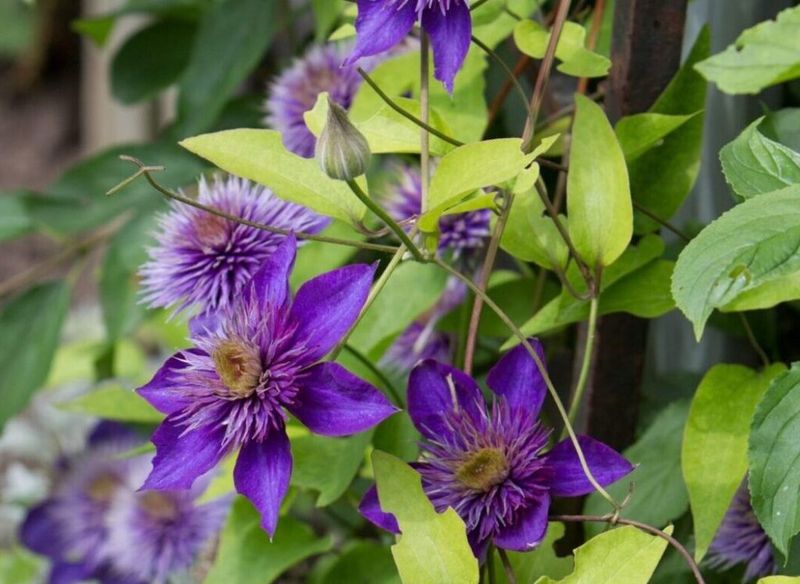
Knowing which pruning group your clematis belongs to is more valuable than any general advice about cutting it back. The clearest way to find out is to check the cultivar name on the plant tag or nursery receipt and look it up.
If that information is no longer available, flowering time offers a secondary clue, though it is not a guarantee.
Early-season bloomers, those that open before early summer, are more likely to carry their buds on wood that grew the previous year. Cutting that wood away in late winter or early spring can cost you the entire season’s display.
Clematis that flower from late June onward tend to bloom on the current season’s growth and are generally more tolerant of a hard late-winter cutback, though cultivar, regional climate, winter severity, and that year’s weather can all shift when a plant actually opens.
The three groups break down this way. Group 1 generally flowers on previous-season’s growth and needs little to no pruning beyond light shaping.
Group 2 blooms on both old and new wood, meaning it can produce an early flush on last year’s stems and a later flush on new ones. Group 3 flowers on the current season’s growth and is the type that benefits most from a hard cutback in late winter or early spring.
The RHS pruning guide and Iowa State Extension both outline these distinctions in detail.
Bloom timing is a helpful starting point when cultivar information is unavailable, but treat it as a clue rather than a definitive answer. A late spring or a harsh winter can delay flowering enough to make a Group 1 plant look like a Group 3.
When in doubt, observe the plant for a full season before making a major pruning decision.
Match the cut to the wood that carries flowers
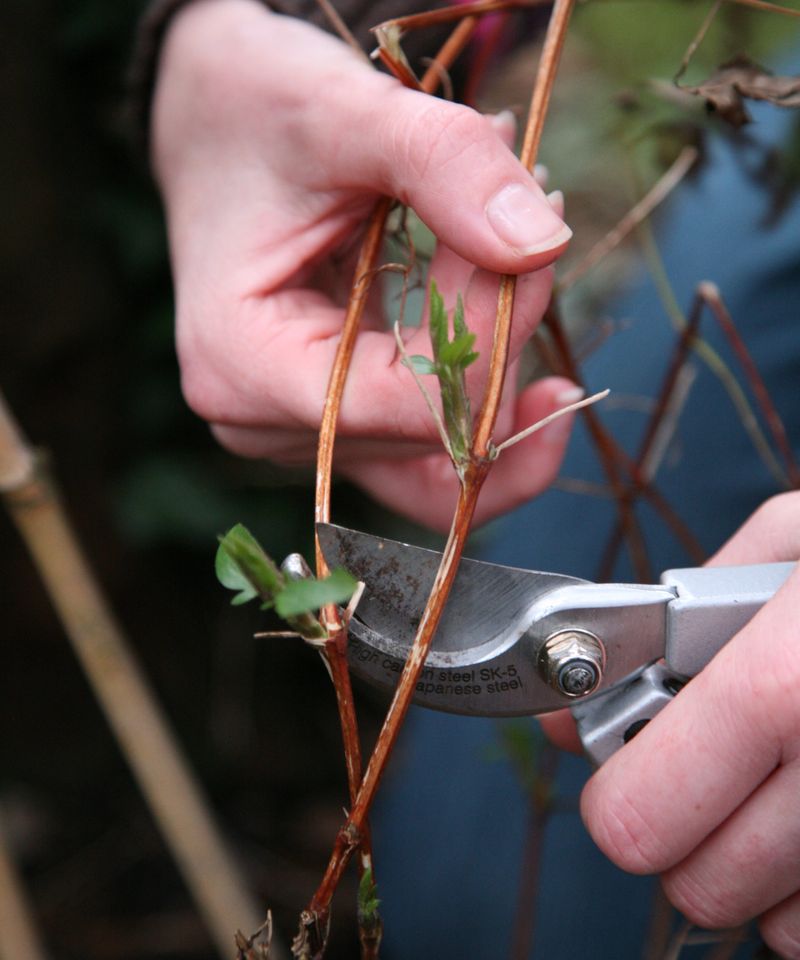
Once you know the group, the pruning decision becomes much more straightforward. Group 1 clematis, which flower on last year’s growth, generally need very little intervention.
If shaping is necessary, do it immediately after the plant finishes blooming so the vine has the rest of the growing season to produce the wood that will carry next year’s flowers. Cutting Group 1 back hard in late winter is one of the most reliable ways to end up with a leafy vine and no blooms the following spring.
Group 2 requires a lighter touch in early spring. Remove any dead or damaged wood, but preserve as much live growth as possible.
Iowa State Extension notes that aggressive pruning on a Group 2 plant can sacrifice the first flush of flowers, even if the vine recovers to produce some later blooms on new wood. The goal is to clean up the plant without stripping away the old stems that are already carrying early-season buds.
Group 3 is where a hard cutback genuinely helps. Iowa State recommends cutting stems to approximately 6 to 12 inches above ground level in late winter or early spring.
This is practical guidance tied to the plant’s habit and local conditions, not a rigid rule that applies to every cultivar or climate. The reason for the cutback is straightforward: a Group 3 vine left unpruned will still produce flowers, but they tend to appear only near the tips of long, tangled stems, far from eye level and concentrated at the top of an old framework.
Cutting the plant back encourages fresh shoots from the base, which fill in the lower part of the trellis and distribute blooms more evenly. The RHS pruning guide confirms this distinction: an unpruned Group 3 vine producing flowers only at its tips is a different situation from a vine that sets no buds at all, and the two problems call for different responses.
Lush growth can signal overfeeding, but it cannot prove it
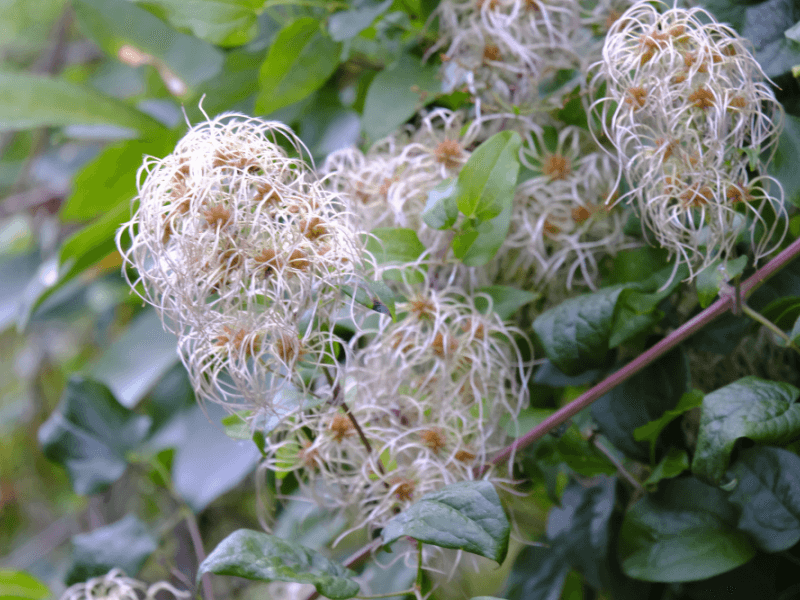
A clematis that looks almost too healthy, with thick stems and unusually dark, abundant leaves but almost no buds, deserves a second look at its fertilizer history. Iowa State Extension specifically lists too much fertilizer, particularly nitrogen, as a cause of lush vegetative growth with few blooms.
Nitrogen encourages the plant to invest energy in stems and leaves rather than flowers, which is useful for a lawn but counterproductive for a flowering vine.
That said, leafy growth alone does not confirm a nitrogen problem. Incorrect pruning, low light, plant immaturity, and other factors can produce a similarly overgrown appearance without any fertilizer being involved.
Think of the lush foliage as a clue worth investigating, not a diagnosis on its own.
The practical response is to stop adding fertilizer automatically and review what the plant has actually received. Iowa State advises avoiding products high in urea and ammonia, and recommends a relatively low-number, all-purpose fertilizer for established plants when feeding is warranted.
Oregon State Extension similarly cautions against overfertilizing and points to balanced formulas like 5-10-5 or 5-10-10 as examples for established clematis.
Before reaching for any fertilizer product, consider getting a soil test. University of Illinois Extension guidance on soil sampling explains how testing gives you an accurate picture of what nutrients are already present, which is far more reliable than guessing.
The RHS clematis FAQ notes that potassium or bloom-booster products should only come into play after growing conditions and pruning are already well matched to the plant. No fertilizer product can force flowers on a vine that is being pruned at the wrong time or growing in too much shade.
Give the vine light while keeping its roots cool and evenly moist
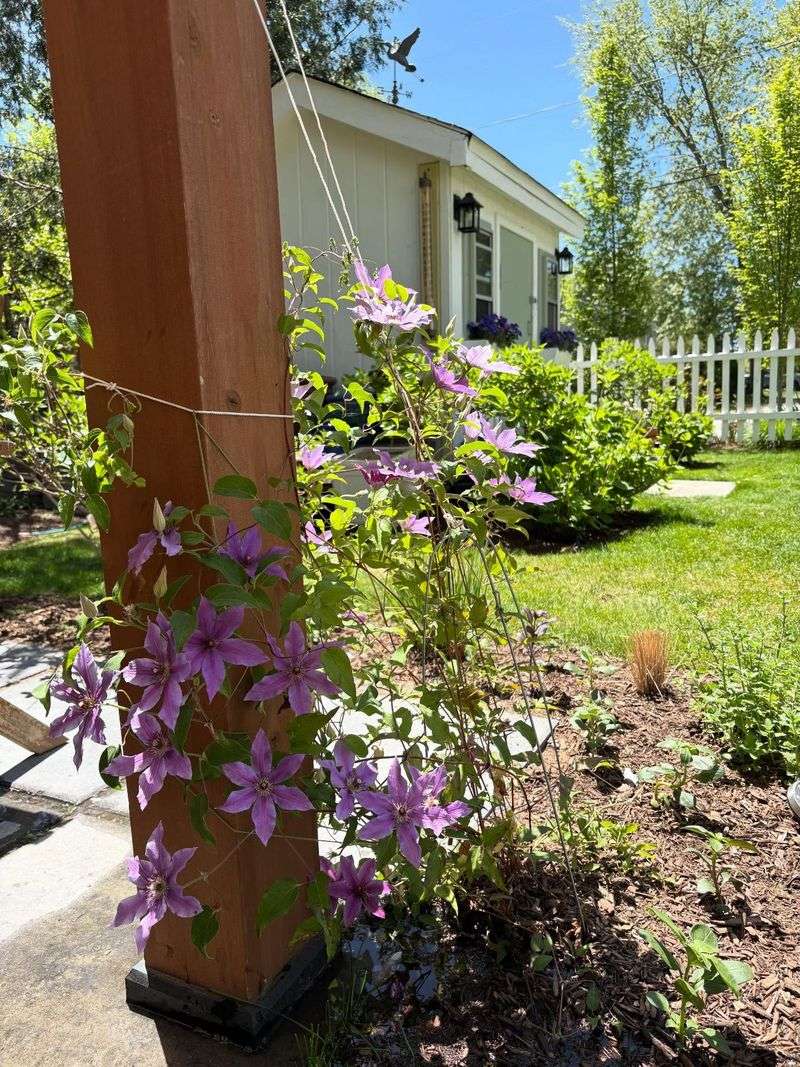
After checking pruning and fertilizer history, growing conditions deserve a careful look. Clematis foliage and flowers need substantial direct light to perform well.
Iowa State Extension recommends at least six hours of direct sunlight per day, while University of Illinois Extension offers four to five hours as a practical lower threshold. Neither figure is universal, since cultivar, regional climate, and the intensity of summer heat all affect how much light a given plant actually needs.
What the research consistently supports is that deep shade reduces blooming, sometimes dramatically.
The familiar gardening saying about clematis wanting its “head in the sun and feet in the shade” is worth unpacking. The foliage and flower-producing stems genuinely need light, but the root zone does benefit from staying cool and evenly moist.
Oregon State Extension recommends filtered shade or mulch to keep roots cool, especially in regions with hot summers. A layer of mulch over the root zone, or a few shallow-rooted annual plants at the base of the vine, can accomplish this without shading the climbing stems above.
Water management matters alongside light. Iowa State gives approximately one inch of water per week as a general target, with more attention needed during dry spells and during the establishment period after planting.
The RHS clematis FAQ echoes the importance of moisture-retentive but well-drained soil. Roots sitting in waterlogged ground can become damaged and unable to support healthy flowering, even if everything above ground looks fine.
Checking soil drainage is straightforward: dig a small hole near the root zone after a rain and see how quickly water drains away. If water pools and sits for hours, drainage is likely limiting the plant’s health, and no amount of pruning adjustment or fertilizer review will fully compensate for that underlying condition.
Check plant age, winter damage, and the difference between no blooms and sudden collapse
Not every clematis that blooms poorly is sick or being mismanaged. Iowa State Extension notes that newly planted clematis can show limited above-ground growth during the first year or two as the plant focuses energy on root development, and may take up to three years to establish reliably enough to bloom well.
A young plant that produces mostly stems and leaves during its first couple of seasons is often doing exactly what it should.
Winter damage is another factor that can quietly reduce flowering without any obvious sign of failure. In Groups 1 and 2, flower buds form on wood that developed the previous season.
A hard winter can kill that wood back to the ground, removing the buds along with it. The vine may push vigorous new growth in spring, looking healthy from a distance, while the flowering wood it needed simply is not there.
A cool spring can also delay bloom enough to make a plant appear late or struggling when it is actually progressing normally for its cultivar and region.
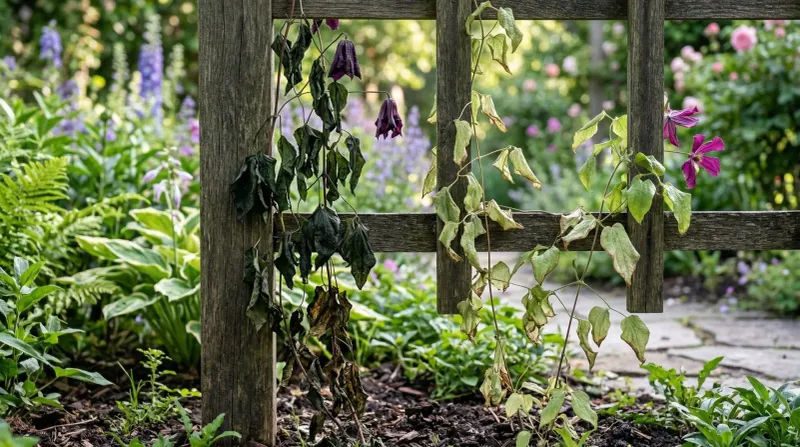
Chronic nonflowering over multiple seasons is a different problem from sudden wilting, spotted leaves, or stem collapse. The RHS clematis FAQ explicitly cautions that many cases of wilting are not caused by clematis wilt disease, and that broken stems, poor drainage, root pests, and heat stress can all produce similar symptoms.
Oregon State Extension recommends diagnosing the specific symptom rather than defaulting to a fertilizer response.
When foliage shows necrotic spots alongside wilting or collapse, disease becomes a more serious consideration. A published plant-pathology report on Calophoma clematidina confirms that this fungal pathogen can cause leaf spot and wilt on clematis, including dark necrotic spots that precede stem collapse.
When disease is a concern, water the soil directly rather than wetting the foliage, and focus on identifying the underlying cause before taking further action. Adding fertilizer to a diseased plant is unlikely to help and may complicate the picture.
Use a step-by-step diagnosis instead of one universal fix
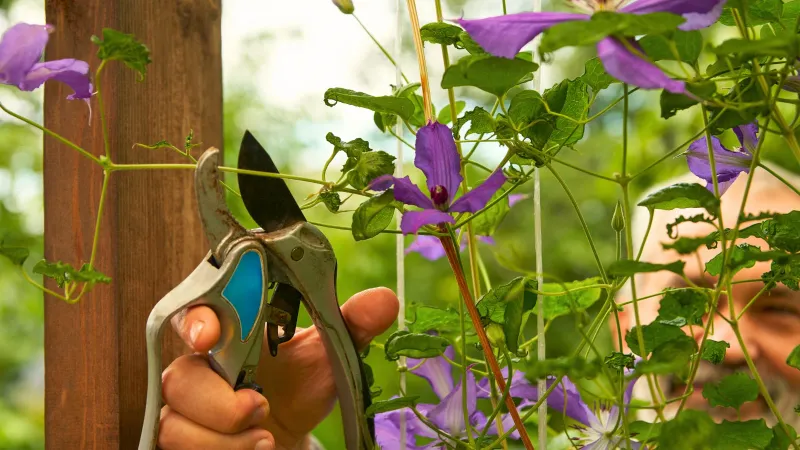
Working through a clematis that barely blooms is more productive when you follow a sequence rather than applying a single remedy and hoping for the best. Start with the cultivar name or, if that is unavailable, the plant’s bloom period.
Use that information to determine which pruning group the plant likely belongs to and which type of wood should be carrying its flowers. Then check when the plant was last pruned and whether that timing matched its group.
Iowa State Extension and the RHS pruning guide both treat pruning-group mismatch as a sensible first check because it is a commonly missed possibility and one that is easy to correct once identified. After reviewing pruning, assess fertilizer history and look honestly at how much direct light the plant receives each day.
Check soil moisture and drainage, consider the plant’s age, and think back to how severe the past winter was in your area.
If the vine shows spotted foliage, sudden wilting, or stem collapse rather than slow chronic nonflowering, treat those as separate symptoms requiring their own diagnosis, as the RHS clematis FAQ advises. No single fertilizer, no universal spring cutback, and no bloom-booster product resolves every case.
The gardeners who get their clematis flowering again are usually the ones who take the time to observe carefully before they act. A vine that has been growing for years without blooming well has a reason, and finding that reason is almost always more useful than reaching for a quick fix.