
The One Thing North Carolina Peonies Need Right After Blooming Or They Skip The Whole Next Spring
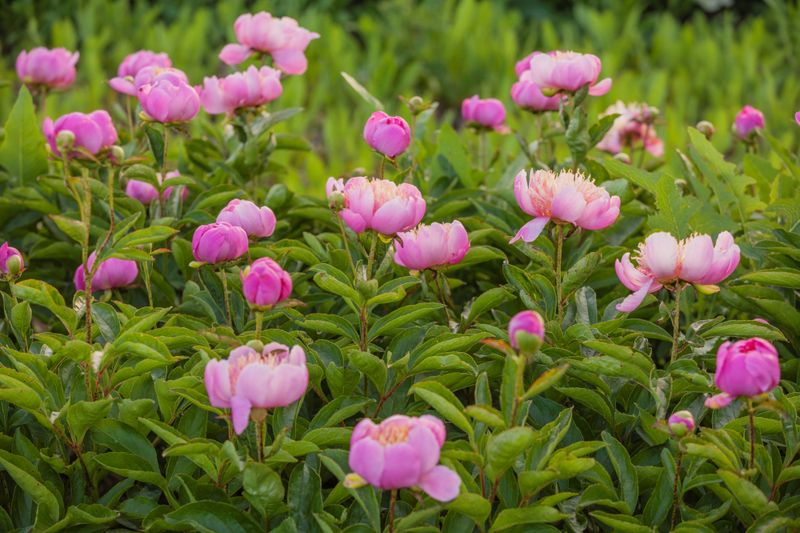
Once your peony flowers fade, there is a small window to do one thing that helps protect next year’s blooms. That step is deadheading: removing each spent flower while leaving all the healthy green leaves in place.
Skipping it is not a guaranteed disaster, but doing it right gives your plant the best shot at flowering again. What follows is a clear, practical guide for North Carolina gardeners in the mountains, Piedmont, and Coastal Plain.
Deadhead the flower, not the peony
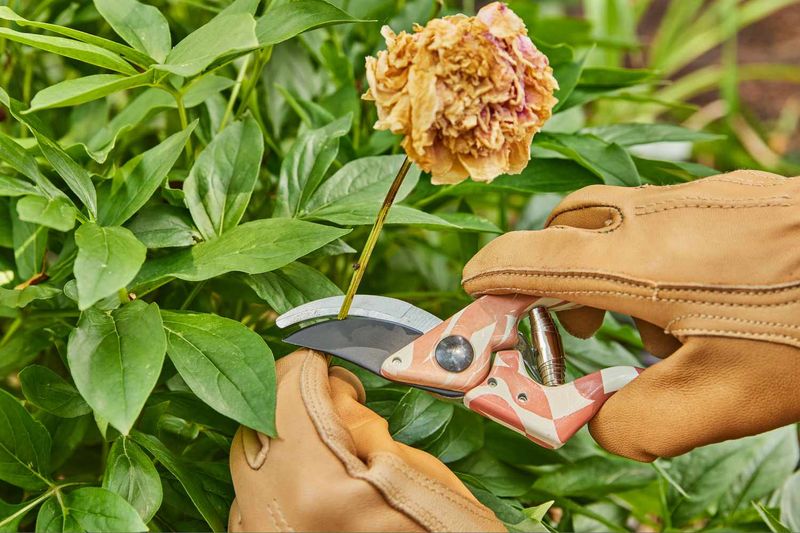
When peony petals drop and the flower looks spent, reach for your pruners rather than walking away. The right move is to remove each faded bloom promptly while leaving the rest of the plant completely alone.
University of Connecticut Extension peony guidance consistently recommends removing faded flowers while preserving healthy foliage, because the leaves keep working through summer to support future growth.
What deadheading actually does is remove the developing seed head at the tip of the flower stem. When a peony sets seed, the plant puts resources into that reproductive effort.
Cutting the spent bloom off redirects that energy, though the green foliage is still doing the heavier lifting by manufacturing carbohydrates through photosynthesis. Deadheading is a useful habit, not a magic switch.
Here is where the headline framing needs an honest correction. Failing to deadhead promptly will not guarantee that your peony sits out all of next spring.
University of Wisconsin Extension bloom-failure guidance identifies excessive shade, crowns planted too deeply, insufficient winter chilling, recent transplanting, late frost damage, and disease as common causes of missing flowers. Deadheading is one good practice among several.
Treating deadheading as the single thing that controls every bloom outcome sets gardeners up for frustration. A peony growing in too much shade or planted an inch too deep may skip flowering regardless of how quickly you removed last year’s spent blooms.
Getting the post-bloom step right matters, and so does everything else: site, sunlight, planting depth, winter temperatures, plant health, and cultivar suitability for your part of North Carolina.
Make the cut just above useful leaves
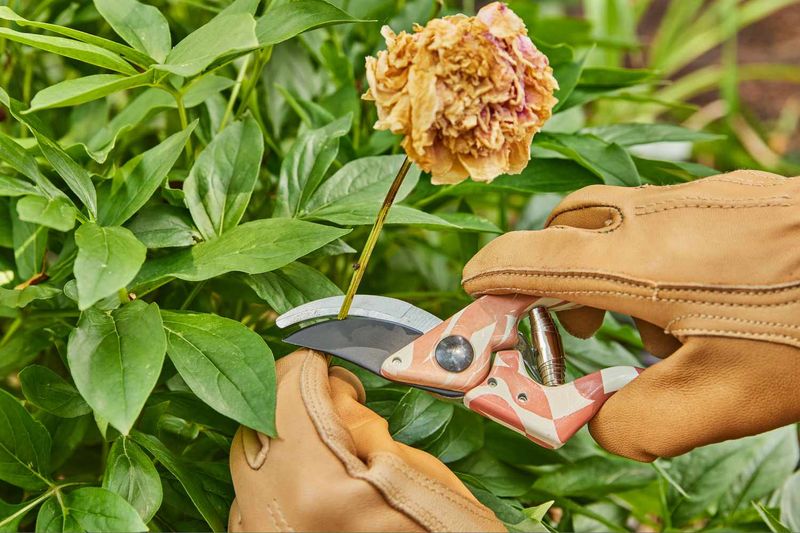
Grab a pair of clean, sharp pruners and follow the spent flower stem downward from the faded bloom. Your target is the first strong set of leaves you reach below the flower.
Cut the stem just above that leaf set, removing the seed head and its immediate stem while keeping as much healthy foliage as possible attached to the plant.
This is a more deliberate cut than it might sound. Kansas State University horticulture guidance describes cutting just above the first set of leaves or within the foliage canopy as the correct approach, and that phrasing is worth taking literally.
You are not trimming a hedge. You are removing one stem at a time, tracking each faded bloom back to a natural branching point where a set of leaves can take over.
The reason this precision matters is leaf area. Every leaf on the plant is a small solar panel pulling energy from summer sunlight and converting it into carbohydrates.
North Dakota State University peony extension guidance confirms that the foliage continues to support the plant after flowering ends, making it worth protecting during the cut. Slicing too far down the stem removes leaf sets that would otherwise keep working through July and August.
Avoid cutting down into the main crown or removing large portions of the stem below the first strong leaf set. That kind of aggressive cut crosses from deadheading into early pruning, which is a separate job with a different season.
For now, the goal is simple: find the spent flower, trace the stem down to healthy leaves, and cut cleanly just above them. Repeat for each faded bloom on the plant.
Keep healthy foliage working through summer
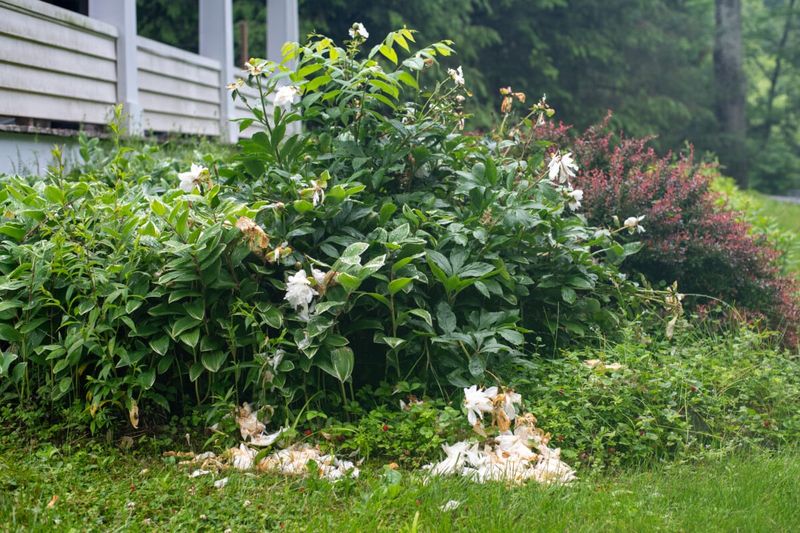
After deadheading, put the pruners away. The single biggest mistake gardeners make after peony flowers fade is cutting the whole plant back, and it is an understandable impulse because the foliage can look a little ragged once the show is over.
Resist it. Those leaves are not decorative at this point; they are functional.
Green peony foliage keeps photosynthesizing through the summer months, pulling energy from sunlight and building the carbohydrate reserves that the plant draws on when it wakes up next spring. Iowa State University Extension bloom-failure guidance lists premature removal of foliage as a reason peonies underperform in future seasons.
Cutting the plant down immediately after flowering shortens that productive window and can leave the crown with less stored energy heading into dormancy.
The American Peony Society specifically warns against early mowing or shearing of peony foliage. Ordinary green leaves should stay on the plant until one of three things happens: they yellow naturally as the plant approaches dormancy, a hard frost kills them, or disease makes removal necessary to protect the rest of the plant.
That last exception is worth understanding clearly. If you spot signs of botrytis blight, a fungal disease that shows up as grayish mold or brown blotches on leaves and stems, removing affected foliage promptly is the right call.
Diseased material should not sit on the plant or be left on the ground where spores can overwinter. But ordinary green foliage that is simply past its visual peak is doing real work, and removing it early trades next spring’s potential for a tidier summer bed.
Let it run its course through the season.
North Carolina summers are humid, particularly in the Piedmont and Coastal Plain, so keep an eye out for fungal issues, but do not pull healthy leaves just because the garden looks less polished than it did in May.
Match the routine to your North Carolina site
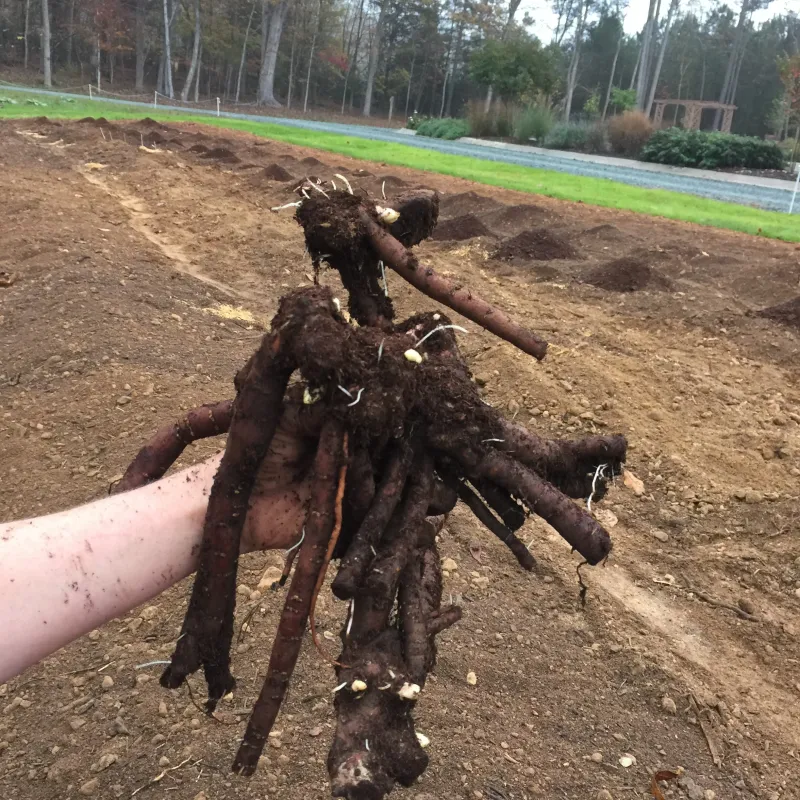
Post-bloom care does not look exactly the same across North Carolina because the state covers a wide range of growing conditions. Peonies generally perform best in the mountains and the cooler parts of the Piedmont, where winters are cold enough to meet the chilling requirements most cultivars need.
NC State Extension peony guidance notes that peonies can languish in warmer areas where those chilling requirements are harder to meet, and the Coastal Plain fits that description for many standard cultivars.
If you are gardening in the warmer parts of the state, cultivar selection becomes one of the most consequential decisions you make. NC State Cooperative Extension guidance for Scotland and Hoke Counties recommends early-blooming cultivars and singles or Japanese-flowered types for North Carolina conditions, noting that many large, late, double-flowered peonies are better suited to cooler climates.
Planting a cultivar that needs more winter cold than your site can deliver is a setup for disappointing springs regardless of how carefully you deadhead.
Sunlight is another site factor that shapes bloom success at least as much as any post-bloom routine. Peonies want a minimum of six hours of direct sun per day.
A plant growing under a canopy that has filled in since it was planted, or one shaded by a fence or structure for much of the day, will struggle to flower well no matter what you do after the blooms fade.
Planting depth matters too, and it is one of the most common reasons North Carolina peonies disappoint. Herbaceous peony crowns should be placed near the soil surface, with the eyes no more than one to two inches deep.
Warmer sites call for especially shallow placement. A crown buried several inches down may produce lush foliage every year while flowering rarely or not at all.
If your peony has never bloomed well and you planted it yourself, depth is worth checking before you blame anything else.
Water when dry, but do not feed by reflex

Summer aftercare for peonies is lighter than many gardeners expect. Once the flowers are gone and the foliage is doing its quiet work, the main job is keeping the plant from drying out during extended dry spells.
Matthaei Botanical Gardens peony care guidance recommends deep watering when the soil dries out, while avoiding keeping the crown or surrounding soil constantly wet.
Direct water at the soil line rather than overhead. Wetting peony foliage, especially in humid North Carolina summers, creates conditions where fungal diseases like botrytis find it easier to take hold.
A soaker hose or careful hand watering at the base of the plant works better than a sprinkler. New plants need more attention during their first season or two because their root systems are still establishing; established plants in reasonable soil can handle moderate dry periods without distress.
Fertilizer is where a lot of gardeners overdo it. The instinct after bloom is to give the plant a boost, but that impulse can backfire.
NC State Extension soils guidance recommends soil testing before making nutrient amendments, because fertilizer needs depend on what your soil already contains. Applying nutrients your soil does not lack is wasteful and can cause problems.
Excessive nitrogen is a particular concern with peonies. Too much of it encourages lush, leafy growth at the expense of flowering.
NC State Cooperative Extension peony recommendations favor low-nitrogen feeding in spring, and multiple extension sources advise against late-summer or fall fertilizer applications. If you have not done a soil test recently, that is a more useful step than reaching for a fertilizer bag based on habit alone.
Wait for dormancy before fall cleanup
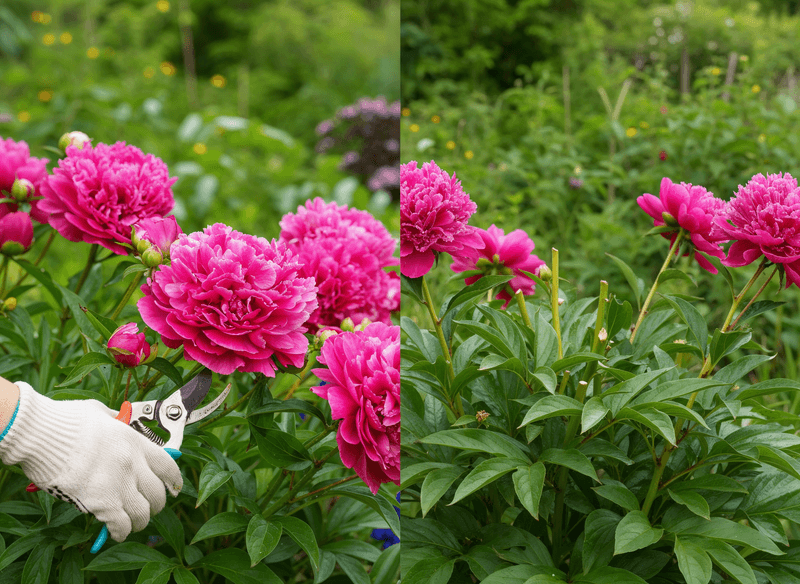
Fall cleanup for peonies has a specific trigger: wait for it. Cutting herbaceous peonies down before they have gone dormant removes foliage that may still be contributing to the plant.
Once a hard frost has killed the stems and leaves, or the foliage has clearly yellowed and died back on its own, the timing is right.
At that point, cut herbaceous peony stems to ground level or just below it and clear fallen leaves and plant debris from around the base. Matthaei Botanical Gardens peony calendar guidance recommends removing fallen foliage from the garden rather than leaving it in place, because fungal pathogens including the botrytis blight common to peonies can overwinter in plant debris.
Diseased material in particular should be bagged and discarded rather than added to a home compost pile.
The most important rule in fall cleanup applies to plant type: do not cut tree peonies to the ground. NC State Extension tree peony guidance explains that tree peonies retain their woody stems year-round, and those stems are where next year’s buds develop.
Cutting them to the ground destroys the flowering framework and can take years of recovery, if the plant recovers at all. Tree peonies need only light pruning to remove dead wood, not a ground-level cutback.
Itoh peonies, also called intersectional peonies, occupy a middle ground. University of Wisconsin Extension peony growing guidance notes that Itoh peonies have short woody stems but generally die back more like herbaceous types.
Before you prune aggressively in fall, confirm what type of peony you have. If you are not certain, err on the side of caution and remove only the clearly dead or frost-killed material until you can identify the plant with confidence.
American Peony Society resources can help with identification if the plant type is in question.
Diagnose missing flowers before blaming deadheading
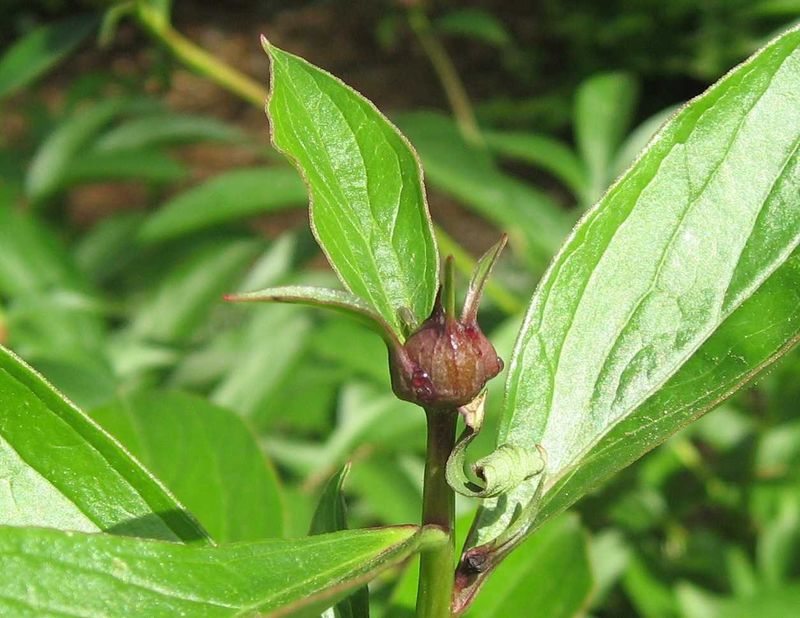
A peony that produces lush foliage every spring but never opens a single flower is telling you something, and the answer is rarely that last year’s deadheading was too slow. Several factors are more likely candidates, and working through them systematically saves a lot of frustration.
Shade is one of the first things to check. Iowa State University Extension bloom-failure troubleshooting lists insufficient sunlight as a primary reason peonies fail to flower.
If trees or structures have grown up around a plant that used to bloom well, reduced light may be the culprit. Peonies want six or more hours of direct sun each day.
Crown depth is another major factor. Eyes buried more than one to two inches below the soil surface can suppress flowering even in an otherwise healthy plant.
NC State Extension peony guidance specifically flags deep planting as a common problem in North Carolina and recommends especially shallow crown placement in warmer parts of the state.
Newly planted or divided peonies often need one or more full growing seasons before they flower reliably. University of Wisconsin Extension bloom-failure guidance notes that transplant stress can delay flowering, and patience is part of the remedy.
If you moved the plant or divided it within the last year or two, give it time before assuming something is wrong.
Winter chilling, late frost damage, disease, and cultivar mismatch round out the list. A cultivar that needs more cold than a warm Piedmont or Coastal Plain winter provides may leaf out reliably but never quite have the energy reserves to bloom.
A late frost hitting emerging buds can cancel the whole spring show in a single night. Botrytis blight can destroy buds before they open.
One thing that is not causing the problem: ants. American Peony Society guidance confirms that ants are drawn to the sugary secretions on peony buds and do not interfere with flowering.
Spraying them is unnecessary and solves nothing.
Use the simple sequence that protects future growth
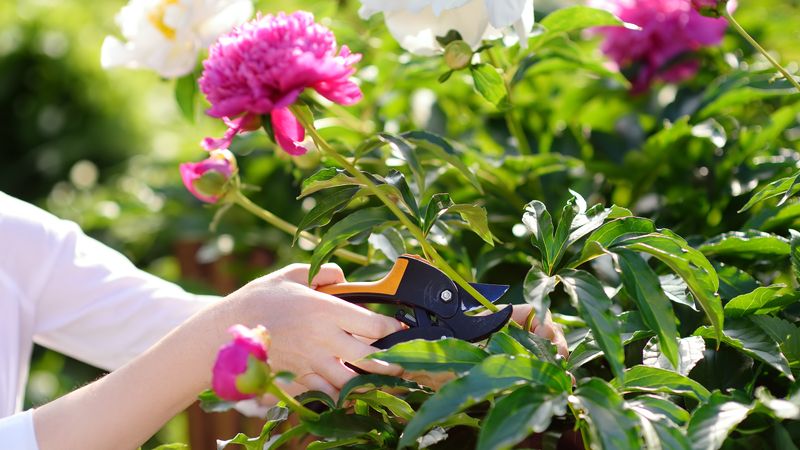
The post-bloom routine for North Carolina herbaceous peonies comes down to a short, repeatable sequence. University of Connecticut Extension peony care guidance and NC State Extension peony recommendations together support each step below.
Deadhead each faded flower by cutting its stem just above the first strong set of leaves. Keep all healthy green foliage in place through summer.
Water deeply during prolonged dry spells, directing water at the soil line rather than over the leaves. Skip the automatic post-bloom fertilizer, get a soil test if you have questions about nutrients, and avoid excessive nitrogen.
Wait for frost or clear dormancy before cutting herbaceous peonies down to ground level. Leave tree peony stems intact, and identify Itoh peonies before pruning aggressively.
Deadheading is a genuinely useful habit that supports future flowering by removing developing seed heads and keeping the plant focused on its foliage. A peony that skips next spring’s blooms almost certainly has a deeper issue: wrong cultivar, too much shade, crowns planted too deep, or a winter that did not deliver enough chill.
Tend the foliage well, and the plant takes care of the rest.