
If You Want A Living Fence That Gets Thicker Every Year, Here’s Exactly How To Plant And Weave One
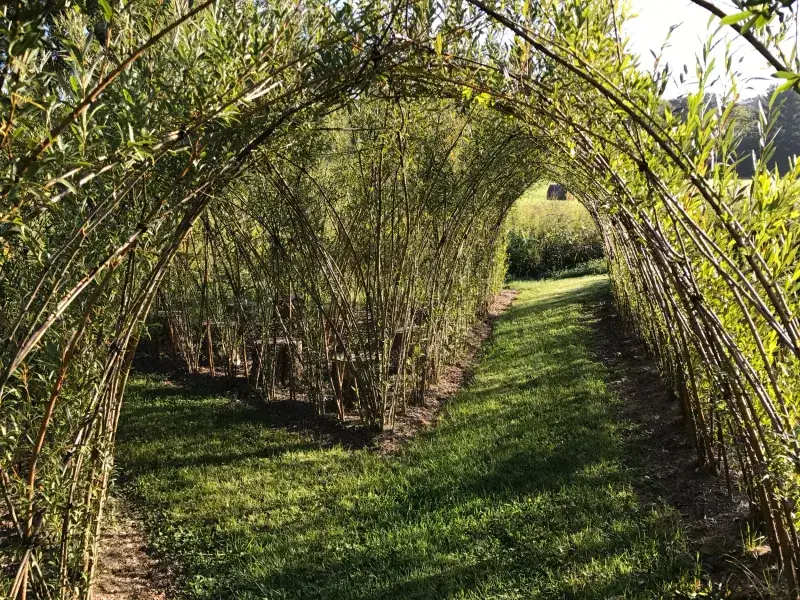
A living willow fedge is one of those backyard projects that feels almost magical: you push bare sticks into the ground, weave them together, and watch a growing, leafy boundary take shape over the seasons. The catch is that it takes the right material, the right spot, and real ongoing care to work well.
Get those three things right, and you can build a fence that grows denser through deliberate training rather than just sitting there looking hopeful.
Choose suitable willow rods before planning the pattern
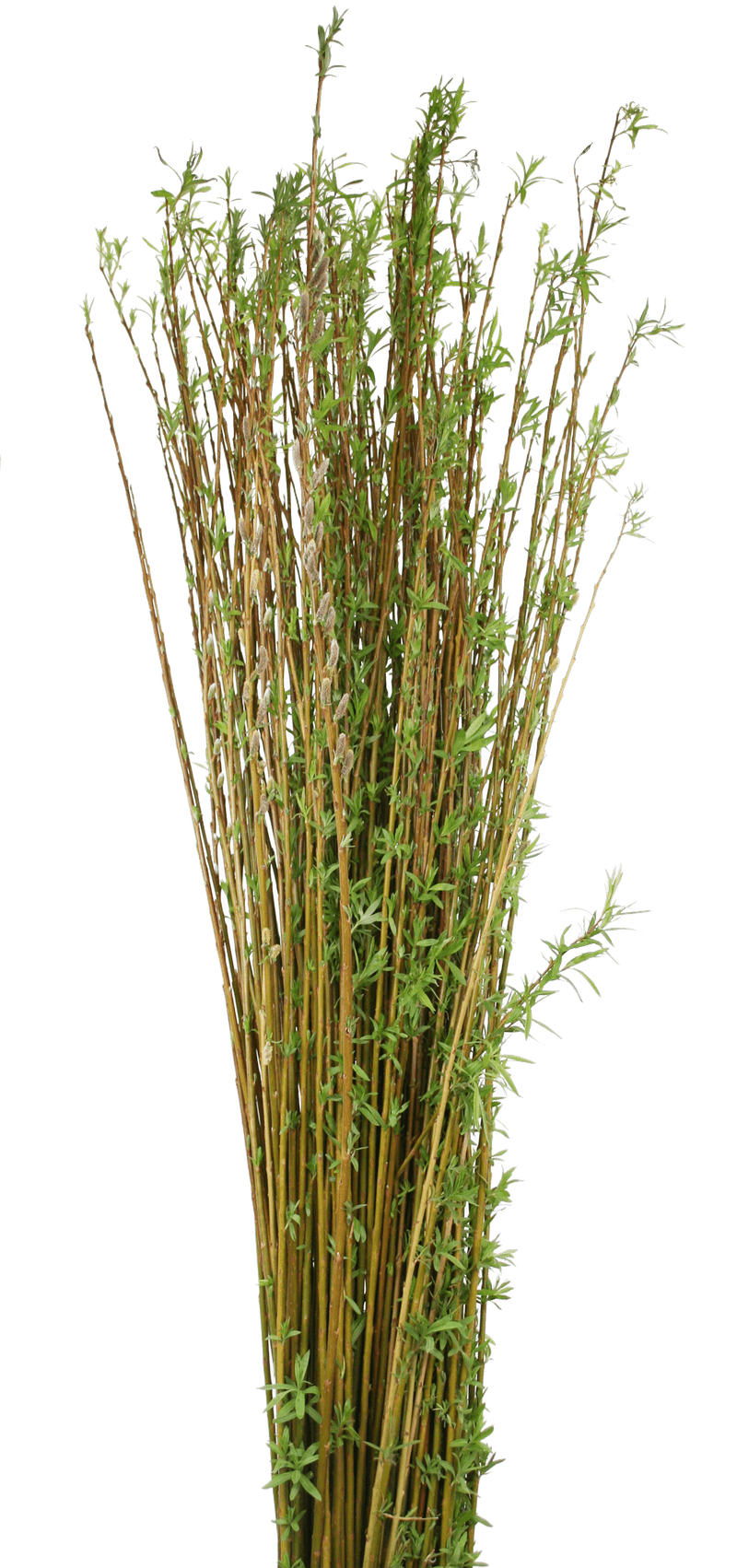
A fedge sits somewhere between a fence and a hedge, which is exactly where the word comes from. You build one by pushing dormant, unrooted willow rods into the ground at opposing angles, weaving them into a diamond pattern, and letting the living material root and shoot.
The result is a boundary that can grow denser through living growth and deliberate training, though it will not necessarily thicken on its own every year without care.
Choosing the right rods matters more than most beginners expect. RHS guidance on living willow explains that specialist growers commonly supply one-year-old rods for woven infill and thicker two-year-old material for uprights.
Buying from a supplier who grows willow specifically for living structures gives you rods that are the right length, flexibility, and diameter for the job.
One important distinction to get straight before you order anything: dormant, unrooted willow rods are not the same thing as rooted bare-root nursery whips. Unrooted rods root directly from the buried stem, which is why the angled weaving method works with them.
Rooted nursery whips have an established root system that needs to be planted at the correct depth according to the nursery’s own instructions, and you should not automatically apply the 45-degree diamond geometry to them.
Species choice is equally important and genuinely regional. USDA guidance on native willows recommends using locally adapted material where possible, because stock origin affects establishment.
A shrub willow suited to your climate, hardiness zone, and soil moisture will outperform a fashionable species that struggles in your conditions. Ask your supplier which species they recommend for your region, check your state’s native plant resources, and verify that your chosen material is appropriate before you commit to a planting plan.
Will your site keep willow alive?
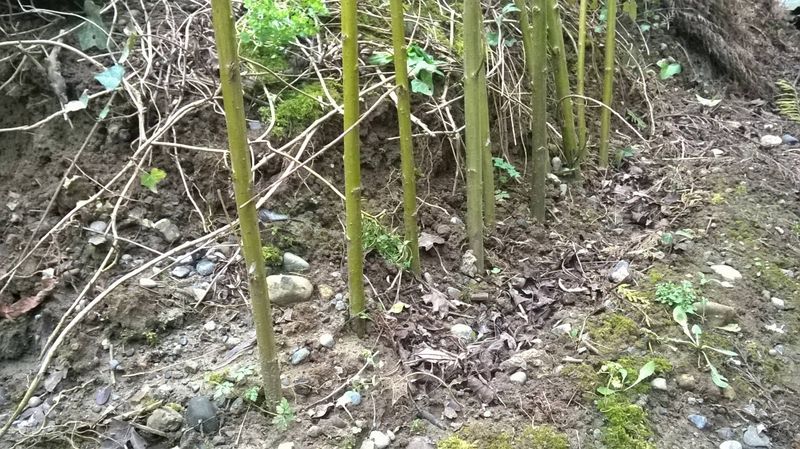
Before you order a single rod, walk your planned fence line and ask one honest question: can this spot keep willow alive through a dry summer? Most willows prefer full sun and soil that stays reliably moist.
A shaded or drought-prone strip along a fence may look like a logical privacy boundary, but it can be exactly the wrong place for this project unless you are prepared to irrigate consistently.
Root behavior is the other site factor that catches homeowners off guard. North Carolina Extension’s profile of black willow notes that some willows develop shallow, spreading roots that can seek out water and sewer lines and should not be allowed to dry out.
Separately, University of Florida IFAS Extension’s weeping willow profile warns that roots can interfere with drainage systems and sewer lines. Keep your fedge well away from underground water lines, sewer lines, septic drain fields, and any foundation.
Before you dig a single hole, call 811, the national “Call Before You Dig” service that connects you to your state’s utility locating program. University of Minnesota Extension advises calling for utility location before planting trees or shrubs, and a living willow fedge qualifies.
Digging without knowing what is below is a risk that is easy to eliminate.
Climate and regional fit deserve the same scrutiny. USDA guidance on planting willows and cottonwoods emphasizes that regional climate, species, hardiness, and stock origin all affect establishment.
A technique that works beautifully beside a pond in the Pacific Northwest may fail on a dry, hot suburban lot in the South without dependable irrigation. Check your chosen species against your state’s native plant lists, confirm its hardiness zone, and ask your supplier whether it has any restrictions in your area before you finalize your plan.
Prepare a clean, moisture-ready planting line
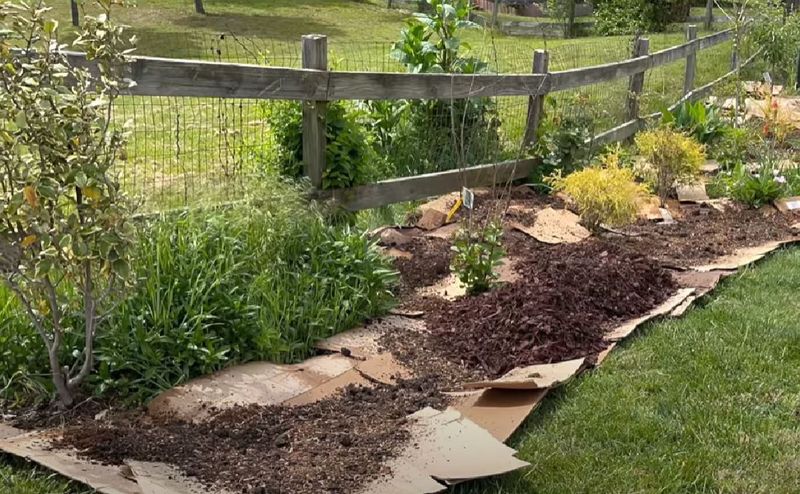
Good preparation before planting does more for your fedge than almost anything you will do afterward. Weed competition can seriously reduce establishment, and a strip that looks reasonably clear in January can be overrun by grass and weeds by May when your young rods are still trying to root.
Clear the entire planting line thoroughly before you handle a single rod, removing roots as well as top growth wherever you can.
USDA planting guidance for willows specifically highlights weed control and moisture management as major factors during the first years of establishment. Laying a weed-suppressing membrane or thick cardboard layer along the planting strip before you add mulch on top is a practical way to reduce competition without herbicides.
Mark your planting line clearly, whether it runs straight or follows a gentle curve, so you can space your holes consistently.
Prepare all your planting holes before you bring the rods out. Willow rods dry out faster than you might expect, and having everything ready means you can work quickly.
Plan your irrigation at this stage too: a soaker hose or drip line along the base of the fedge makes consistent watering far easier during the dry months ahead.
Mulch laid over the planting strip after installation will help retain soil moisture and continue suppressing weeds. University of Minnesota Extension recommends keeping mulch away from stems and trunks to reduce the risk of rot and pest problems.
A gap of a few centimeters around each rod is enough. Preparation done carefully at this stage pays dividends for years, because a moisture-retentive, weed-free planting line gives every rod the best realistic chance of establishing.
Build the first diamond framework with dormant rods
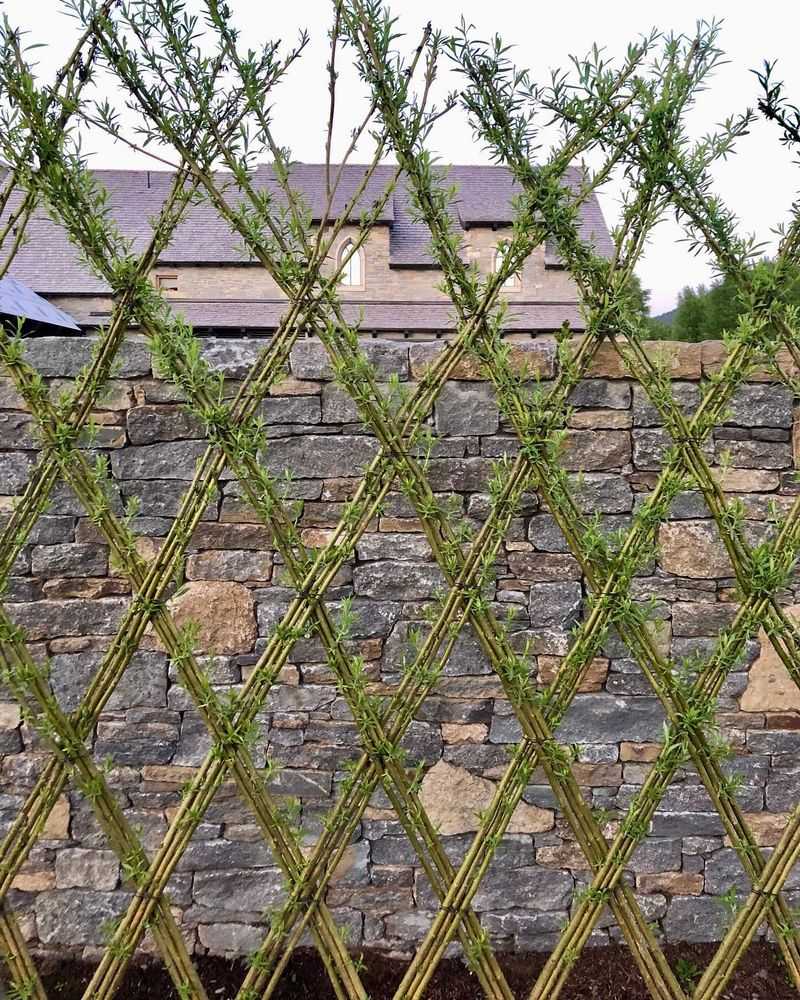
Working with dormant rods requires a clear sequence, because the geometry only comes together if you follow a consistent order. Set out your planting holes approximately 25 cm apart along the fence line, alternating the direction of lean so that each rod will cross the one beside it.
RHS guidance on living willow recommends inserting rods at least about 30 cm deep and planting opposing sets at roughly 45-degree angles so they cross into a diamond pattern. That buried depth gives the rod enough contact with moist soil to root reliably.
Thicker, two-year-old rods work well as uprights because they provide structural stability while the framework establishes. Thinner, more flexible one-year-old rods fill in the woven infill between the uprights, bending to follow the diagonal lines of the design without snapping.
Push each rod firmly to its full depth, making sure it contacts moist soil rather than a dry air pocket.
Where rods cross, tie them loosely with natural string or a thin strip of willow. The goal is to hold the angle in place while the rods establish, not to bind them so tightly that you restrict any future movement or growth.
Crossed stems may naturally graft together over time under suitable conditions, but this is a possible outcome rather than something you can rely on as a structural guarantee. Do not plan your fence’s long-term integrity around grafting happening at every joint.
One technique that catches beginners off guard: never direct a shoot deliberately downward into the soil. RHS guidance is clear that downward-directed shoots will die.
Keep all your angles leaning upward and outward from the planting holes. If you are using rooted bare-root hedge plants rather than unrooted willow rods, set that material aside and follow your nursery’s specific planting depth and training instructions instead.
University of Minnesota Extension guidance on planting trees and shrubs stresses planting at the correct root depth, which matters especially for rooted stock that cannot be treated as interchangeable with unrooted cuttings.
Give new rods the care that closes early gaps
Planting day is the beginning of a relationship with the fedge, not the end of the heavy lifting. Water deeply during dry spells rather than giving brief, frequent sprinkles.
University of Minnesota Extension recommends deep watering for newly planted woody material, with the exact frequency depending on your soil type, rainfall, temperature, and the size and species of your plants. A soaker hose set to run slowly for an extended period reaches deeper into the root zone than a quick overhead spray.
Keep the planting strip weed-free throughout the first growing season. Weeds compete directly for the moisture and nutrients your rods need to root and push their first shoots.
Checking the strip every couple of weeks and pulling anything that breaks through the mulch is far easier than trying to reclaim an overgrown strip later in summer.
Rabbits and deer can browse young willow shoots heavily enough to set back or kill newly establishing rods. RHS guidance specifically identifies rabbits and deer as potential threats to living willow, and physical protection is often the most reliable solution.
Wire mesh guards around individual rods or a temporary fence along the fedge line can prevent browsing damage during the most vulnerable first season.
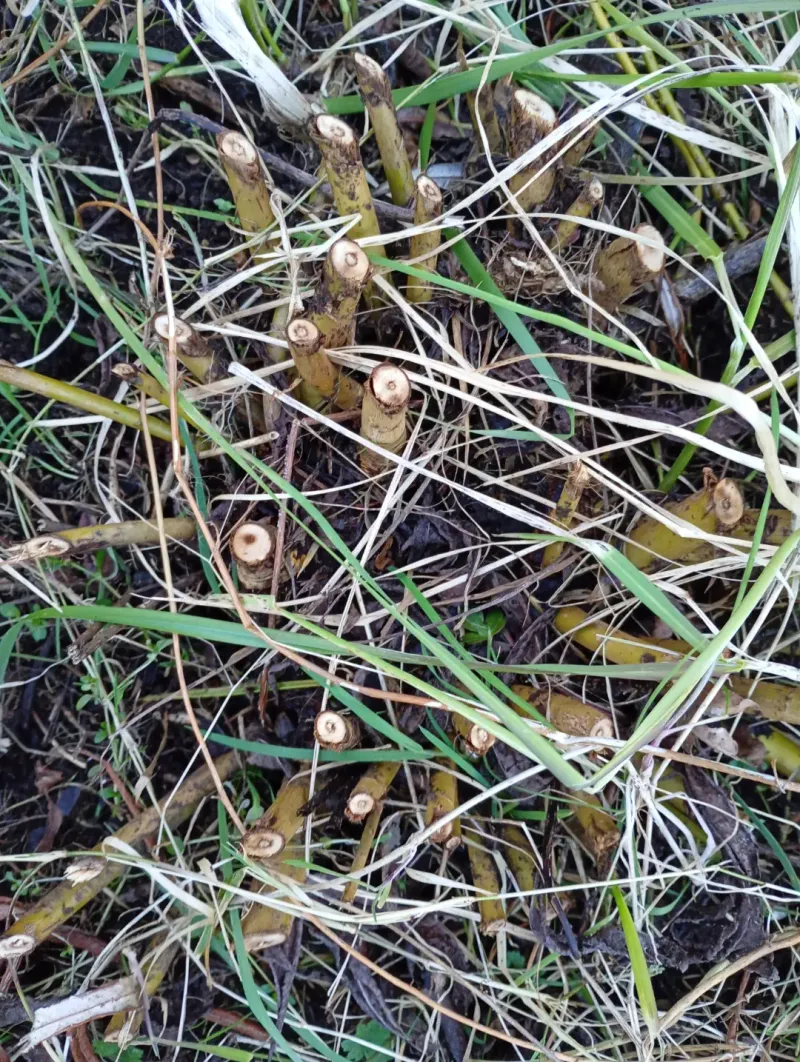
Buried willow rods can produce additional side shoots along the buried section, and cutting back some of those shoots selectively can encourage a denser growth habit. Do not expect a specific rate of thickening from this; results vary with soil moisture, species, and how well each rod has rooted.
Living fence maintenance guidance from SUNY ESF treats replanting during the first several growing seasons as routine, because complete survival across every planted rod is unlikely. Spot gaps early, have replacement rods available, and fill them promptly rather than hoping a neighboring rod will eventually spread to cover the space.
Use annual weaving and pruning to guide density
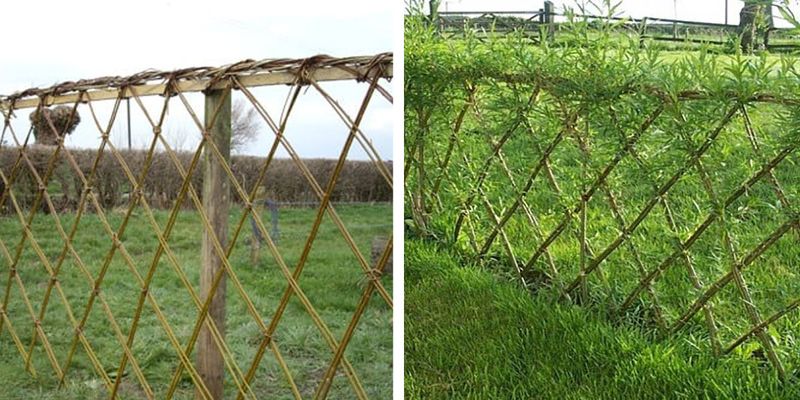
Once your fedge has its first growing season behind it, a yearly maintenance rhythm takes over. Winter is the best time to work with new growth because the shoots are dormant, pliable, and easy to weave without snapping.
RHS guidance on living structures recommends annual maintenance that includes weaving new growth and trimming to preserve the intended shape. Skipping a year does not mean the fedge quietly holds its shape; it means shoots grow in directions you did not plan for and the structure becomes harder to correct.
Work methodically along the fence, threading each pliable new shoot through the existing diamond framework rather than leaving it to grow outward. Shoots that have grown too long to weave neatly can be shortened with clean pruning cuts.
The aim is to keep new growth contributing to the density of the framework rather than escaping beyond it.
RHS notes that willow can grow up to about 2 m, or 6.5 ft, per year under suitable conditions, which means summer trimming may be necessary more than once to keep the fedge within its intended height and width. A single annual winter session handles the structural weaving, but fast-growing shoots in summer may need a light trim to prevent the top of the fence from becoming a tangle of whippy growth.
One rule to keep in mind throughout: never deliberately direct a shoot downward. Downward-directed shoots will die, which wastes a shoot that could have contributed to the structure.
Weave every shoot upward or laterally through the existing framework. Annual weaving and pruning together help guide and maintain increasing density when growth and establishment are adequate, but results vary with moisture, species, survival rate, and the consistency of your care.
Some gaps may persist for seasons, and honest expectations from the start make that easier to manage without frustration.
Know what a developing fedge cannot do yet
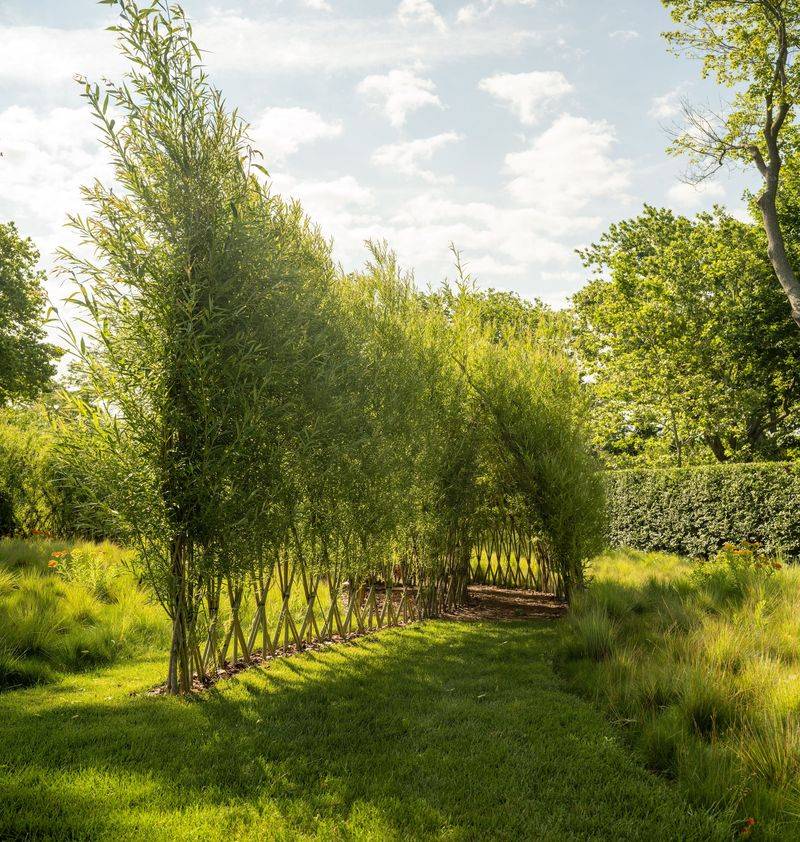
A freshly planted fedge looks more like promise than privacy, and that is exactly what it is for the first season or two. The rods are fragile, the joints have not yet grafted, and gaps between plants are not a sign of failure but a normal feature of a structure that is still establishing.
Temporary bamboo canes or stakes alongside the fence line can help hold the framework steady while roots develop and the structure gains its own rigidity.
Functionally, a developing fedge works as an ornamental boundary or visual screen, not as an immediate security fence, child-safety barrier, or livestock enclosure. RHS guidance on living willow describes woven willow structures as garden features rather than secure barriers.
If you need a fence that keeps animals in or people out from day one, a living fedge is the wrong tool for that job until it has matured considerably, and even then it should not be relied upon as a primary safety barrier.
Living fence maintenance research from SUNY ESF is clear that plant losses are expected and that replacing dead or struggling plants during the first several growing seasons is standard practice. Walk the fence line regularly, note which rods have failed to shoot, and replace them rather than leaving permanent holes in the framework.
Drought stress, browsing damage, and poor rooting are the most common reasons rods fail, so reassessing those three factors before replanting helps you avoid repeating the same loss. RHS living structures guidance reinforces that these projects require ongoing commitment rather than a one-time installation.
Words like permanent, maintenance-free, or automatically thickening do not describe a fedge accurately at any stage of its development. Knowing that going in makes the project genuinely satisfying rather than unexpectedly discouraging.
A fedge rewards consistent care
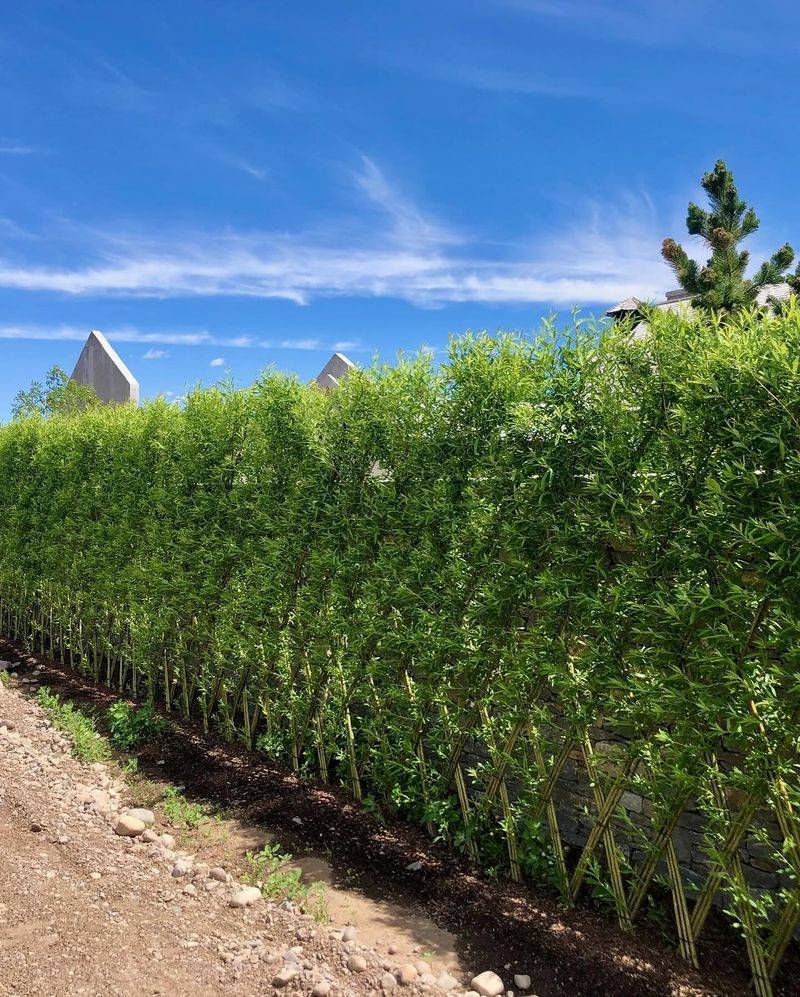
Every part of this project builds on the one before it: appropriate dormant willow rods, a sunny moisture-retentive site cleared of competing weeds, a carefully woven initial framework, and a steady return each year to prune, reweave, protect from browsing, and replace any rods that did not make it. None of those steps can be skipped and recovered from easily later.
RHS guidance on living willow and RHS living structures maintenance advice together make clear that living growth combined with deliberate annual training can increase density over time, while SUNY ESF living fence maintenance research confirms that gaps and plant losses are normal rather than exceptional. No evidence supports promising improvement every single year, and planting once without returning to maintain is not enough.
What this project does offer, honestly, is something more interesting than a panel fence: a boundary that responds to your care, changes through the seasons, and becomes more itself the longer you tend it.