
September Scouting and Sanitation Give North Carolina Fig Trees Their Best Defense Against Rust
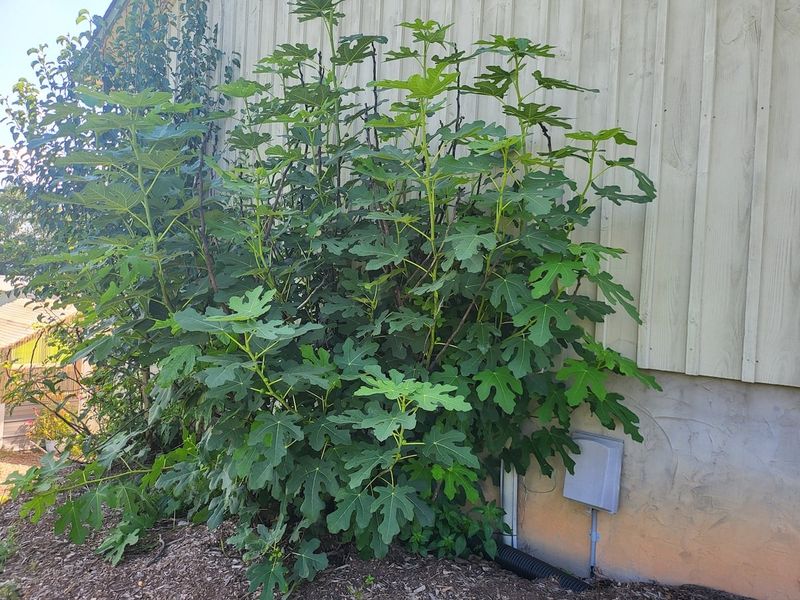
Fig rust can turn a healthy-looking tree into a bare skeleton of branches faster than most North Carolina homeowners expect, and late summer is when the disease tends to pick up speed. September is not a magic treatment deadline, but it is a genuinely useful window for inspecting your tree, pulling off infected leaves, and cleaning up fallen foliage before the season ends.
Knowing what to look for, what to do with what you find, and when real preventive protection actually needs to happen can make a real difference for your tree next year.
September calls for scouting and cleanup, not a magic spray deadline
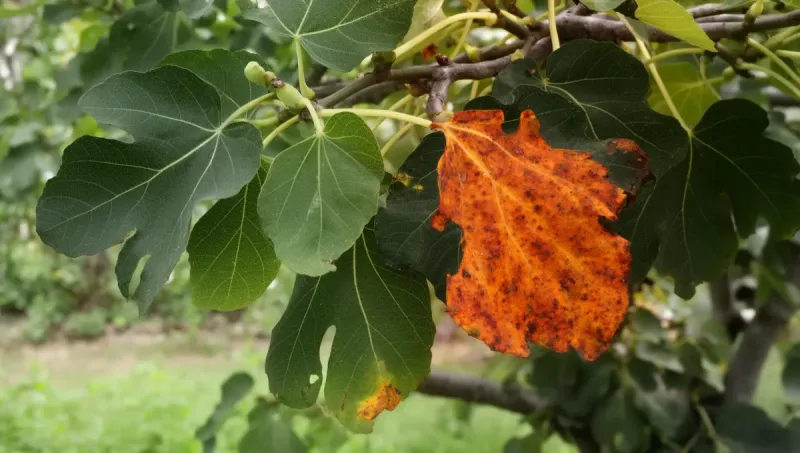
Most of the urgency you hear about September and fig rust is pointed in the wrong direction. The month does matter, but not because a single spray on a specific date will save your tree.
What September actually gives you is a window to walk out to your fig, look closely at what is happening, and take the sanitation steps that Extension specialists consistently recommend as the most practical late-season response.
Fig rust is a fungal disease caused by Cerotelium fici, a pathogen that tends to ramp up during the warm, humid conditions that North Carolina summers produce reliably. NC Cooperative Extension’s Beaufort County report from the 2024 season described fig rust as prevalent in coastal eastern North Carolina and noted that infected trees can shed leaves rapidly once symptoms appear.
That report is specific to one county and one season, so it should not be read as a statewide calendar rule that applies equally to every Piedmont suburb or mountain yard.
Severity varies with your location, the weather patterns in your part of the state, the cultivar you are growing, how dense your canopy is, and whether rust has shown up in your yard before. A tree growing in a shaded, crowded spot in a humid coastal county faces different conditions than one in a drier Piedmont yard with good airflow.
Preventive fungicide applications, according to Arkansas Cooperative Extension’s plant health guidance on fig rust and UGA Extension’s home garden fig publication, generally belong in May or early June when new leaves first reach full size, not in September. By the time rust lesions are visible in late summer, protective chemistry has already missed its most effective window.
September’s job is inspection and cleanup, and those two actions are genuinely worth doing.
Look for a pattern consistent with fig rust
Yellowing leaves and early leaf drop are common enough in late summer that they do not, by themselves, tell you much. Seasonal senescence, heat stress, water imbalance, and several other problems can all produce yellow or browning foliage on a fig tree.
Reaching a confident working diagnosis of rust requires looking for a specific combination of signs, not just one symptom in isolation.
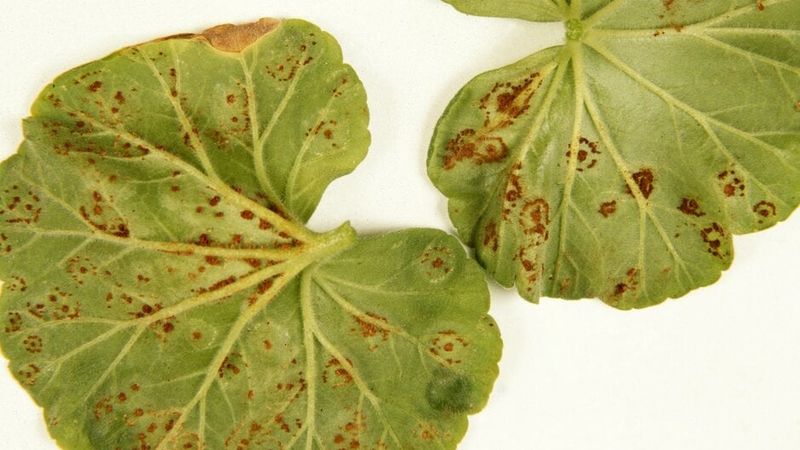
Start by picking a few leaves that look discolored and turning them over. NC Cooperative Extension’s Beaufort County article describes the characteristic pattern as small yellow or yellow-green spots on the upper leaf surface.
As those spots enlarge, they can shift toward orange, reddish-brown, or necrotic coloring. The feature that most strongly points toward rust rather than something else is what you find on the underside: raised, powdery, rust-colored or brown pustules that contain fungal spores.
University of Maine Extension’s plant disease image library for fig rust shows this underside pustule pattern clearly and is worth reviewing before you make a judgment call in your own yard.
Several other conditions can produce overlapping symptoms. Sunburn creates bleached or tan patches, usually on sun-facing surfaces.
Sooty mold produces a dark, smudgy coating rather than discrete spots. Fig mosaic virus causes irregular mosaic-patterned discoloration that does not match the spot-and-pustule pattern.
Arkansas Extension’s fig rust disease note and Virginia Cooperative Extension’s small fruit disease guide both note that other leaf-spot diseases and environmental damage can resemble rust closely enough to cause confusion.
If you see yellow-to-orange spots on upper surfaces combined with raised rust-colored pustules underneath, you have a pattern consistent with fig rust. If the symptoms remain ambiguous, or if you are considering a treatment decision based on what you find, contact your local NC Cooperative Extension office or submit a sample to the NC State Plant Disease and Insect Clinic.
Visual inspection in the yard, even careful inspection, is not a substitute for a confirmed diagnosis when the stakes are higher.
Defoliation can weaken the season without usually killing the tree
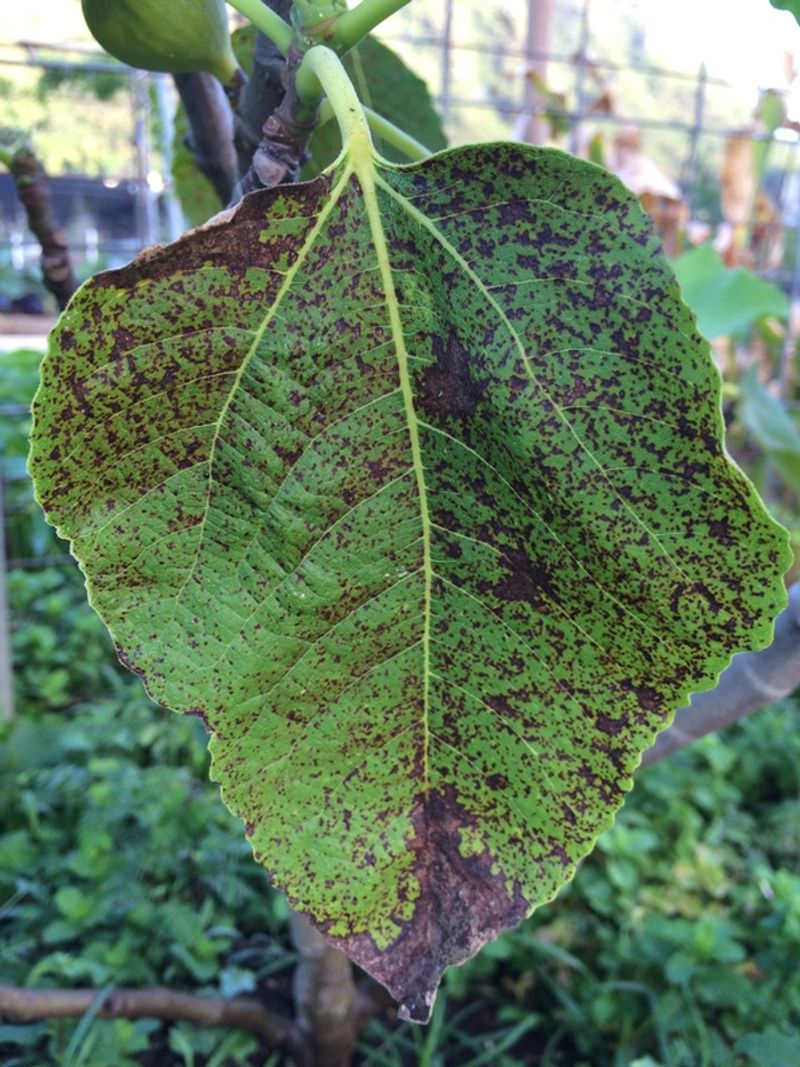
Fig rust rarely kills a mature tree outright, and that reassurance is worth holding onto when you are staring at a tree that has dropped half its leaves by September. Multiple Extension sources describe the disease as serious but not typically fatal.
Understanding what rust actually does to the tree, though, helps explain why confirmed or strongly suspected infections deserve a practical response even without a crisis-level reaction.
The disease attacks leaves rather than fruit directly. Heavy infection causes the tree to lose its photosynthetic capacity earlier than it should, and NC Cooperative Extension’s Beaufort County guidance notes that defoliation can occur within about three weeks after the first yellow spots appear.
That is a fast timeline, and a tree that loses most of its canopy in late summer has less time to build the carbohydrate reserves it will draw on during winter dormancy and spring regrowth.
UGA Extension’s home garden fig guide and UGA Extension’s Colquitt County homeowner post on fig leaf drop both note that while rust targets leaves, significant or repeated defoliation can reduce plant vigor. The practical consequences may show up as reduced fruit size, lower fruit quality, or disrupted fruit development and maturation the following season.
A USDA fig production handbook similarly connects sustained defoliation to reduced tree performance over time. A single bad September does not necessarily doom your harvest, but a tree that loses its leaves to rust year after year without any management response is likely to perform below its potential.
Keeping that risk proportionate is the goal: take the disease seriously enough to act, without treating it as an emergency that requires drastic measures.
Remove infected leaves and fallen litter from the growing area
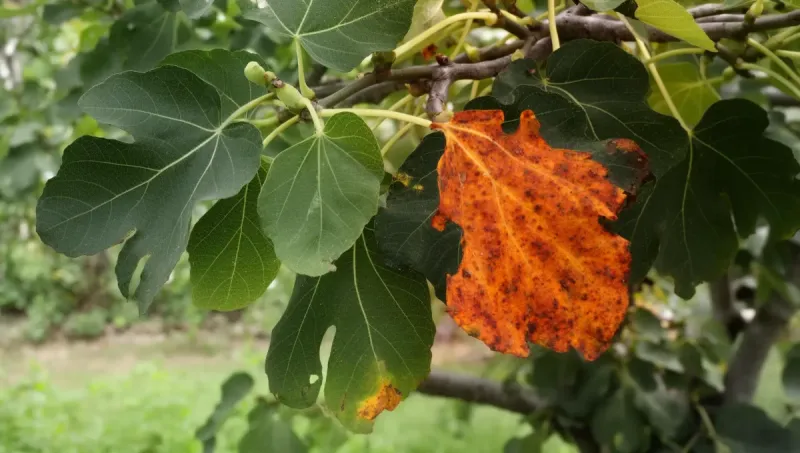
Sanitation is the most consistently supported action for a North Carolina homeowner dealing with rust in September, and it starts at ground level. Before you do anything else, walk around the base of the tree and rake up every fallen leaf you can find.
Fallen foliage from an infected tree carries fungal spores, and leaving it in place underneath the tree keeps that material close to the root zone where next season’s cycle can begin.
NC Cooperative Extension’s Beaufort County article on fig rust specifically recommends removing and disposing of affected leaves, noting that raking and removing infected foliage may be more effective than fungicide applications in many situations. UGA Extension’s Colquitt County homeowner page and UGA’s home garden fig publication both recommend collecting infected leaves from beneath the tree in fall as a standard management step.
After clearing the ground, remove visibly infected leaves that are still attached to the tree. Pick them off by hand or use clean pruners if needed, working methodically through the canopy.
Do not shake branches over the ground to speed things up, since that can scatter spores across a wider area.
Disposal matters as much as removal. Do not place visibly infected leaves in an ordinary backyard compost pile unless you are confident the pile consistently reaches the temperatures needed to kill fungal material.
Penn State Extension’s guide to figs in the home garden advises collecting and destroying fig rust debris rather than composting it. Bag the material in yard-waste bags and dispose of it according to your local waste management rules.
Open burning is regulated in most North Carolina counties and should not be assumed as a casual disposal option. Sanitation is a prudent step that may reduce disease-conducive debris around the tree, though it does not come with a promise that rust will not return next season.
Improve airflow without making drastic September cuts
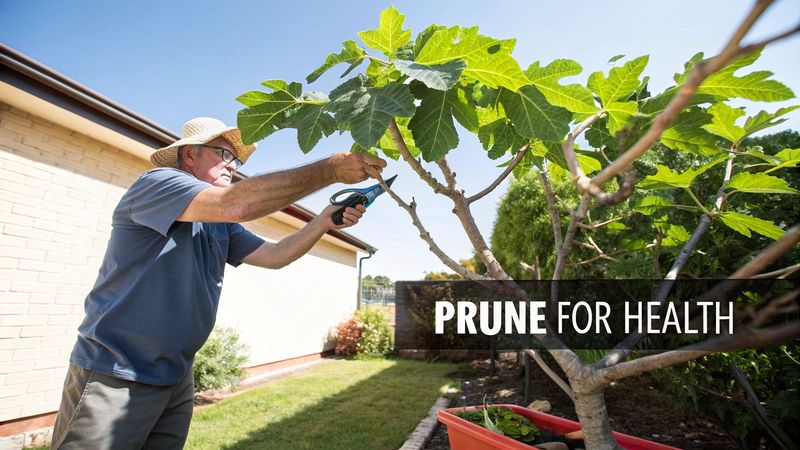
Airflow through the canopy affects how quickly leaves dry after rain or heavy dew, and wet leaf surfaces are more hospitable to fungal spores. Opening up a congested fig canopy where practical is a reasonable cultural step, but the word “modest” carries real weight here.
September is not the time to reshape the tree structurally, and no amount of pruning will reverse lesions that have already formed.
NC Cooperative Extension’s Beaufort County guidance mentions improving airflow as a cultural measure alongside sanitation, framing it as a supporting action rather than a primary treatment. Virginia Cooperative Extension’s small fruit disease guide similarly lists canopy management as part of an integrated approach to fig rust, not as a standalone fix.
In practice, modest airflow improvement means removing branches that are crossing and rubbing against each other, cutting out shoots that are growing directly into the center of the canopy, and thinning a few crowded spots so light and air can move through more freely. This kind of light maintenance is different from a major structural pruning session.
Heavy late-season cuts on a fig that has already been stressed by rust and early defoliation can add more strain at a time when the tree has limited reserves to recover.
If your fig is planted against a fence, a wall, or another structure that traps humidity, consider whether there are simple ways to increase air circulation around the plant without moving it. Clearing nearby vegetation that crowds the lower canopy can help.
These are supporting measures that work alongside sanitation, not replacements for it, and they will not eliminate rust from the yard on their own.
Preventive protection usually starts before September
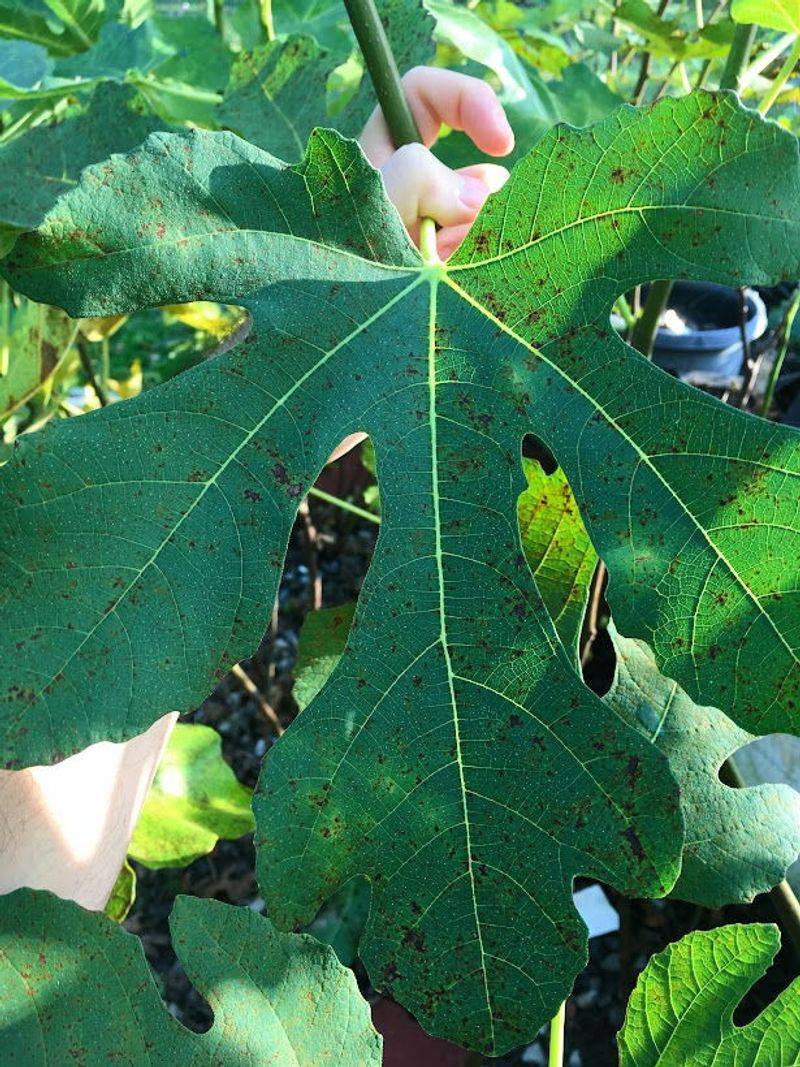
Fungicide protectants work by forming a barrier on leaf surfaces before fungal spores land and germinate, or very early in the infection process before the pathogen has established itself. Once rust lesions are visible, the chemistry that might have stopped them has already missed its moment.
That is a critical point for any homeowner who is tempted to reach for a spray bottle in September after spotting yellow spots on their tree.
Arkansas Cooperative Extension’s plant health clinic note on fig rust recommends applying neutral copper when the first leaves reach full size, generally in May or early June, with a second application about three to four weeks later. The logic is straightforward: new foliage is the most vulnerable tissue, and getting protection on those leaves early gives the material its best chance to prevent infection rather than try to stop it after the fact.
A USDA fig production handbook describes a similar approach, recommending applications to newly expanded leaves and repeat treatments at three-to-four-week intervals as the season progresses. The emphasis in both sources is on protecting tissue before it gets infected, not on treating established disease.
A 2025 peer-reviewed study on fig leaf susceptibility to rust found that younger leaves were more vulnerable to infection than older leaves, which directly supports the logic of early-season protective applications. The study’s findings reinforce May or early June as the window when preventive decisions are most likely to matter, not September.
Fungicide registrations and recommendations change as products are updated or withdrawn, so always check current guidance before purchasing or applying anything.
Check the current label before considering any pesticide
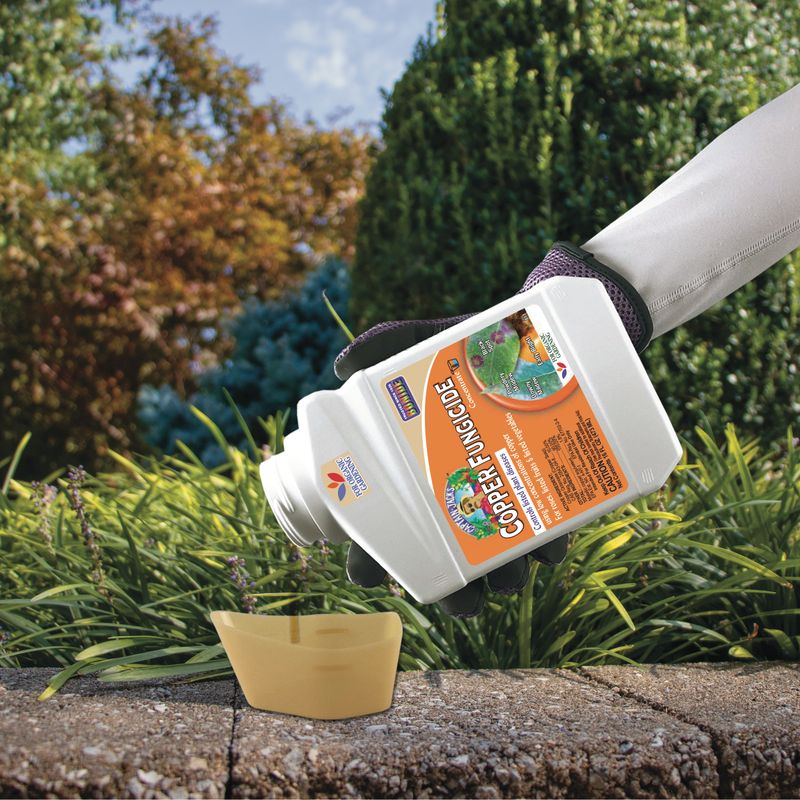
Pesticide labels are legal documents, and the label on the product you are holding controls what you are allowed to do with it. That principle matters especially for fig rust, where the available options are limited and the rules around what is actually registered for use on backyard figs are not always clear-cut.
Before you buy or apply anything, you need a product whose current label specifically permits use on figs and addresses the target disease or use site.
NC Cooperative Extension’s 2024 Beaufort County article on fig rust is direct on this point: at the time of publication, no fungicides were specifically labeled for fig rust in North Carolina. That does not mean no options exist anywhere, but it does mean you cannot assume that a copper product labeled for other fruit trees or vegetables will cover your fig legally or safely.
NC State Extension’s pesticide safety guidance requires users to follow the label on application rates, timing, reentry intervals, and preharvest waiting periods. NC State’s home orchard disease and insect management resource reinforces that requirement for residential fruit-growing situations.
Copper products, which some Extension sources discuss as a preventive option, carry their own risks. Copper can injure foliage and fruit, particularly when applied under stress conditions, at incorrect rates, or more frequently than the label permits.
The North Carolina Agricultural Chemicals Manual is a current reference for checking registered products and their approved uses in the state.
A September spray will not restore leaves that already carry established rust lesions. If you are past the preventive window, the most effective actions available to you are the sanitation and airflow steps described earlier, not a last-minute chemical application.
Save the fungicide research for late winter, when you can confirm current registrations and plan a properly timed early-season program for next year.
Use September findings to plan earlier scouting next year
Whatever you find on your fig tree this September, write it down. Record the date you first noticed symptoms, how many leaves were affected, whether the tree had already dropped foliage, and which parts of the canopy showed the most damage.
That information is worth more than it might seem right now, because it gives you a reference point for watching the same tree more closely when conditions are right next spring.
NC Cooperative Extension’s Beaufort County fig rust article and Arkansas Extension’s fig rust disease note both point toward early-season vigilance as the period when preventive decisions carry the most weight. Start checking newly expanding leaves in spring as soon as the first flush reaches full size, typically around May or early June in most parts of North Carolina.
That is when a preventive application, if you have confirmed a currently labeled product and want to pursue that route, would have its best chance of actually preventing infection rather than chasing it.
The sanitation work you do now, bagging infected leaves and clearing fallen litter from beneath the tree, is a prudent step that may reduce the amount of disease-conducive debris near your tree going into winter. Penn State Extension’s fig home garden guide supports removing and disposing of rust debris as a standard fall practice.
No cleanup routine guarantees a rust-free season next year, but leaving infected material in place removes any chance of reducing it. The fig tree that gets the most attention in May will likely have a better September than the one that only gets noticed when the leaves start falling.