
If Dragonflies Patrol Your Garden Pond, Here’s The Missile-Grade Math Their Rice-Sized Brain Runs
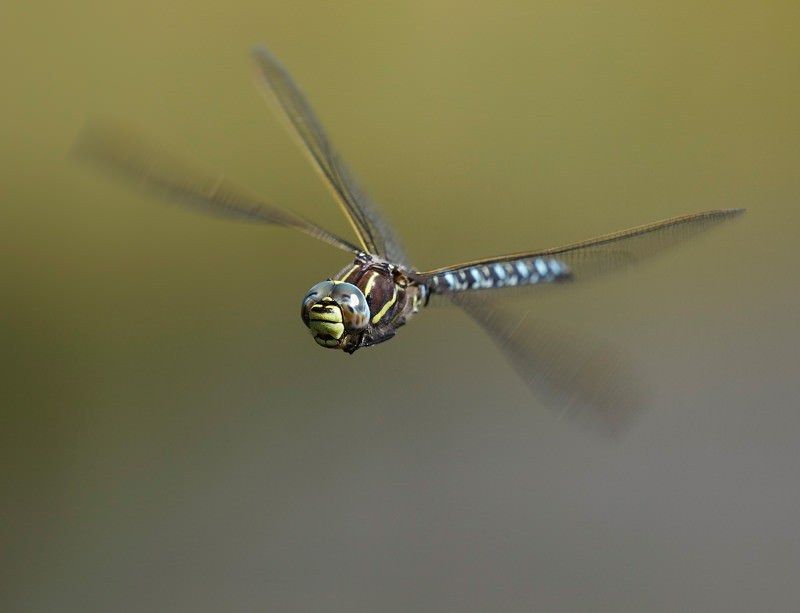
Watch a dragonfly long enough from a pond’s edge and you’ll catch something almost unbelievable: it launches before its target is anywhere near reachable, and somehow the two meet in midair. That isn’t luck or reflex alone.
Researchers studying high-speed flight have found that dragonflies steer toward where a prey insect is going to be, not where it is right now, using a control strategy that engineers compare to guidance geometry in aerospace systems. The “missile-grade math” and “rice-sized brain” in the title are vivid metaphors, not literal biology, and this article explains what the science actually shows and why it still makes your backyard dragonfly worth watching.
The pond patrol is an interception, not a chase
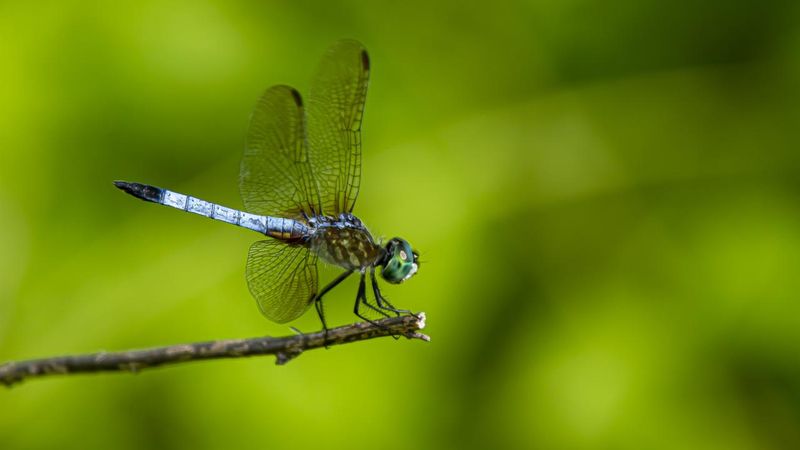
A dragonfly rests on a cattail stem at the pond’s edge, abdomen tilted slightly upward, compound eyes sweeping the airspace above the water. A small fly crosses maybe two feet away, angling diagonally.
Before the fly completes that arc, the dragonfly is already airborne, and half a second later the two animals meet at a point neither of them occupied when the chase began.
That meeting point is the key to understanding what makes dragonflies such capable hunters. A simple pursuer, one that just chases where the prey is right now, falls behind every time the prey changes speed or direction.
It is always correcting for the past. A dragonfly does something different: it calculates a likely future location and flies there instead, arriving at the interception point as the prey arrives from its own path.
Field and laboratory tracking work on prey pursuit and interception showed that dragonflies steer toward a meeting point rather than simply trailing behind. Later modeling research confirmed that this predictive steering accounts for much of the flight path seen in a typical hunt.
The result is a trajectory that looks almost geometric from above, a smooth curve converging on where the prey will be.
Nothing about that behavior requires conscious planning, and the phrase “missile-grade math” in this article’s title is a metaphor pointing at a resemblance in guidance geometry, not a claim that dragonflies solve equations or share hardware with aerospace systems. What the research does support is that a small flying insect with a compact nervous system runs a control strategy sophisticated enough that aerospace engineers have found it worth modeling.
That is the real surprise waiting at your garden pond, and the sections ahead unpack how it works.
What does the dragonfly actually aim at?
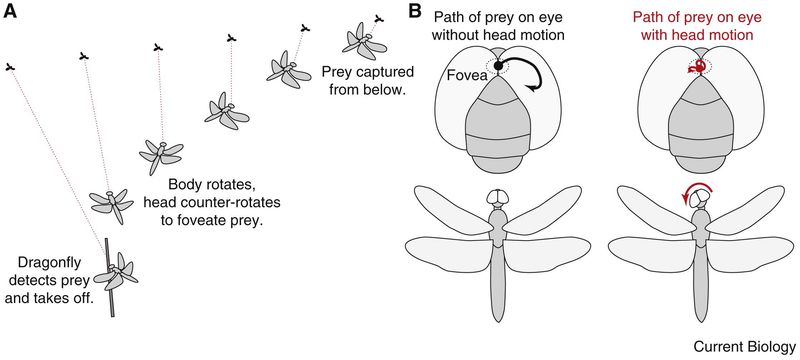
Forget the image of a predator sprinting straight at its target. A dragonfly’s steering strategy is more like a chess player thinking two moves ahead: it picks a square on the board where both pieces will arrive at the same time, then moves there.
The mechanism behind this involves something called retinal image stabilization. As a dragonfly adjusts its flight path, it works to keep the prey’s image as still as possible on its retina.
If the prey’s image drifts to the left across the eye, the dragonfly steers left to bring it back. If it stays nearly fixed, the dragonfly is already on a converging course.
Holding that image steady is mathematically equivalent to flying toward an interception point, because the only way to keep a moving target’s image from sliding across your eye is to be heading toward the same spot the target is heading toward.
Contrast that with a naive chase. A pursuer that always flies directly at the prey’s current position traces a curved path that lengthens the chase, wastes energy, and often fails when the prey changes direction.
The dragonfly’s strategy, by aiming at the future position, produces a shorter and more efficient flight path.
Research on prey pursuit and interception in dragonflies documented this behavior through high-speed tracking of actual hunts, finding that the insects consistently steered toward an interception point rather than trailing the prey’s current location. A broader review in a comprehensive survey of dragonfly and damselfly flight confirmed that this approach has been observed across multiple species and experimental setups.
The strategy works because it converts a moving-target problem into something simpler: hold a visual angle steady and trust that the geometry does the rest. No symbolic reasoning required, just a nervous system tuned to keep one tiny image from sliding away.
The calculation lives in neural circuits, not tiny arithmetic
When people hear that a dragonfly “calculates” where prey will be, the tempting picture is a tiny brain running numbers like a pocket computer. The biology is stranger and more interesting than that.
A dragonfly’s visual system is built for exactly this job. Its large compound eyes cover nearly the full sphere of space around its head, and the neural hardware behind those eyes can isolate a single small target moving against a cluttered background of waving leaves and rippling water.
Special neurons respond to small, dark, moving objects while largely ignoring background motion, a filtering trick that lets the insect lock onto a fly without being confused by wind-blown reeds.
A study published in PNAS identified 16 target-selective descending neurons in the dragonfly that encode the direction of a prey item and relay that information from the brain toward the wing motor centers. These neurons do not constitute the entire hunting system, and many other neurons participate in detection, tracking, and flight control.
But the finding illustrates how dedicated neural hardware can carry precise directional signals from eye to wing with very little delay.
The predictive side of the behavior has its own neural signature. Research published in eLife found that certain visual neurons respond preferentially to a target’s expected future position, firing ahead of where the target actually is based on its recent motion.
That is a neural-level sign of predictive processing, not conscious forecasting, but a tuned response that anticipates where the target will appear next.
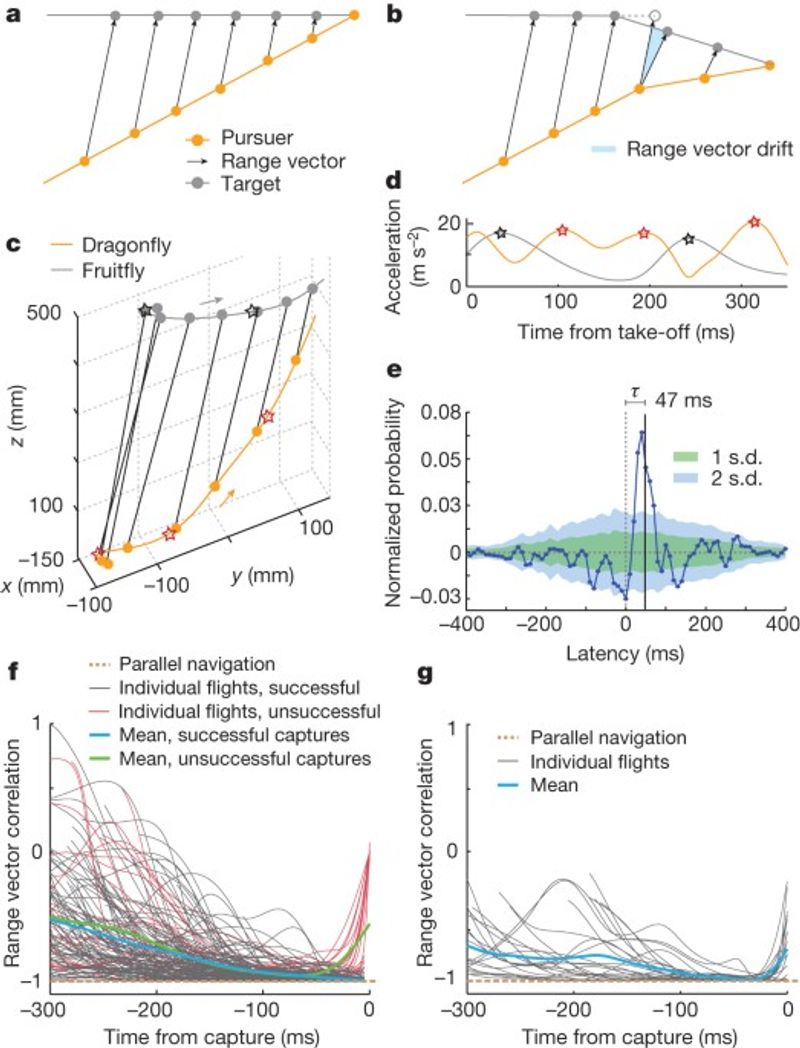
Steering during a hunt is not purely predictive, though. Modeling work published in Nature found that internal models of prey motion and the dragonfly’s own body dynamics account for much of the steering, while visual feedback steps in to correct course when prey moves unexpectedly.
Prediction leads; feedback follows. Together they produce the smooth, efficient interception paths seen in high-speed recordings, without any symbolic arithmetic happening anywhere in the process.
Why the missile comparison works—and where it breaks
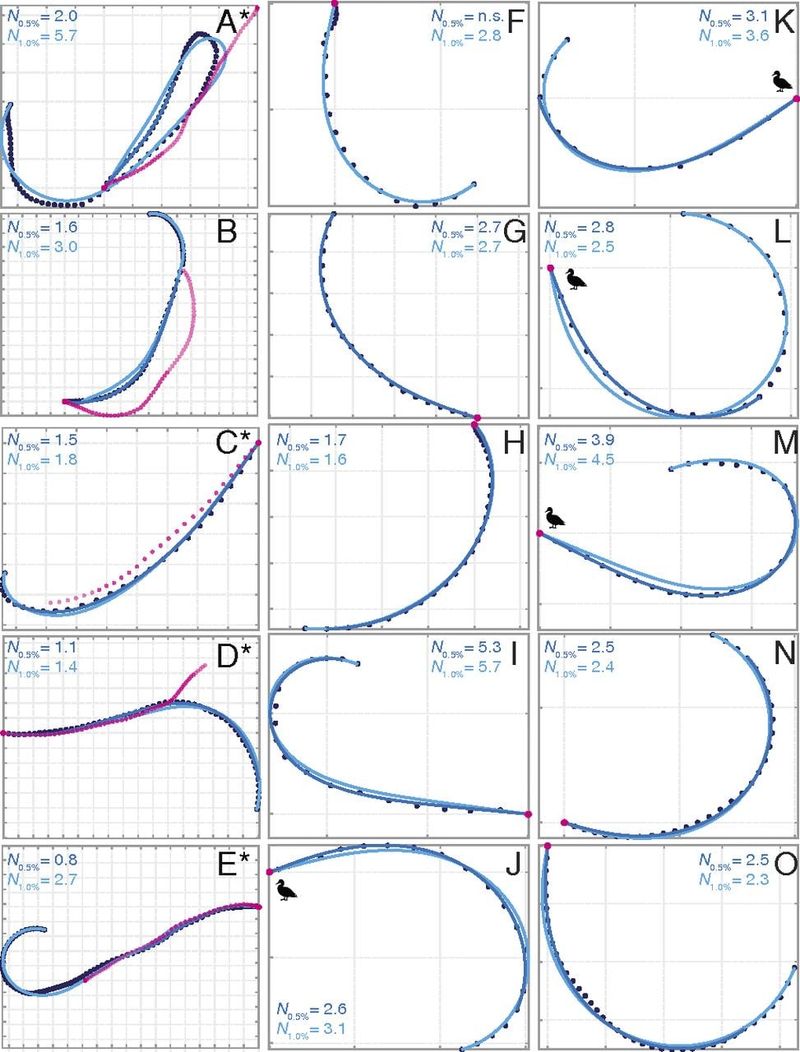
Proportional navigation is a guidance strategy used in certain missile and aerospace systems. The core idea is simple: the pursuer adjusts its own heading in proportion to how fast the line-of-sight to the target is rotating.
If the target appears to be drifting left across the pursuer’s field of view, the pursuer turns left to cancel that drift. Keep the line-of-sight angle from rotating, and the two objects will converge at an interception point.
That geometry matches what dragonflies appear to do. When researchers modeled dragonfly interception flights mathematically, the trajectories aligned with proportional-navigation-style guidance laws, and reviews of dragonfly and damselfly flight note this resemblance explicitly.
Engineers at national laboratories have taken the comparison seriously enough to use dragonfly interception as a starting point for their own guidance research, with one Sandia National Laboratories report and related follow-on work drawing on biological interception models.
Where the comparison breaks is in the details. A missile uses electronic sensors, onboard computers, actuators, and a specific mathematical implementation of a guidance law.
A dragonfly uses compound eyes, neural circuits, and muscle-driven wings. The shared feature is the geometric outcome: both pursuers can converge on a moving target by minimizing line-of-sight rotation.
The underlying hardware, algorithms, and architectures are entirely different.
Saying a dragonfly uses “the same math as a missile” overstates the case. Saying its interception geometry resembles proportional navigation is accurate and genuinely interesting.
The comparison earns its place in science writing because it translates a biological behavior into a framework engineers already understand, not because it implies military computation running inside an insect.
The 90–95% figure describes selected captures, not every hunt
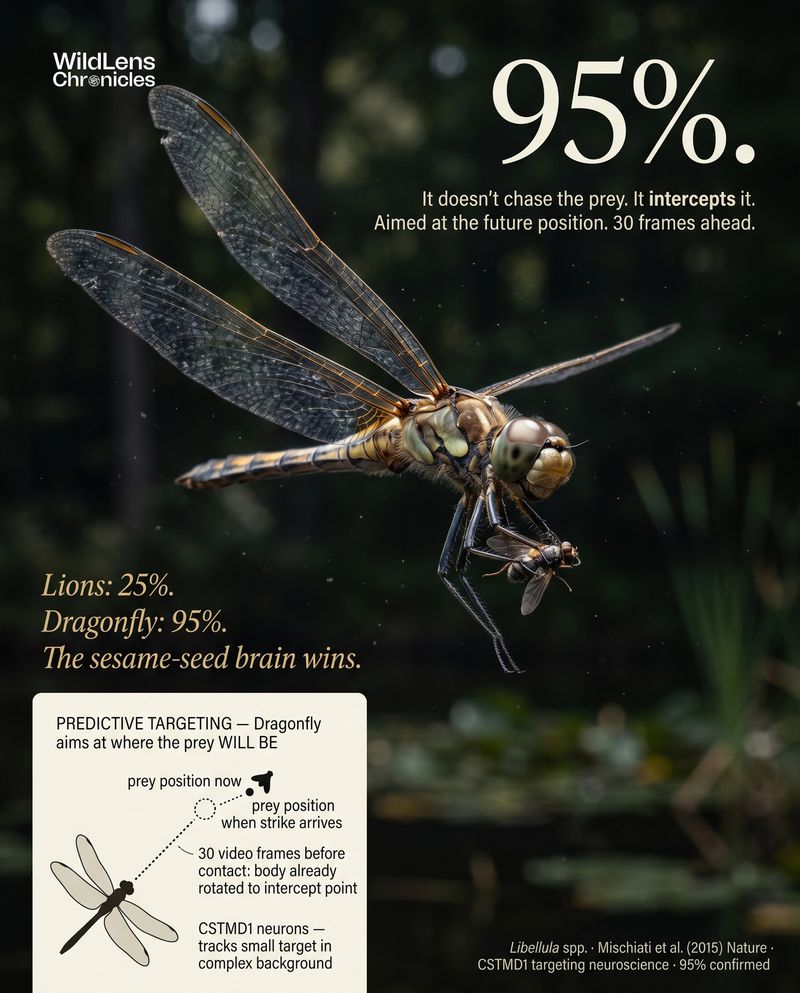
High capture rates are real, but the numbers need their context to mean anything. A 2013 controlled study of four libellulid species pursuing fruit flies reported average capture-success rates of 91.9% for ruby meadowhawks, 97.1% for blue dashers, 89.5% for spangled skimmers, and 93.1% for painted skimmers.
Those are striking numbers, and they come from carefully designed trials where researchers could observe each pursuit from start to finish.
The same study found that success and efficiency both declined as prey size increased, which tells you the numbers are not fixed properties of dragonflies in general. Change the prey, change the result.
A broader look at the literature, summarized in a review of dragonfly capture success and pursuit behavior, puts the range for percher-style dragonflies at roughly 83% to 97%, with variation tied to species, prey type, and study design.
What those percentages actually measure matters just as much as the values themselves. The flight-survey literature notes that many studies count only the pursuits that researchers observed or deliberately induced, often in laboratory settings, wind tunnels, or semi-controlled outdoor enclosures.
That means the denominator in the success calculation is “pursuits we watched,” not “every hunting attempt the dragonfly made that day.”
Missed detections don’t get counted. A prey item the dragonfly never noticed, a pursuit abandoned before it started, a target that escaped before the dragonfly committed to a flight path, none of those appear in the capture-success tally.
So “97% capture success” describes a very specific thing: when a blue dasher in a controlled trial committed to chasing a fruit fly, it caught the fly 97 times out of 100. That is genuinely impressive.
It is not a promise about every dragonfly in every backyard under every condition.
A garden pond can support more than the adult you see

The dragonfly patrolling your pond is just the visible tip of a longer story. Most of a dragonfly’s life unfolds underwater, where the larval form, called a naiad, hunts smaller aquatic organisms and grows through a series of molts that can span one to several years depending on the species.
National Park Service guidance on dragonfly larvae describes naiads as active freshwater predators that need clean, vegetated water to survive and develop.
Seeing an adult hover over your pond does not confirm that naiads are living below the surface. Adults visit ponds to hunt, defend territory, find mates, and lay eggs.
Repeated sightings of emerging adults, or direct observation of naiads, give stronger evidence that a pond is actually functioning as breeding habitat rather than just a hunting perch.
Penn State Extension’s guidance on attracting dragonflies to backyard ponds points to several features that make a pond more welcoming: shallow or gently sloping margins where naiads can move between depths, aquatic and marginal plants that provide cover and egg-laying sites, emergent stems and rocks that emerging adults can climb, and nearby shrubs or tall plants where adults can perch between hunts. A pond that satisfies all of those tends to attract and hold dragonflies more reliably than a deep, steep-sided, vegetation-free basin.
Fish complicate the picture significantly. Many fish species eat dragonfly eggs and naiads, which can prevent successful reproduction even in a pond that looks otherwise suitable.
National Wildlife Federation coverage of dragonfly habitat supports the general principle that fishless ponds tend to be more productive for dragonfly breeding. Penn State’s broader water-for-wildlife resource reinforces that point while noting how pond design choices ripple through the full aquatic community.
A pond with fish can still attract hunting adults, but if supporting the full life cycle is the goal, keeping fish out gives naiads a much better chance.
Dragonflies may help with mosquitoes, but they are not a control plan
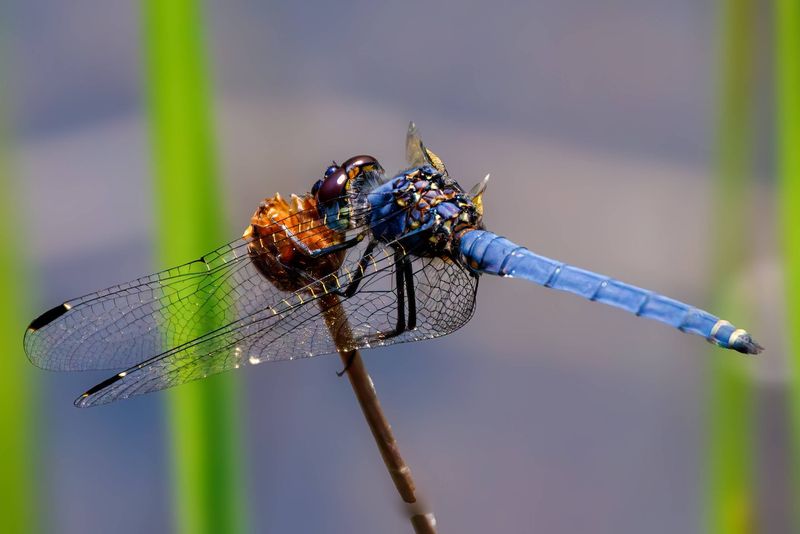
Dragonfly larvae do eat mosquito larvae, and the evidence for that is solid. A 2023 meta-analysis covering 31 experimental studies found that a single odonate naiad consumed an average of roughly 40 mosquito larvae per day and reduced larval populations by about 45% per day in experimental containers.
Those are meaningful numbers from controlled conditions, and they justify describing dragonfly naiads as potential contributors to mosquito suppression.
The gap between “experimental container” and “backyard pond” is wide, though. A wildlife pond also provides habitat for other aquatic life, including mosquito larvae that find the vegetation and shallow edges just as hospitable as naiads do.
Adding a pond does not subtract mosquitoes from your yard; it adds complexity, and the net effect on your local mosquito population will depend on water quality, species present, weather, and what other water sources exist nearby.
For actual mosquito management, CDC guidance on mosquito control at home is direct: empty, scrub, cover, or remove any artificial containers that hold water at least once a week. Flower pot saucers, birdbaths, buckets, and clogged gutters are far more productive mosquito nurseries than a well-planted pond, and eliminating them has a faster and more predictable effect than hoping for dragonfly predation.
Where water cannot be removed or covered, CDC larvicide guidance recommends using a labeled product according to its instructions.
One more caution applies to any gardener tempted to treat a mosquito problem with broad insecticide sprays near the pond. EPA documentation on insecticides in aquatic systems notes that these compounds enter water through spray drift and surface runoff, where they can harm the full aquatic community, including the dragonfly naiads you are trying to support.
Any pesticide or larvicide used near a pond must be applied strictly according to its label and any applicable environmental restrictions. Dragonflies can be part of a healthy yard’s ecology without being asked to carry the entire burden of mosquito control.
Watch the patrol as a living guidance system
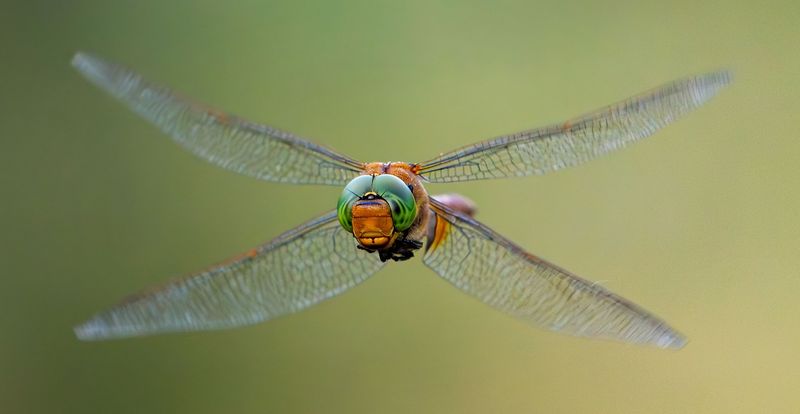
Standing at your pond’s edge and watching a dragonfly work is a chance to see something that took researchers decades to describe. Every launch, every curving approach, every midair catch reflects a system built from predictive visual processing, neural target encoding, body dynamics, and rapid feedback correction, all running simultaneously in an insect that weighs less than a paperclip.
The Nature modeling study that helped clarify how dragonflies blend internal prediction with visual feedback, and the PNAS work identifying target-selective descending neurons, together paint a picture of a hunting system that is distributed, fast, and tuned over millions of years for exactly this task. The missile analogy names a real geometric resemblance, not a shared blueprint, and the impressive capture rates in the literature belong to specific species in specific studies, not to every dragonfly on every hunt.
For a gardener, the practical takeaway is modest and achievable. Providing good pond habitat, keeping pesticides away from the water’s edge, and handling artificial containers with CDC-recommended discipline gives dragonflies a better chance to complete their full life cycle near your yard.
The reward is not a mosquito-free summer, but a front-row seat to one of the most precisely engineered hunting behaviors in the animal world, playing out in real time a few feet from your garden bench.