
If You Dig Dandelions Out Of Your Lawn Every Spring, Here’s The 7,000-Unit Nutrient Factory You’re Throwing Away
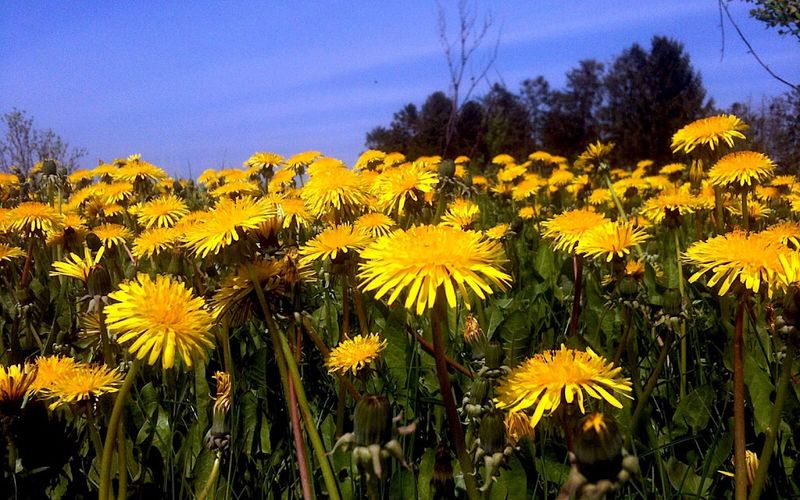
Every spring, millions of gardeners grab their weed pullers and go to war with dandelions, convinced they are doing their lawn a favor. But before you haul another bucketful to the curb, it is worth asking whether those yellow-flowered plants are actually as worthless as your lawn care routine assumes.
The “7,000-unit nutrient factory” label circulating online makes dandelions sound like buried treasure, and that claim deserves a straight answer. What you find out might not make you love dandelions, but it will help you make a smarter choice about what to do with them.
The “7,000-unit” number does not measure fertilizer
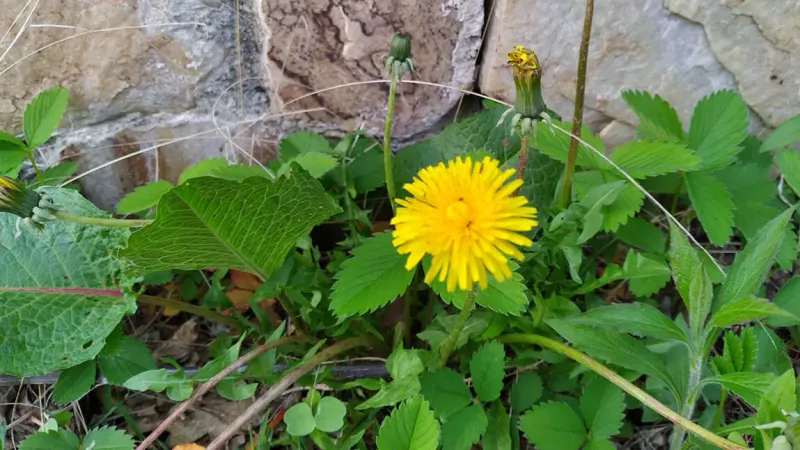
The phrase “7,000-unit nutrient factory” gets repeated across gardening blogs as though it settles the debate about dandelions, but the number itself is slippery. Nobody seems to have documented exactly where the slogan started, and the supplied research does not trace its origin either.
A reasonable hypothesis is that it came from an older nutritional claim that dandelion leaves contain 7,000 international units of vitamin A per ounce of raw greens. That figure, if it ever appeared in print, has since been overtaken by more detailed measurement.
The USDA Standard Reference Release 28 dataset reports approximately 10,161 IU of vitamin A per 100 grams of raw dandelion greens. Converting that to ounces gives roughly 2,880 IU per ounce, not 7,000.
Whether the older figure was rounded up, measured differently, or simply wrong is not clear from the available sources. The NIH Office of Dietary Supplements vitamin A database does not resolve the discrepancy either.
What both sources make plain is that the number, wherever it came from, measured a nutrient in leaves, not a quantity of fertilizer the plant produces for your soil.
Vitamin A content and fertilizer output are completely different things. A plant can be nutritious to eat and still contribute nothing to neighboring roots.
The “unit” in the slogan does not correspond to any fertilizer measurement, any mineral pumping rate, or any output that benefits your tomatoes or petunias. Treating 7,000 IU of vitamin A per ounce as proof that dandelions manufacture fertilizer is like saying a bag of spinach feeds your garden because it feeds you.
The numbers may have a legitimate nutritional story behind them, and that story gets told in a later section, but it has nothing to do with fertilizer factories.
A taproot explains persistence, not plant-to-plant fertilization
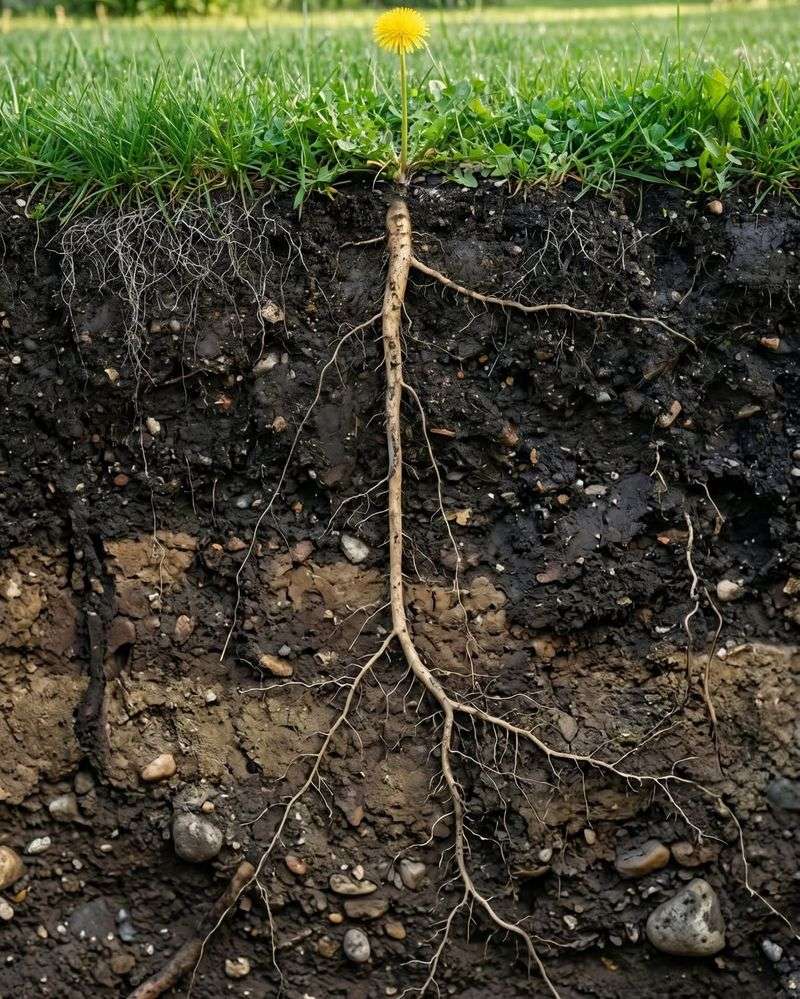
Pull a dandelion and you already know the taproot story firsthand. The root is thick, fleshy, and often snaps off several inches below the surface, leaving enough behind to regrow the whole plant by next spring.
University of Maryland Extension describes dandelion as a perennial broadleaf weed whose taproot survives winter and sends up new growth reliably each year. That persistence is exactly why hand-pulling feels futile unless you get the full root out.
A deep root can explore soil layers that shallow grass roots never reach, and dandelions do absorb minerals and trace elements from their growing conditions. A peer-reviewed study published in the Journal of Experimental Botany compared Taraxacum officinale with other grassland species and found effects on soil pore structure in compacted-soil experiments.
That is genuinely interesting, but it is a long way from proving that dandelions in your backyard reliably break up hard residential soil or funnel minerals to the hydrangeas growing three feet away.
Root depth, nutrient uptake, and nutrient release to neighboring plants are three separate questions, and the research only answers the first two in limited contexts. A dandelion sitting in your lawn absorbs nutrients for its own growth.
Those nutrients stay locked inside the plant’s tissues until the plant decomposes. While it is alive, there is no documented mechanism by which it delivers calcium, potassium, or phosphorus to nearby roots.
Calling a deep-rooted plant a mineral pump for the rest of your garden skips several steps that the available evidence simply does not support.
The leaves contain real nutritional value
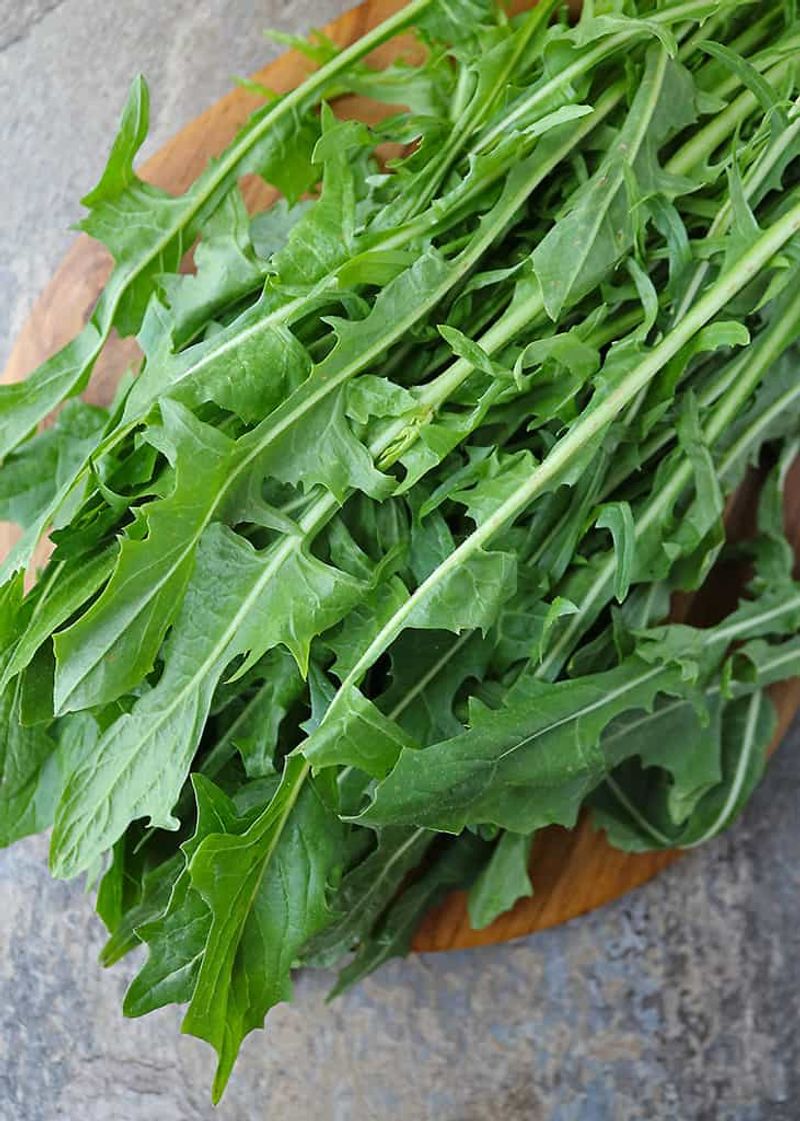
Strip away the slogan and dandelion leaves still have a legitimate nutrition story. The cited USDA SR28 dataset puts raw dandelion greens at approximately 45 calories per 100 grams, with 2.7 grams of protein and 3.5 grams of dietary fiber.
Mineral content is notable: 187 milligrams of calcium, 3.1 milligrams of iron, 36 milligrams of magnesium, and 397 milligrams of potassium per 100 grams. Vitamin A comes in at roughly 10,161 IU per 100 grams, which is meaningful by any reasonable standard, even if it falls short of the 7,000-per-ounce figure that circulates online.
Those are values for raw leaves, not roots, dried powder, tea, or a whole plant averaged together. Age, growing conditions, soil quality, and the methods used to build the database all affect the final numbers, so treat them as a useful estimate rather than a precise guarantee.
Oregon State University Extension notes that dandelion leaves, flowers, and roots have traditionally been eaten, with young spring leaves being the mildest. Older leaves turn bitter, which is why most culinary use focuses on early growth before the plant flowers.
Where the nutrition story ends is at the supplement aisle. The National Center for Complementary and Integrative Health reports that there is little research on dandelion’s health effects in humans and no compelling evidence supporting it for any specific health condition.
Dandelion may also interact with certain medications and can cause reactions in people sensitive to related plants such as ragweed. Eating a few fresh leaves from a clean garden site is a different matter than relying on supplements or teas for health benefits, and those two uses should not be treated as the same thing.
Living dandelions do not automatically fertilize the lawn
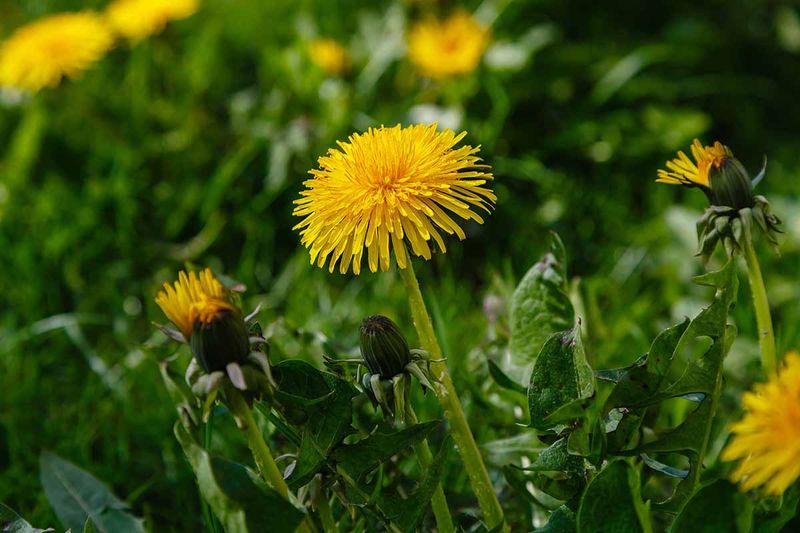
Here is the core gardening question, answered plainly: a dandelion growing in your lawn does not fertilize your tomatoes, petunias, or any other nearby plant simply by being there. Nutrients absorbed by the plant stay inside its tissues.
Pulling it out removes those nutrients from the soil unless you do something deliberate with the plant material afterward.
Chopped, uncontaminated dandelion material left on the surface or added to a compost pile can return some of those absorbed nutrients and organic matter to the soil as it breaks down. University of Florida IFAS Extension describes chop-and-drop as a way to turn plant waste into organic matter, and the same logic applies to dandelion biomass.
The key word is decomposition: nutrients recycle through breakdown, not through the living plant radiating minerals outward to its neighbors. University of Maryland Extension’s lawn guidance makes the same point about grass clippings, noting that returning organic matter to the soil is a recycling process, not nutrient creation.
Two firm rules apply before you chop and drop or compost anything. First, do not compost or spread dandelions treated with herbicides or pesticides unless the product label and your local guidance specifically allow it.
Herbicide residues can persist in plant material and may harm other plants when that material is returned to beds. Second, avoid returning seed heads to garden beds or compost piles.
Oregon State University Extension and the University of Maryland dandelion resource both flag prolific reseeding as a primary reason dandelions spread so effectively. Composting seed heads is an easy way to accidentally plant hundreds more.
Dandelions can accumulate elements from risky soil
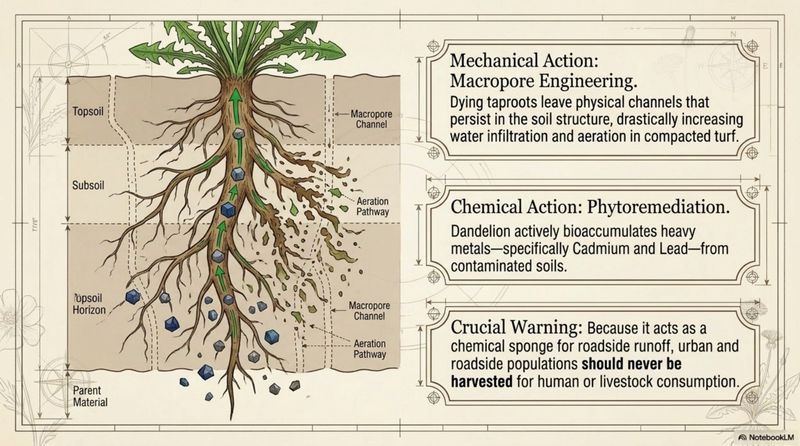
A plant that absorbs minerals efficiently can absorb the wrong minerals just as readily. Research published in a peer-reviewed environmental study found that dandelions accumulate trace elements including lead at levels that vary substantially by soil conditions and plant part.
That accumulation makes dandelions potentially useful as environmental indicators, meaning scientists can sample them to map contamination in a given area. For a backyard gardener planning to eat the leaves, it means the growing site matters as much as the plant itself.
A separate study on element accumulation in dandelions from different environments confirmed that lead and other heavy metals concentrate differently depending on location, with roadside plants showing elevated levels compared to plants from cleaner sites. Washing leaves removes surface dirt but cannot remove contaminants absorbed into the plant’s tissues during growth.
If the soil is contaminated, the plant grown in it carries that contamination internally, and no amount of rinsing changes that.
The practical rule is straightforward. Avoid harvesting dandelions from roadsides, highway medians, treated lawns, areas with a history of industrial use, old painted structures, or any site where the soil history is uncertain.
The same caution applies to composting: Oregon State University’s pest management resource and Oregon State Extension both advise against using plant material from treated or contaminated sites. Animal waste exposure adds another layer of concern.
A dandelion growing in a clean, untreated garden bed that has never been sprayed and sits well away from roadways is a very different thing from one growing at the edge of a parking lot.
Early flowers offer limited pollinator value
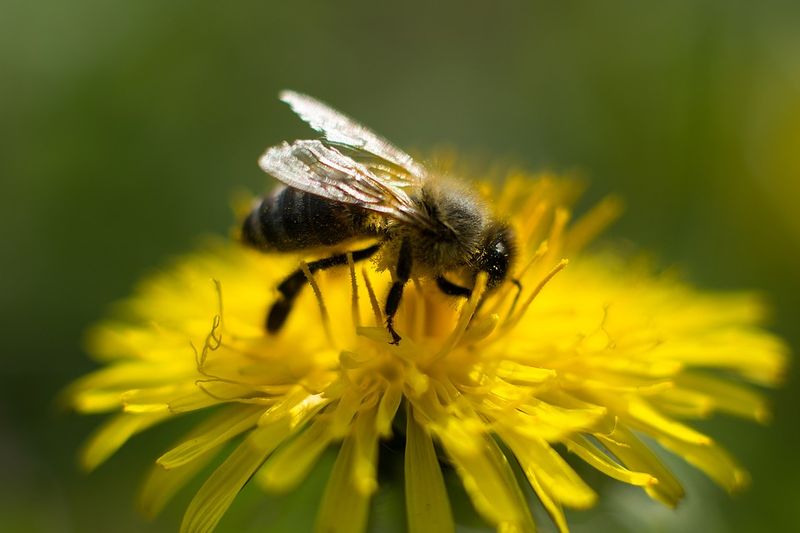
Dandelion flowers do offer something real to early-season insects, but the case for keeping them is more modest than pollinator advocates sometimes suggest. University of New Hampshire Extension explains that dandelions bloom early in spring when few other flowers are open, making them accessible to bees and other insects that need forage before the main season gets going.
That timing matters. Availability when alternatives are scarce is different from being the best option available.
The pollen quality piece is where the story gets more complicated. Dandelion pollen is considered nutritionally inferior compared to the pollen of many other flowering plants, including most native wildflowers.
University of Minnesota Extension notes that dandelions cannot substitute for a diverse planting of native species, which provide better nutritional variety across the entire season. Leaving dandelions alone does not replace the work of planting coneflowers, native asters, or other pollinator-friendly species.
A practical compromise is possible without turning your lawn into a meadow. Delaying mowing by a week or two in early spring lets the first flush of flowers open and close before you cut them.
Alternatively, leaving a small, contained patch in a low-traffic corner of the yard gives insects early access without surrendering the whole lawn. The tradeoff is honest: any dandelion allowed to flower will eventually set seed, and dandelions reseed aggressively.
Keep that patch small, mow or deadhead before seed heads form, and accept that some spread is inevitable if you choose this route.
Match your choice to the purpose of the lawn
Three evidence-aligned choices cover most backyard situations. First, harvest from the plant if your site qualifies: no herbicide or pesticide applications in at least the past season, no roadside proximity, no uncertain soil history, and no animal-waste exposure.
Young spring leaves from a clean, untreated garden bed are the safest candidates. Second, leave selected plants while managing seed spread by mowing or deadheading flowers before they turn to seed heads.
Third, remove dandelions when a uniform, weed-free lawn is the goal, and do it thoroughly.
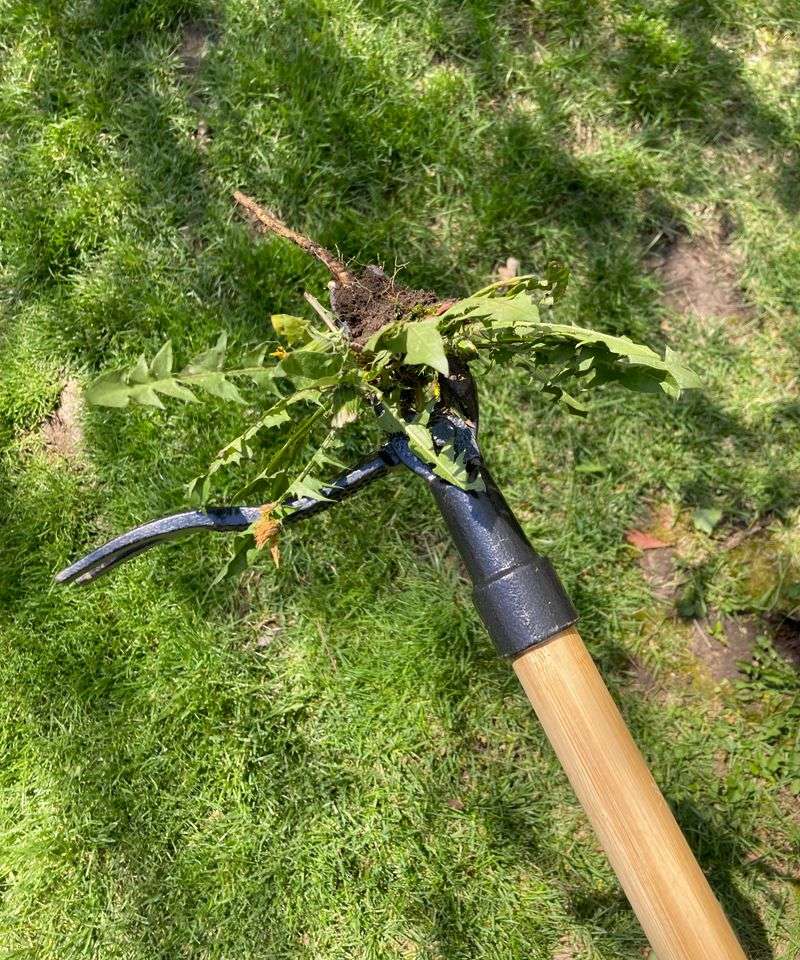
Hand removal works best when you get as much of the taproot as possible. A long-handled dandelion puller or a narrow-bladed weeding tool angled alongside the root gives you more leverage than pulling by hand.
Iowa State University Extension recommends removing plants before they flower and set seed, which reduces next year’s population. University of Maryland Extension adds that maintaining dense, vigorous turf is one of the most reliable long-term controls, because thick grass crowds out seedlings before they establish.
Herbicide use requires reading the label every single time. Broadleaf lawn herbicides can target dandelions without necessarily killing turf grasses, making them an option for lawns where hand removal is not practical.
Glyphosate is nonselective and will kill grass along with the weeds, so it is not suitable for broadcast lawn use. UC IPM guidance and Oregon State Extension both specify that herbicides must be labeled for the intended use, whether lawn, landscape bed, or vegetable garden.
Never apply a lawn herbicide to a vegetable or flower bed unless the label explicitly permits it. Plant material treated with any herbicide should not go into your compost unless the product label and local guidance specifically allow it.
The useful truth is smaller than the slogan
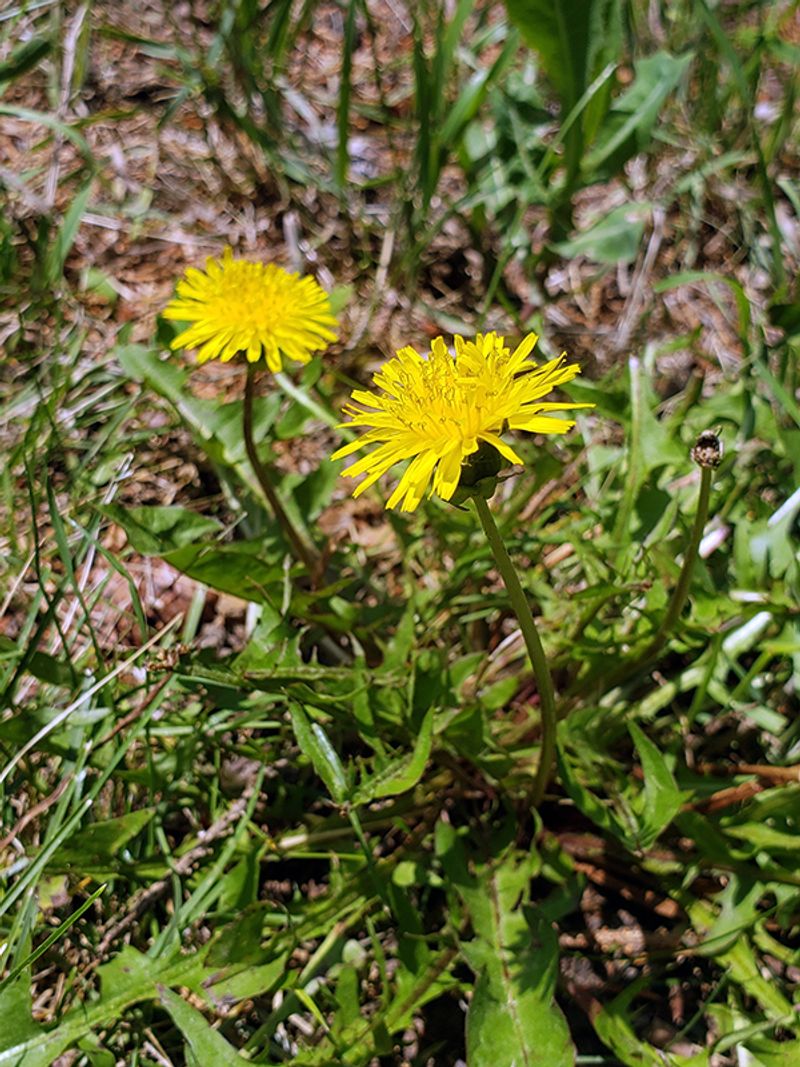
Dandelions are edible, nutrient-containing perennial plants with persistent taproots and early flowers that some insects visit in spring. That is a fair and honest description, and it is worth something.
What they are not is a proven 7,000-unit fertilizer factory, a mineral pump for neighboring plants, or a complete pollinator solution. The slogan made for a memorable headline, but it overstates what the plant actually does.
Every dandelion in your yard deserves a quick site assessment before you decide what to do with it. A plant growing in a clean, untreated bed is a candidate for harvesting or composting.
One growing beside a treated lawn edge or a roadside curb is not. University of Maryland Extension and its lawn management guidance consistently point toward site-specific decisions over blanket rules.
The USDA SR28 dataset confirms the nutritional reality for raw leaves without turning the plant into something it is not.
Eat it, leave a few blooms, compost the clean material, or pull it out entirely. All four choices are reasonable depending on your site and your goals.
A weed that earns a second look is still a weed you get to decide about on your own terms.