
Praying Mantis Egg Cases Turn Up On Your North Carolina Shrubs Because The Yard Fed Them All Season
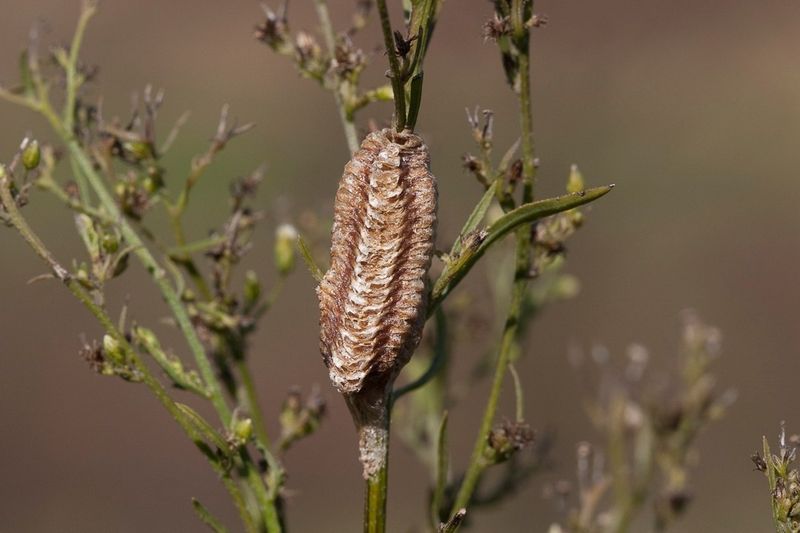
Finding a strange, papery blob attached to a shrub stem in your North Carolina yard can stop you in your tracks. That foam-like lump is a praying mantis egg case, called an ootheca, and it is a normal part of late-season insect life across the state.
Before you grab a stick to scrape it off, or start celebrating a pest-free garden next spring, there are a few things worth understanding about what it actually means and what to do next.
The fall case is an ootheca built for winter
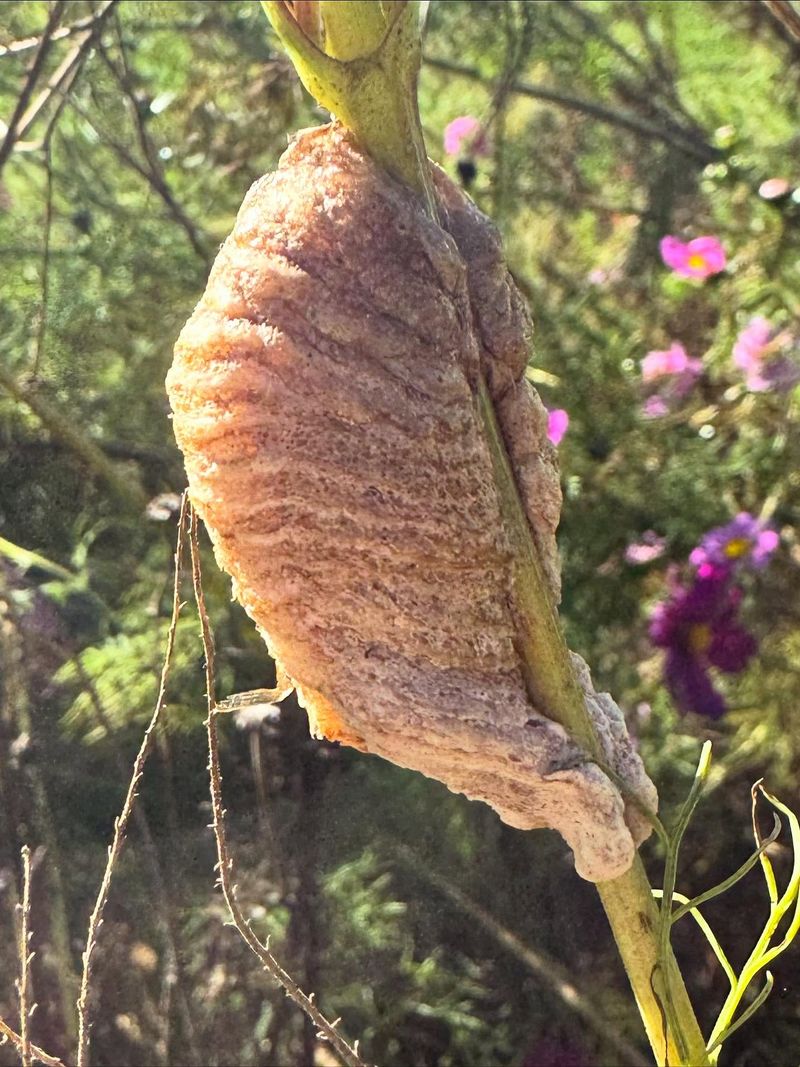
Sometime in late summer or fall, a female praying mantis found a suitable twig, stem, fence rail, or rock face and deposited her eggs there. She did not simply drop them loose.
She produced a frothy secretion around the egg mass, and that secretion hardened into the tough, spongy structure you are looking at now. The structure is called an ootheca, and published morphological research on mantid egg cases confirms that the hardened foam helps insulate the eggs and provides some protection against winter conditions and natural enemies.
The ootheca stays attached to whatever surface the female chose, and it stays there through winter. Adults die off in late fall, so there is no mantid guarding the case or returning to it.
The eggs are on their own until temperatures and day length signal spring. NC State Extension’s Carolina mantid profile describes this overwintering pattern as typical for mantids in the southeastern United States, including North Carolina.
Egg cases can appear on shrub branches, ornamental grasses, wooden fences, brick walls, and even the sides of buildings. The attachment site does not have to be a plant at all.
University of Illinois Extension’s fall mantis egg case guide notes that cases turn up on a wide range of outdoor surfaces, and hatching generally happens in spring or early summer.
The discovery is a routine seasonal event, not a warning sign or a trophy. A female used that spot to protect the next generation through winter.
What the spot tells you about your yard is a separate question, and the answer is more complicated than it might first appear.
What the shrub can—and cannot—tell you
A reasonable first reaction to finding an ootheca is to assume your yard must be full of insects and that mantises have been hunting there all season. That conclusion feels logical, but the egg case alone does not support it.
What the ootheca proves is that a female chose that location for oviposition, meaning she laid her eggs there. It does not prove she spent the entire growing season in your yard, that your shrubs hosted unusual insect diversity, or that your property fed mantids more reliably than your neighbor’s yard.
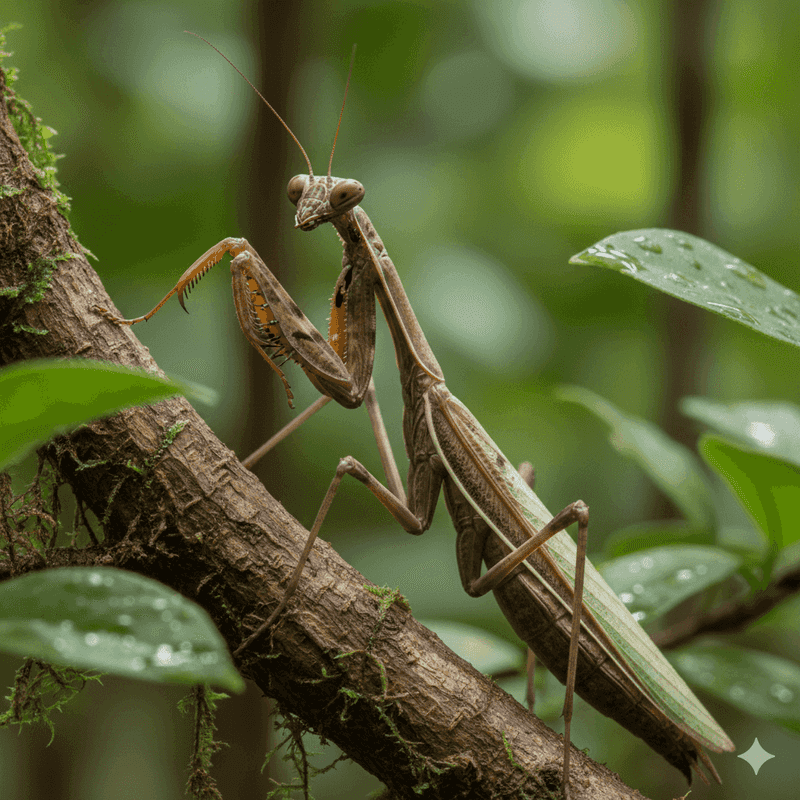
Habitat selection in mantids is shaped by more than prey availability. A study on stage-specific site selection in the mantid Tenodera aridifolia found that vegetation height, structural complexity, and leaf characteristics influenced where mantids occupied habitat at different life stages.
A separate review of decision-making and motor control in predatory insects reinforces that mantids rely heavily on visual camouflage and perch structure for ambush hunting, meaning the physical qualities of a plant can matter as much as the insects feeding on it.
Background color, stem diameter, shelter from wind, and microclimate may all factor into where a female deposits her eggs. A shrub that blends with the ootheca’s tan color, sits at a useful height, and offers some protection from the elements could be selected even in a yard with ordinary insect activity.
The case is evidence of a usable site, not a complete ecological report card on your property.
Treating the ootheca as proof of a thriving insect ecosystem can lead to unrealistic expectations. Your yard may well support a healthy range of insects, but that conclusion deserves more than one foam-covered twig to back it up.
Use the discovery as a prompt to observe and support your yard broadly, not as confirmation that the season went perfectly.
Identify the mantid before making a conservation claim
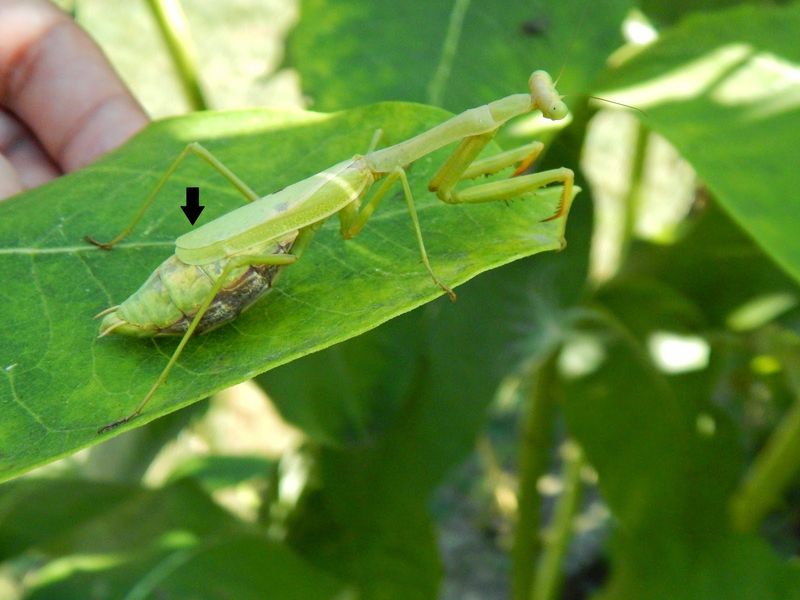
Not every praying mantis in a North Carolina yard is the native Carolina mantid, and not every egg case on your shrub belongs to a species with a local conservation story. North Carolina is home to at least four mantid species: the native Carolina mantid and three introduced species, including the Chinese mantid, the European mantid, and the narrow-winged mantid.
Knowing which one left the case matters before you frame the find as a native-species sighting.
According to NC State Extension’s Carolina mantid identification guidance, the native Carolina mantid is generally smaller, reaching about two inches in length. It is mottled gray, brown, or green, and its wings cover roughly two-thirds of the abdomen rather than the full length.
The faceplate, the flat area between the eyes, tends to be rectangular. The Chinese mantid is noticeably larger, with wings that reach the tip of the abdomen and a more square faceplate.
The European mantid carries a distinctive dark spot on the inside of the front leg near the body, which is the clearest single field mark to look for.
Egg cases can offer some clues, but they are not definitive. Chinese mantid oothecae tend to be larger and more rounded, while Carolina mantid cases are typically smaller and more elongated.
These are rough guides, not guaranteed identifiers, especially for a homeowner working from memory rather than a specimen in hand.
A clear photograph shared with your local NC State Extension office or submitted through a community science platform is the most reliable path to a confident identification. NC State’s review of conventional wisdom about praying mantids cautions against assuming introduced species carry the same ecological standing as native ones.
Hold off on any conservation framing until the species is confirmed.
Leaving the outdoor case alone is usually the safest choice
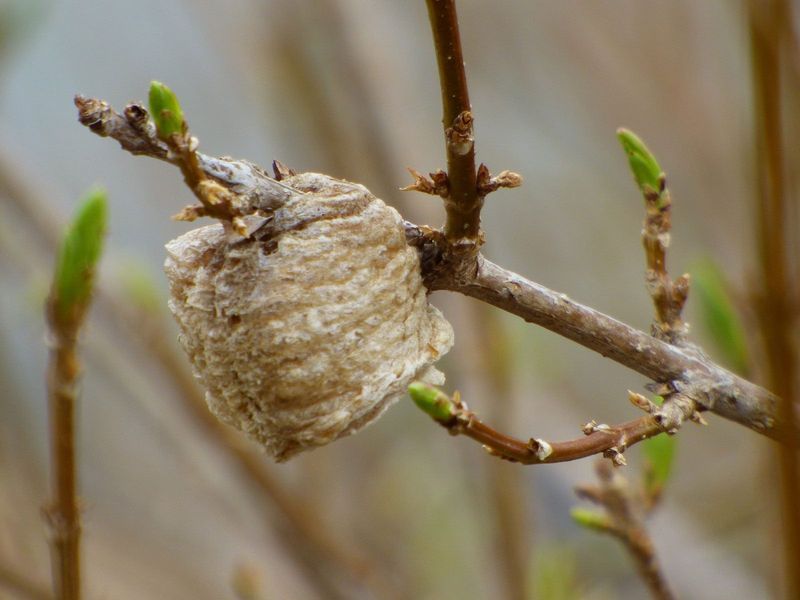
Once you have spotted an ootheca on an outdoor shrub, the default action is to leave it exactly where it is. The case is already in the environment the female selected.
Moving it introduces new variables: different exposure, different temperature swings, and potentially less shelter than the original spot offered. If the case is not attached to anything that will be cut, moved indoors, or disposed of, there is simply no good reason to touch it.
Scraping an egg case off a stem and dropping it on the ground is not a neutral act. University of Illinois Extension’s guide to fall mantis egg cases specifically cautions that placing an ootheca directly on bare soil exposes the eggs to ants, which can consume them before spring.
The case needs to stay attached to something upright and sheltered.
A few situations do call for relocation. The most common one in North Carolina is a case attached to a cut Christmas tree or a wreath that is about to come indoors.
Warm indoor temperatures can trigger hatching weeks or months too early, leaving dozens of tiny nymphs with no food source and no way to survive. Penn State Extension’s guide to insects on real Christmas trees addresses this directly and notes that the common belief that mantises are legally protected is a misconception, so there is no legal barrier to moving a case when necessary.
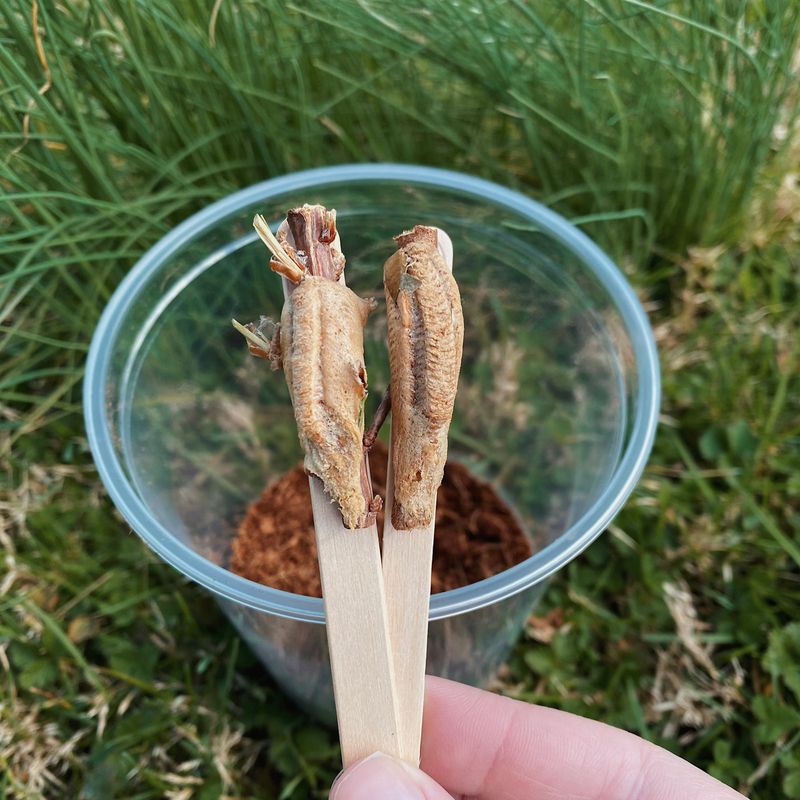
When relocation is needed, the cleanest approach is to cut the small section of twig or branch the case is attached to and tie or place that cutting in a sheltered outdoor shrub or a protected corner of the yard. Keep it off the ground and reasonably close to the original microclimate.
The Connecticut Agricultural Experiment Station’s mantis fact sheet supports outdoor relocation as the appropriate option when an indoor situation cannot be avoided, reinforcing the guidance to keep the case outside under natural winter conditions.
Spring hatchlings will not become a guaranteed pest-control crew
By the time nymphs begin emerging in spring or early summer, the adult that laid the case is long gone. Mantid adults in North Carolina typically die in late fall or winter, leaving the ootheca to manage on its own.
When hatching does occur, the nymphs that emerge are tiny, fragile, and immediately on their own. They need small live prey right away and will cannibalize each other if prey is scarce or the group is too crowded.
Survival rates among newly hatched mantids are naturally low. Illinois Extension’s fall egg case article notes that starvation, predation, and cannibalism all take a significant toll on early-instar nymphs.
Weather can add further losses if a cold snap follows an early hatch. A single ootheca that contains many eggs does not translate reliably into a large mantid population by midsummer.
The mantids that do survive will not be selective about what they eat. NC State Extension states plainly that the Carolina mantid has no demonstrated value in pest management and that it is a generalist, non-selective predator.
Surviving mantids will take flies, moths, beetles, wasps, bees, and butterflies alongside any caterpillars or aphids that happen to be within reach. There is no mechanism that directs them toward plant pests and away from pollinators or other beneficial insects.
Ticks are arachnids rather than insects, and there is no credible evidence in the reviewed sources that mantids provide meaningful tick control in a residential yard. Treating the egg case as a tick-management tool would be a significant overreach.
Penn State Extension and NC State’s integrated pest management handbook both emphasize that generalist predators support a yard ecosystem in broad terms, not as targeted solutions to specific pest problems.
Build a diverse yard around habitat, not mantises

One egg case on one shrub is a narrow window into what your yard is doing ecologically. Broader stewardship means thinking about the whole property, not just the stem where a mantid happened to deposit eggs.
The goal is a yard that supports a range of insects, birds, and other wildlife through diverse plantings, some undisturbed habitat, and thoughtful management rather than a yard optimized around a single predator species.
Plant diversity is the most reliable foundation. NC State Extension’s guide to biological control for home gardeners explains that naturally occurring predators and parasitoids are better supported by habitat management than by purchasing and releasing any single species, including commercially sold mantis egg cases.
A yard that offers varied plant structure, bloom times, and fruit sources will attract a wider insect community than one planted with pest control in mind.
For North Carolina homeowners, several native shrubs fit that goal well. Southern arrowwood offers flowers for pollinators and berries for birds across much of the state.
Shadblow serviceberry provides early-spring bloom and fruit that wildlife use heavily. Red-twig dogwood adds winter structure and berry crops, while meadowsweet provides late-season bloom and supports a range of specialist insects.
Match any plant choice to your specific region, whether Piedmont, Coastal Plain, or mountain, because site conditions vary considerably across the state.
When a real pest problem does appear on a shrub, the right response is not to abandon all controls because a mantid case is nearby. NC State’s integrated pest management handbook recommends monitoring to confirm the pest and severity, trying cultural or mechanical controls first, and selecting the least harmful effective pesticide only when the situation genuinely warrants it.
NC State’s pesticide safety guidance can help with targeted, low-impact application when treatment becomes necessary. These practices support a broader insect community as a side effect of good management, not as a strategy for feeding any particular predator.
Protect the clue without overselling what it means
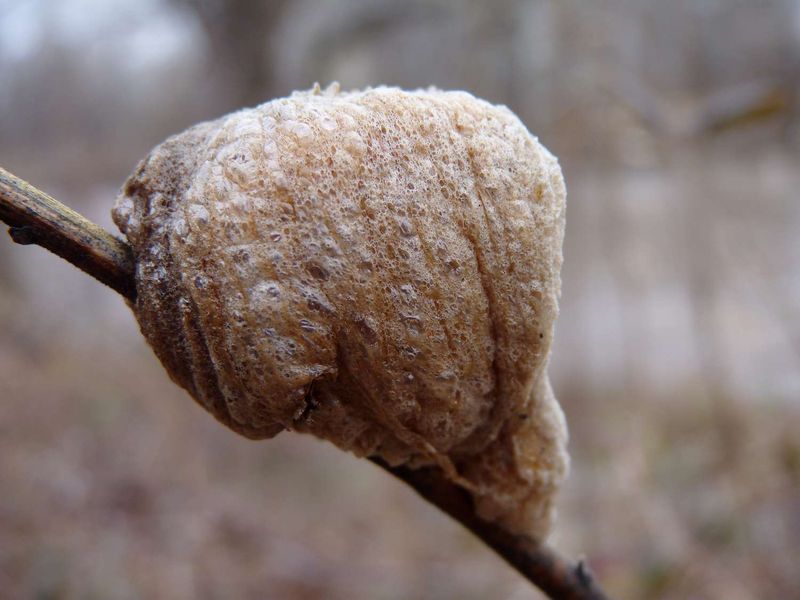
The practical fall to-do list is short. Photograph the case from a few angles, note the shrub species and the height where the case is attached, and consider sharing the image with your local NC State Extension office or a community science platform if you want a species identification.
Then step back and leave it alone if it is already in a stable outdoor location.
If the case is on a stem that needs to be cut or on an object headed indoors, move the attached twig to a sheltered outdoor shrub before that happens. As Illinois Extension advises, keep it off bare ground and in a reasonably protected spot.
That is the full extent of what the case requires from you this season.
Judge your yard’s health by what you do across the whole growing season: the plant diversity you maintain, the habitat you leave undisturbed, and how carefully you apply any controls. NC State Extension and NC State’s IPM guidance both point toward sustained habitat stewardship as the real measure of a yard that supports wildlife.
An ootheca on a shrub may mean a female found a sheltered, structurally useful corner of your property worth using. That is a reasonable thing to appreciate without needing it to mean anything more.