
Don’t Rake Every Leaf Off Your Lawn This Fall – Mowing Them Into The Grass Can Work
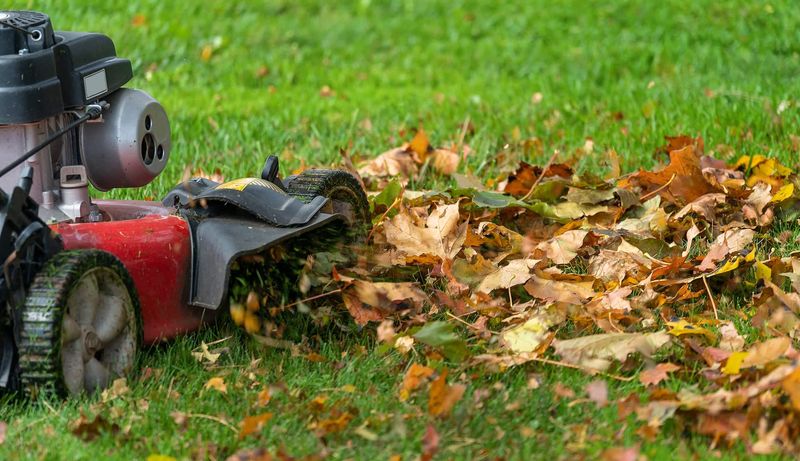
Fall leaves pile up fast, and raking them all can eat a whole weekend. Good news for tired backs: a few passes with the mower can turn many leaves into tiny bits that sink into your grass.
It only works when the leaf load is manageable, though, and some lawns still need a rake. Here is how to tell which kind of yard you have.
Skip the all-or-nothing leaf cleanup
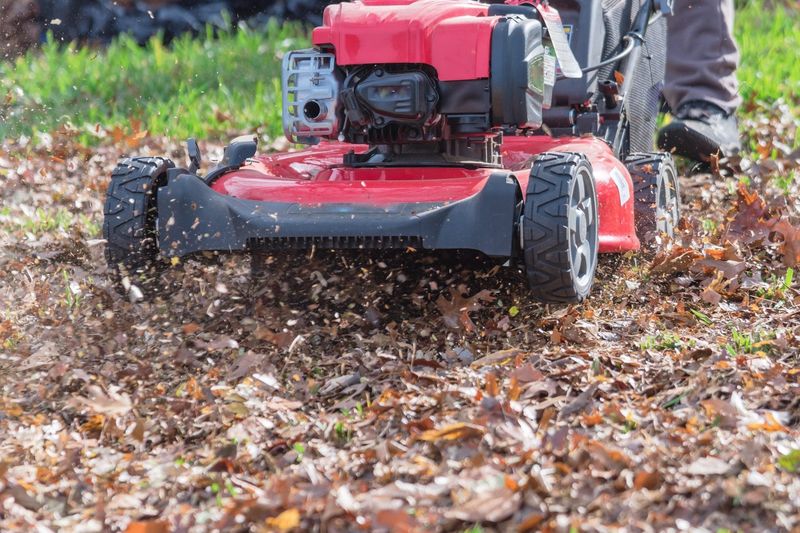
Picture a thick, soggy blanket of whole leaves sitting on your lawn all winter. That is the real problem.
Heavy leaf cover can block light, smother grass, and contribute to snow-mold problems, and leaves left behind can also delay spring growth, as UConn Extension turf guidance explains.
Does that mean you must rake every last leaf? Not necessarily.
Turf specialists at the University of Minnesota say a manageable amount of leaves can be chopped finely and left on an established lawn instead.
Notice the careful wording there: manageable and established. A healthy, mature lawn with a modest sprinkle of leaves is a good candidate.
A newly seeded patch or a yard buried under a giant oak is a different story.
Think of it as a lawn-by-lawn decision. Finely mulching a modest load is a practical option, and University of Missouri Extension also points to composting for leaves you cannot mow in.
When the pile is heavy, removing or spreading out the extra is a smart move, not a defeat.
So mowing is not automatically better than raking. It is simply a handy tool for the right yard, and this guide helps you spot yours.
Small fragments can settle into the grass
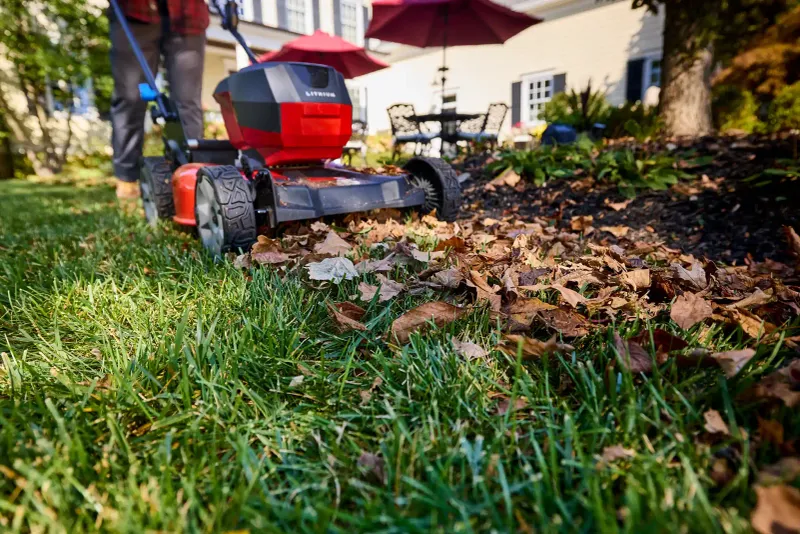
A mower blade changes what a leaf is. Instead of a flat sheet that can lie over the grass like a lid, you get bits small enough to drop down between the blades.
Once they settle in, the fragments break down. According to UConn Extension, mulched leaves add organic matter and some nutrients back to the lawn.
Notice the modest wording: some nutrients, and no promise of a miracle lawn. Results depend on your grass, your soil, and how many leaves you started with.
The difference between chopped and whole is the key. Intact leaves left as a thick layer can shade and smother turf, while fine fragments tuck into the canopy.
Minnesota turf researchers describe aiming for small pieces rather than a visible covering.
A quick check helps. After mowing, look down.
If you see mostly green grass with a light dusting of leaf bits, you are in good shape. If you still see whole leaves lying flat, the job is not finished.
The University of Missouri also notes that mowing works best when leaves are dry enough to chop cleanly.
Use the lawn, not a fixed percentage, as your guide
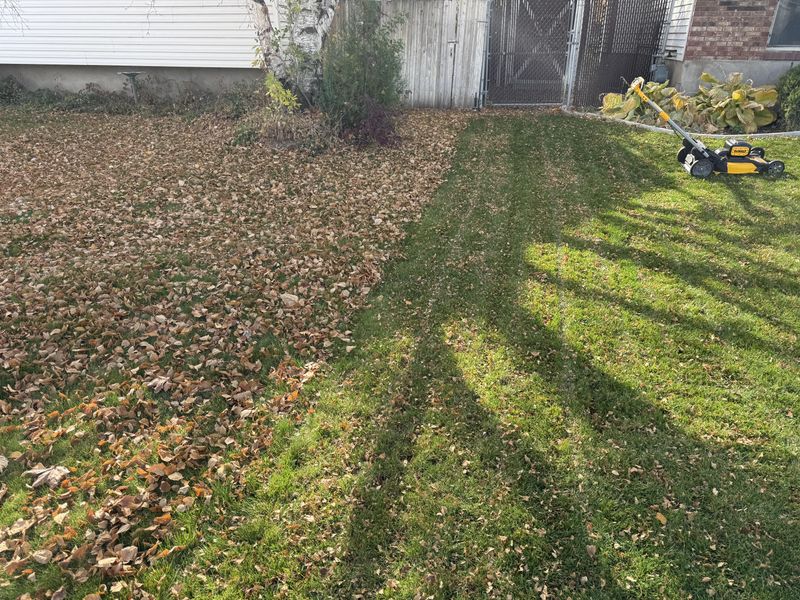
Forget the math. Your eyes make a better gauge than any number.
After you mow, the grass should still be visible, and the chopped pieces should sit down in the canopy instead of lying on top as a mat.
Advice on how much leaf residue is acceptable varies between sources, so a single percentage cutoff would be misleading. Guidance from Minnesota turf specialists and University of Minnesota Extension centers on this kind of practical check.
Try the walk-across test. Stroll over the mowed area and look at your shoes.
If you can see green around each step and the leaf bits vanish into the turf, you passed.
If a mat forms, the lawn is telling you it has hit its limit. Make another pass, or take some leaves off.
Only add more leaves to mulch if the lawn can still meet the visual test. Missouri Extension suggests composting or removing the surplus rather than forcing it into the grass.
Thin, shaded, or struggling turf may handle less than a thick sunny lawn, so judge your own yard.
Mow often enough to prevent a thick buildup
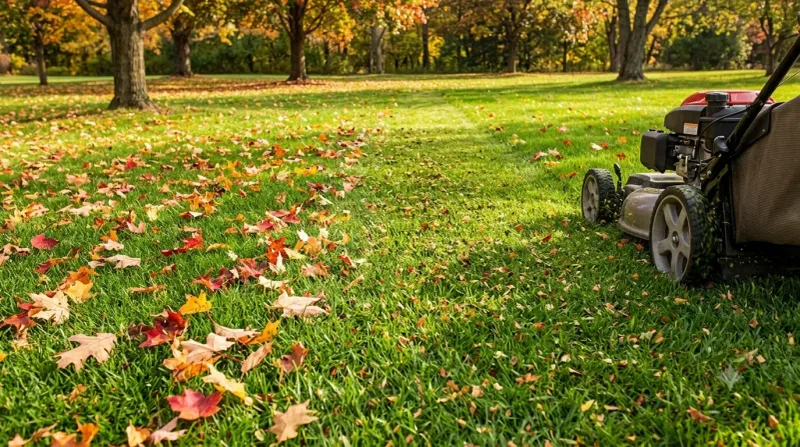
Timing matters as much as technique. Keep mowing while the grass is still actively growing, and do it often enough that leaves never stack into a heavy layer.
Small, frequent sessions beat one giant cleanup. When leaves drop in a steady stream, a weekly pass can keep the load light enough to chop and settle.
UConn Extension notes that several passes or more frequent mowing may be needed.
Do you need special gear? Not always.
A standard mower can do the job, and University of Minnesota turf specialists say it works for many lawns. A mulching mower is designed to chop leaves finely, which can make the process easier.
If your first pass leaves big pieces, go over the area again, perhaps in a different direction. Dry leaves usually chop better than wet, clumpy ones.
Watch the calendar too. Before winter sets in, check that no thick residue is left sitting on the turf.
Missouri Extension advises against leaving heavy leaf cover over the cold months.
Here is a handy habit: after every mowing during leaf season, glance back at the lawn. Green showing through means keep going.
A mat means the next step is removal.
Remove or redistribute what the mower cannot manage
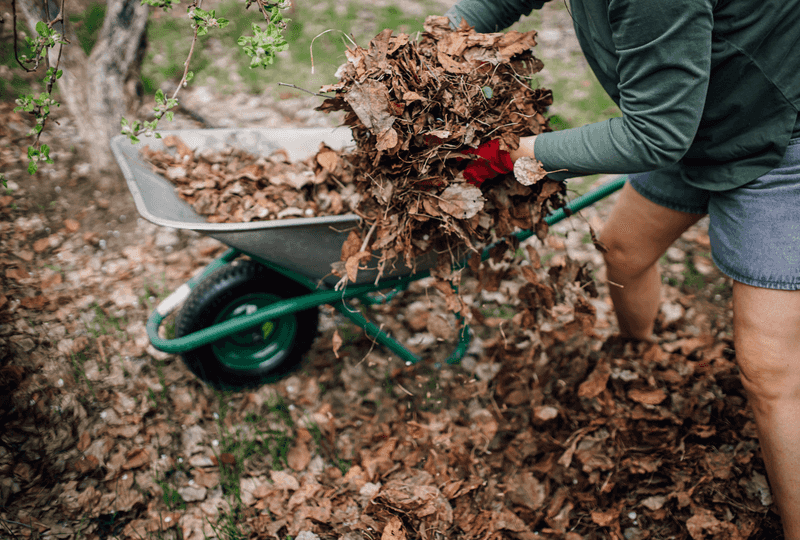
Some yards simply produce more leaves than any lawn can absorb. Big silver maples and oaks can drop a deluge, and the grass underneath cannot handle all of it.
When fragments will not settle into the turf or the load is too heavy, take the extra away. University of Missouri Extension recommends composting as a good option for leaves beyond what mowing can handle.
You can also move them to a spot that benefits. A garden bed, a compost pile, or the base of shrubs can all be suitable homes for the overflow.
Diseased leaves are another case. If your tree had leaf spot or other trouble, or you deal with recurring pest problems tied to leaves, removal and disposal may be better than chopping them into the lawn, as UConn Extension points out.
Treat this as a tool in the kit, not a failure. Plenty of people mulch most of their leaves and rake only the heavy spots under the biggest tree.
A light rake over the thickest drifts, followed by a mower pass over what remains, is a perfectly sensible plan.
Leaf mulch is not a fertilizer guarantee
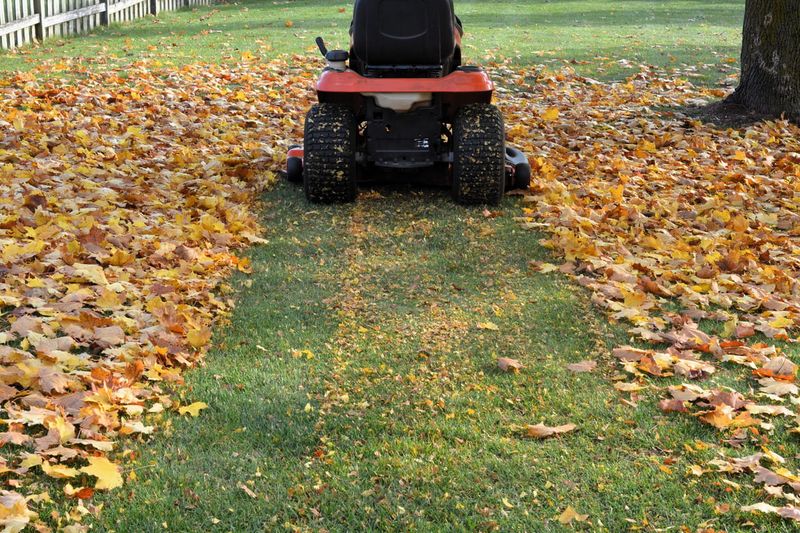
Leaves do bring something to the soil. They add organic matter, and they contain nutrients as they break down.
Whether that replaces your fertilizer is where the story gets less tidy. UConn Extension says annual leaf incorporation may reduce or even eliminate fall fertilizer for some mature lawns.
Other findings are more cautious. Purdue Extension reports no measurable effect on nutrient availability in the research it cites.
Both statements can be true, because lawns, soils, and leaf types differ. Maple leaves are not the same as oak leaves, and a sandy yard behaves differently than clay.
You can read more in the Michigan State turfgrass research report on leaf mulch studies.
So treat the organic matter as a welcome bonus. Do not assume leaf mulch alone meets your lawn’s needs.
A soil test is a handy way to find out what your grass actually needs before you skip a feeding.
Less hauling is possible, but time savings vary
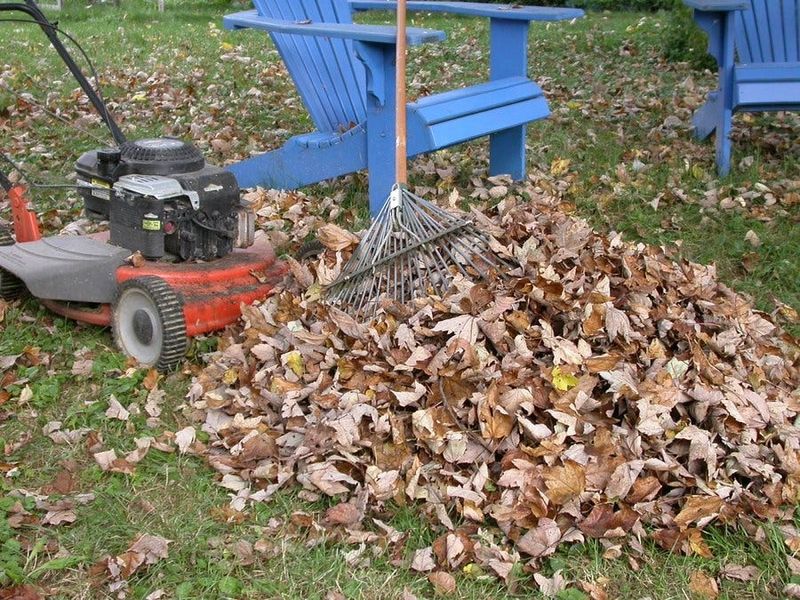
One real payoff of mulching leaves in place is that you may not have to collect, bag, and haul as much. If your lawn can take the load, that is fewer trips to the curb.
Notice the word may. Whether you actually save time depends on your yard, your mower, and how many extra passes the leaves demand.
A field study on mulching leaves in place reported lower fuel use for mulch mowing than for community leaf pickup.
That result is about fuel, not about your weekend. It does not tell us how many minutes or hours one homeowner will save.
If you have a small yard with a few trees, mowing may be far quicker than raking. If you have a big wooded lot, you might mow several times and still need to rake the thickest areas.
Try it for one season and keep honest notes. Compare how long mowing took with how long raking and bagging usually takes you.
Mulch the lawn and keep some intact leaves for habitat
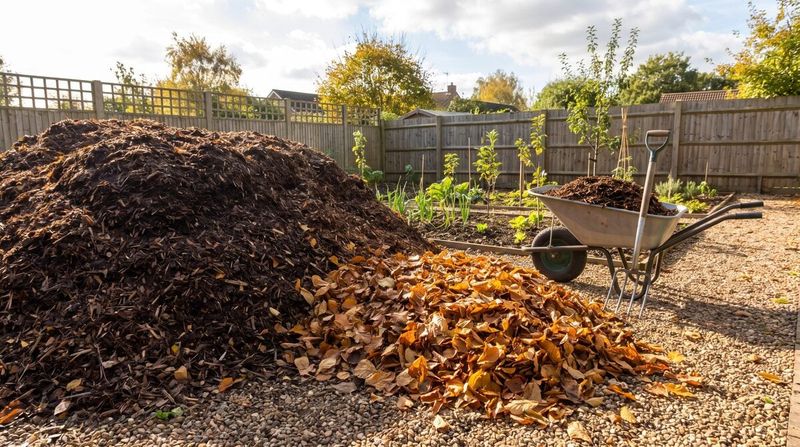
Your lawn and your flower beds do not need the same treatment. Finely mulch a manageable amount into the turf, and let some whole leaves stay put in beds or other suitable spots.
That second part matters for wildlife. A study of residential yards found that removing leaves reduced the spring emergence of several arthropod groups.
Keep the limits in mind. That study did not test every yard, and it did not compare every mowing practice.
It simply shows that intact leaf litter can shelter overwintering insects.
Shredding every leaf everywhere is not the same as keeping some whole leaves around. A few leafy corners under shrubs or along a fence line give habitat without smothering any grass.
Remember that UConn Extension also cautions against letting thick leaf cover sit on turf.
The rule is simple: mulch when the grass stays visible, and remove or move leaves that form a mat. Your lawn gets a light touch, and the beds get a little wild.