
Narrow-Leaf Mountain Mint: A Native North Carolina Patio Border Plant With Aromatic Foliage, Pollinator Value, and Unproven Mosquito Benefits
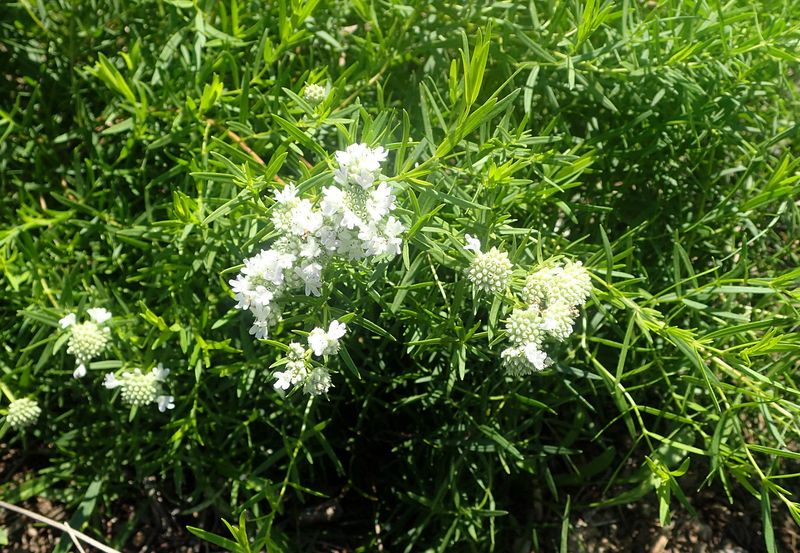
Narrow-leaf mountain mint is a native North Carolina perennial that gardeners across the mountains, Piedmont, and Coastal Plain are starting to notice for all the right reasons. Its aromatic foliage, sturdy upright form, and ability to feed pollinators make it a genuinely useful plant for a sunny patio edge.
What it cannot do, at least based on current evidence, is keep mosquitoes away from your seating area, and that distinction matters before you skip the bug spray.
Choose the right mountain mint for a North Carolina patio border

Narrow-leaf mountain mint, known botanically as Pycnanthemum tenuifolium, is a herbaceous perennial native to all three of North Carolina’s main regions: the mountains, Piedmont, and Coastal Plain. That broad regional fit makes it genuinely versatile compared with many native plants that thrive only in one part of the state.
NC State Extension’s plant profile lists it as tolerating full to partial sun with a preference for acidic, well-drained soil, and it typically grows two feet tall, though established clumps can push toward four feet under good conditions.
Planting it along a patio edge works well for practical reasons that have nothing to do with mosquito control. The plant’s upright habit creates a tidy, defined border, its small white flowers bloom in summer, and the foliage releases a sharp minty scent when brushed.
Those qualities alone justify a spot in a sunny, reasonably well-drained border alongside your hardscape.
Spacing matters more than many gardeners expect. NC State recommends allowing one to three feet per plant, and that range should be taken seriously because the clumps will expand over time.
Starting with wider spacing gives you room to manage growth before it becomes a problem. NC State’s native-plant handbook includes mountain mint among plants suited across all three NC regions, which reinforces its usefulness as a broadly applicable choice rather than a specialty plant for one climate zone.
One thing to settle before purchasing: the common name “mountain mint” covers several PycnanthemumP. tenuifolium species, and nurseries do not always label them precisely. Ask specifically for if you want the narrow-leaf form, or confirm the species tag before buying.
Getting the right plant from the start saves confusion later when the mature size or flower timing differs from what you expected.
A living border has not been shown to keep mosquitoes away
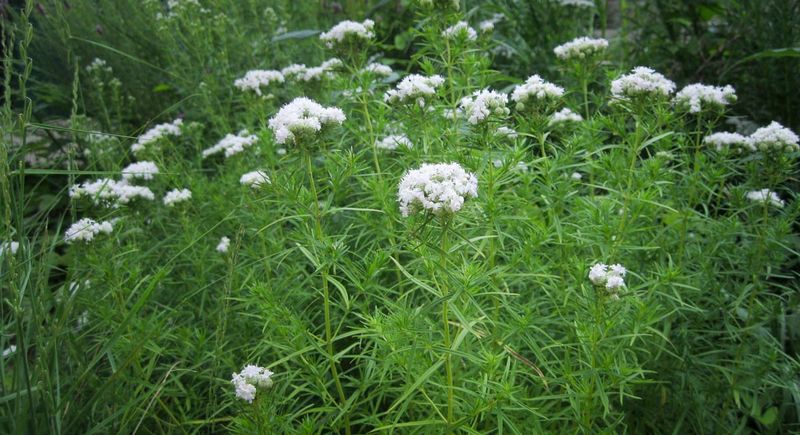
Plenty of gardening content promises that certain aromatic plants, placed around a deck or porch, will drive mosquitoes away. NC State Extension’s mosquito-control guidance addresses this directly, stating that claims about plants repelling mosquitoes from porches and decks are not supported by scientifically based tests.
That applies to mountain mint as much as it applies to lavender, lemon balm, or any other fragrant plant commonly marketed for mosquito control.
There is some early laboratory research on Pycnanthemum tenuifolium that gets cited in discussions like this one. A preliminary Petri-dish assay found that mosquitoes exposed to mountain-mint plant material or extracts died within 24 hours under controlled conditions.
That is an interesting starting point for researchers, but it does not translate into a practical claim for homeowners.
The gap between a laboratory assay and a living plant in your yard is significant. In a controlled exposure, researchers apply concentrated plant material or extracted compounds directly to mosquitoes in a small, enclosed space.
A potted or in-ground plant growing beside your patio releases volatile compounds at much lower concentrations into open air, where they disperse quickly. No field study has established that a border of living mountain mint reduces mosquito landings on people sitting nearby, and no specific planting density, coverage radius, or duration of protection has been identified in the available evidence.
Treating the laboratory finding as proof of backyard mosquito control sets readers up for disappointment and, more practically, may lead someone to skip the steps that actually reduce bites. The right framing is this: mountain mint is worth planting, but its value lies in its native status, its aromatic character, and the pollinators it supports, not in any proven ability to clear mosquitoes from your outdoor space.
Use the patio edge to manage growth and maintenance
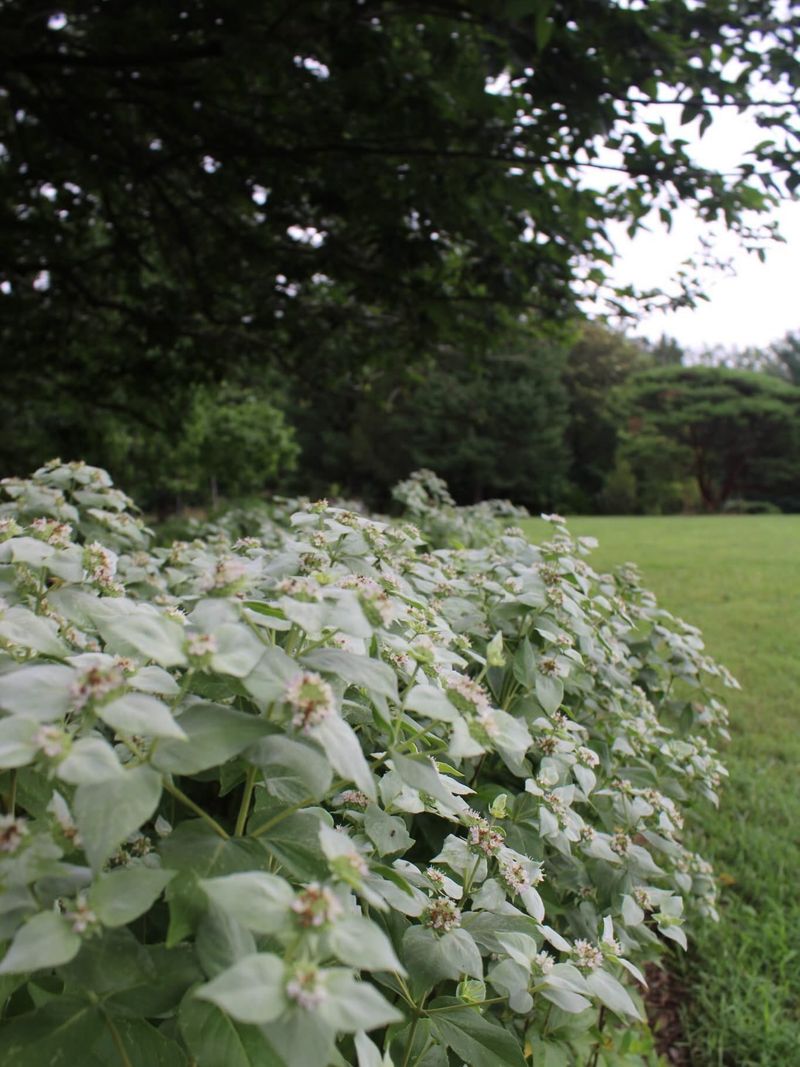
One of the more underappreciated reasons to plant narrow-leaf mountain mint along a defined hardscape edge is that the patio itself helps manage the plant’s growth. P. tenuifolium can spread rapidly, and a concrete or stone border acts as a natural barrier that limits how far rhizomes and stems can move without your intervention.
That containment is a practical advantage, not just an aesthetic one.
Before planting, confirm that the chosen spot gets full sun or at least partial sun for most of the day, and check that the soil drains reasonably well after rain. Mountain mint tolerates a range of soil types but does best in well-drained, acidic conditions, according to NC State’s plant toolbox entry for P. tenuifolium.
A low spot that stays soggy after storms is not a good fit, regardless of how much sun it receives.
Space plants one to three feet apart and plan to check the border at least once a season. Clumps that push beyond the intended planting zone can be cut back at the soil line or dug out entirely.
Division is another option: lift the outer edges of an expanding clump in early spring, remove what you do not want, and replant or share the divisions. For the related P. muticumP. tenuifolium, NC State specifically recommends root pruning in spring to control spread, and the same approach works well for .
Being native does not make a plant automatically well-behaved in every garden situation. Mountain mint is a vigorous grower in its home range, and labeling it “native” should not create the impression that it stays put on its own.
A patio border can be an excellent home for this plant as long as you are willing to monitor it and act when it moves where you do not want it. That kind of active stewardship is a normal part of growing any fast-establishing perennial, native or otherwise.
Treat pollinator value as the reliable benefit
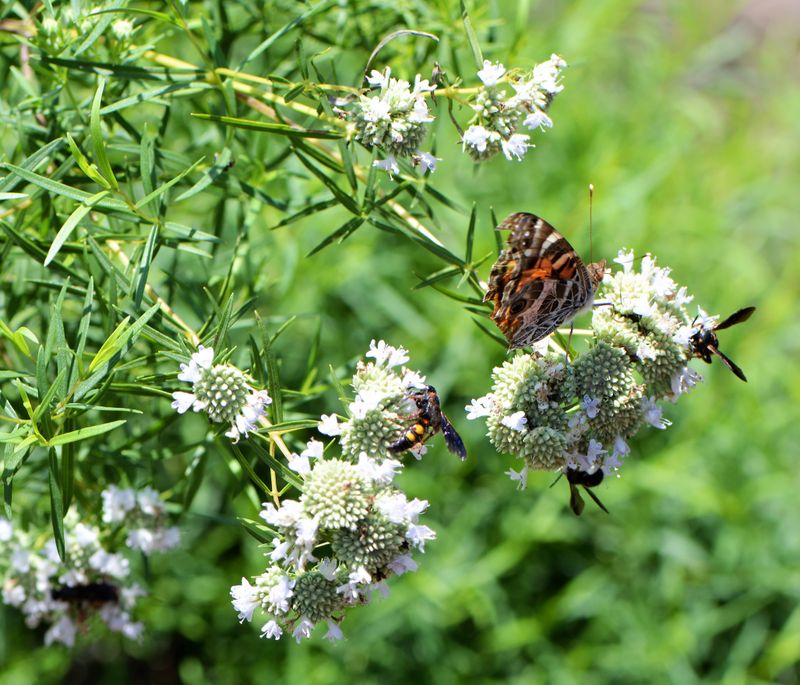
Among the things narrow-leaf mountain mint reliably delivers, its support for native pollinators stands at the top. NC State lists P. tenuifolium among recommended native bee-forage plants for North Carolina, and that recognition reflects real ecological value for a plant that grows in home landscapes with minimal fuss.
The broader picture for mountain mint as a pollinator resource comes from university-based trials summarized by Penn State Extension, which found that clustered mountain mint, specifically Pycnanthemum muticum, attracted exceptionally high numbers and diversity of pollinators across trial seasons. Documented visitors included native bees, honey bees, butterflies, wasps, syrphid flies, and tachinid flies.
That is a wide range of beneficial insects arriving in one planting.
A word of precision matters here: the strongest summarized trial data comes from P. muticumP. tenuifoliumP. tenuifolium, not . Both belong to the same genus and share similar flower structure and aromatic chemistry, so meaningful pollinator attraction from is a reasonable expectation, but readers should not assume the two species perform identically in every situation.
The genus earns the pollinator reputation; the species-level data for P. tenuifolium specifically is less detailed.
One practical consideration follows from all of that insect activity: a thriving mountain-mint border close to your seating area will bring bees, wasps, and other insects within arm’s reach of where people sit and walk. For most households, that is simply wildlife at work and poses no meaningful risk.
If someone in the family manages a severe sting allergy, or if young children regularly play barefoot near the border, consider placing the planting a few extra feet beyond the main seating zone or the edge of a narrow walkway. The pollinators are the point, but a little extra distance can make the activity feel comfortable rather than crowded.
Do not turn mountain mint into homemade mosquito chemistry
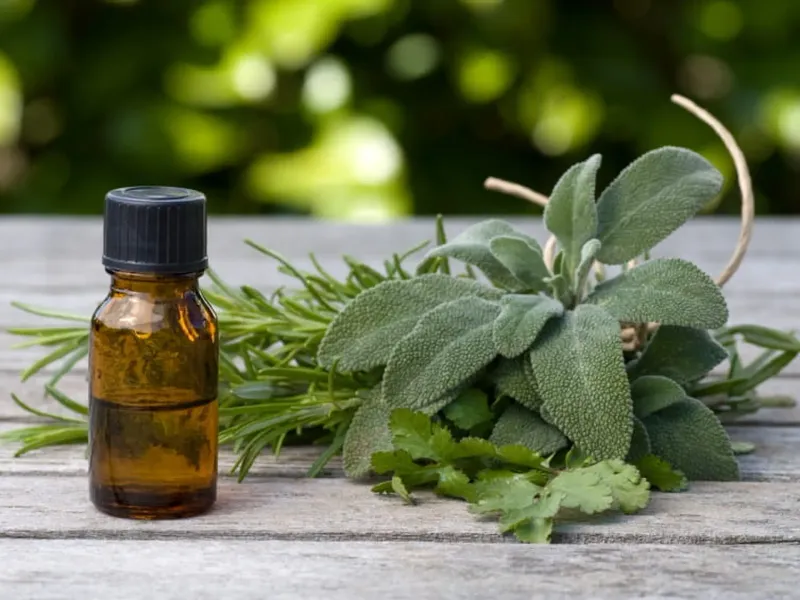
Mountain mint smells strong when you brush against it, and that sensory quality leads some gardeners to wonder whether crushing the leaves and rubbing them on skin, or making a concentrated spray, might work as a natural mosquito repellent. The short answer is: skip those experiments.
The chemistry behind the plant’s aroma is more complicated than the scent suggests, and the available evidence does not support homemade preparations as safe or effective alternatives to registered repellents.
Essential-oil composition in mountain mint varies considerably depending on which species you have, which variety within that species, when in the season you harvest, and what growing conditions the plant experienced. A peer-reviewed study on Pycnanthemum virginianum varieties found substantial seasonal and varietal differences in oil composition, which means that detecting a particular compound in one plant at one time of year tells you relatively little about what you will find in a different plant or a different month.
Pulegone, a compound sometimes cited in mountain-mint mosquito discussions, is one of those variable constituents, and its presence in a leaf does not establish that rubbing the leaf on your arm will reduce mosquito landings.
Concentrated mint-family oils carry real safety considerations. A review of maternal reproductive toxicity from essential oils and their constituents identifies pulegone-rich oils, particularly pennyroyal oil, as having documented toxicity concerns, including potential risks during pregnancy.
Mountain mint is not pennyroyal, but the chemical overlap is enough that making concentrated preparations at home, without knowing the exact composition of your plant, is not a good idea. Pregnant individuals should be especially cautious around concentrated volatile-oil products from mint-family plants.
The practical takeaway: enjoy the scent when you brush past the plant, but do not crush and apply the foliage, brew concentrated teas for mosquito purposes, or attempt to extract the oil at home. Those steps move you away from the plant’s genuine yard value and toward risks that registered repellents, used according to their labels, simply do not carry.
Reduce mosquito exposure with proven measures

A well-chosen native border is a genuine yard improvement, but it does not replace the steps that actually cut mosquito bites. The foundation of any practical mosquito plan at home starts with water, specifically finding and eliminating the standing water where mosquitoes breed.
CDC’s mosquito-control-at-home guidance recommends removing, emptying, scrubbing, covering, or turning over any container that holds water at least once a week. That list covers birdbaths, flowerpot saucers, clogged gutters, tarps, buckets, and anything else that collects rain.
Screens are the second line of defense. A repaired window or door screen keeps mosquitoes out of living spaces without any chemical involvement, and a torn screen that goes unpatched through summer undoes a lot of other effort.
Walk around the house once in spring and again after any storm damage to check for gaps or tears.
For personal protection outdoors, CDC recommends EPA-registered skin repellents applied according to product labels. EPA lists several active ingredients in registered skin-applied repellents, including DEET, picaridin, IR3535, oil of lemon eucalyptus (OLE)/PMD, citronella oil, and catnip oil.
These products have been evaluated for both safety and effectiveness; EPA publishes product-specific protection durations for DEET, while the effectiveness of unregistered natural alternatives remains unknown according to CDC.
A few other approaches get mentioned often but deserve an honest assessment. NC State Extension notes that bats and birds do consume mosquitoes but do not make a significant dent in mosquito populations, so bat houses and bird feeders are fine additions to a wildlife-friendly yard without being relied upon as mosquito management.
Pollinator plantings, including mountain mint, fall into the same category: ecologically worthwhile, not a substitute for breeding-site removal or registered repellent. Layering all of these measures together, water management, screens, and labeled repellent when you are outside, gives you the most reliable protection currently available.
Plant mountain mint for the border, not a mosquito-free promise
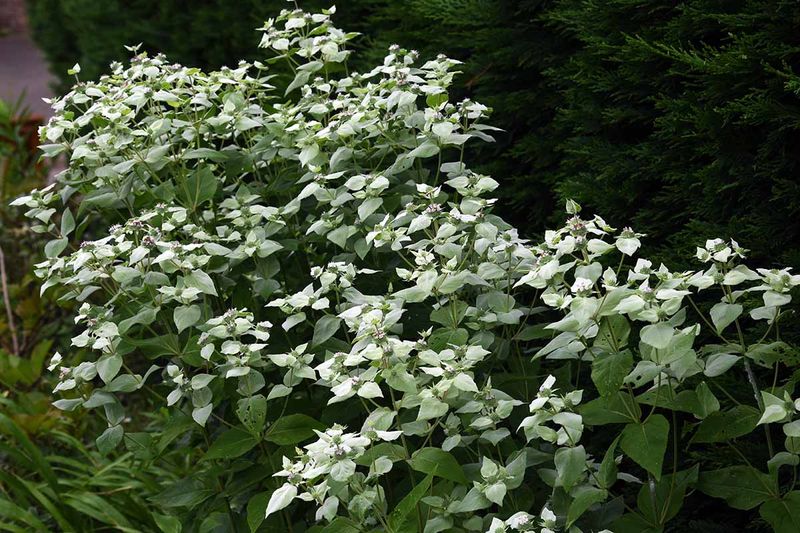
Narrow-leaf mountain mint earns a place along a sunny, well-drained patio edge for reasons that hold up under scrutiny: it is broadly native across North Carolina, it establishes reliably in the mountains, Piedmont, and Coastal Plain, its aromatic foliage adds sensory interest, and it feeds a wide range of native pollinators through the summer. Those are real, repeatable benefits that make it a better choice than many ornamental alternatives for a homeowner who wants a native border with genuine ecological function.
Getting the most from the planting means matching it to the right site, giving each plant one to three feet of space, and staying ahead of spread by dividing or trimming clumps before they move beyond the intended zone. Pair the border with weekly standing-water checks, repaired screens, and an EPA-registered repellent for evenings when mosquitoes are active.
NC State’s plant profile and NC State Extension’s mosquito guidance together point toward the same realistic goal: a better-looking, ecologically richer patio border alongside dependable mosquito prevention, not instead of it. A yard that supports native plants and native insects while its owner uses proven bite protection is simply a well-managed yard, and that is a more honest payoff than any single plant can promise.