
Orchid Roots Crawling Out Of The Pot? Put Down The Scissors – Here’s What They’re Telling You
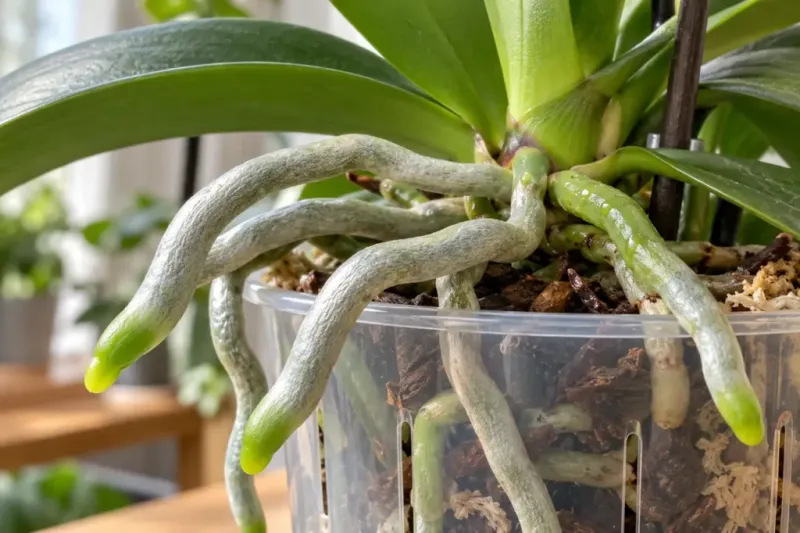
You glance at your moth orchid and spot a thick root creeping over the pot’s edge like it is trying to escape. Many owners panic and grab scissors, sure they have done something wrong.
Good news: that wandering root is usually just your orchid being an orchid. Here is how to read what your Phalaenopsis is showing you, and when to act or hold still.
Aerial roots are normal for moth orchids
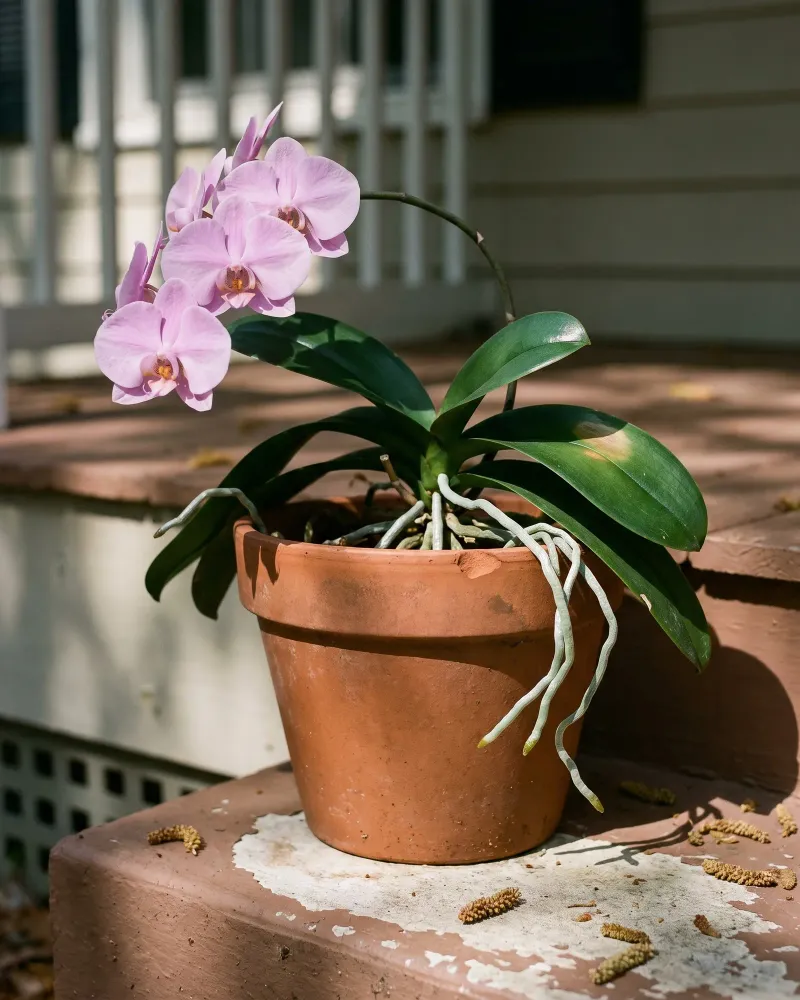
Out in nature, moth orchids do not grow in soil. They cling to tree trunks and branches, and their roots stretch out into the open air.
Your Phalaenopsis is simply doing what it evolved to do, so a root growing outside the pot is not a defect or an emergency, as University of Maryland Extension care guidance explains.
That means you can relax about the sight of roots reaching past the rim. They do not need to be trimmed, tucked away, or hidden.
Think of them as part of how this plant lives rather than a problem waiting to be fixed.
Here is the catch, though. A root outside the pot tells you the plant is behaving normally, but it does not prove the whole orchid is thriving.
A plant can send out aerial roots and still have soggy bark, tired leaves, or damaged roots hiding down inside the pot.
Root appearance is one clue among several. Look at the leaves, check how the potting mix feels, and notice whether the plant is wobbly in its pot.
The American Orchid Society’s root overview treats roots as a window into how the plant is living, not a complete health report.
So when you see an adventurous root, take a breath and put the scissors back in the drawer. Then use the next sections to learn how to tell a healthy root from a struggling one.
What a root’s color and texture can tell you
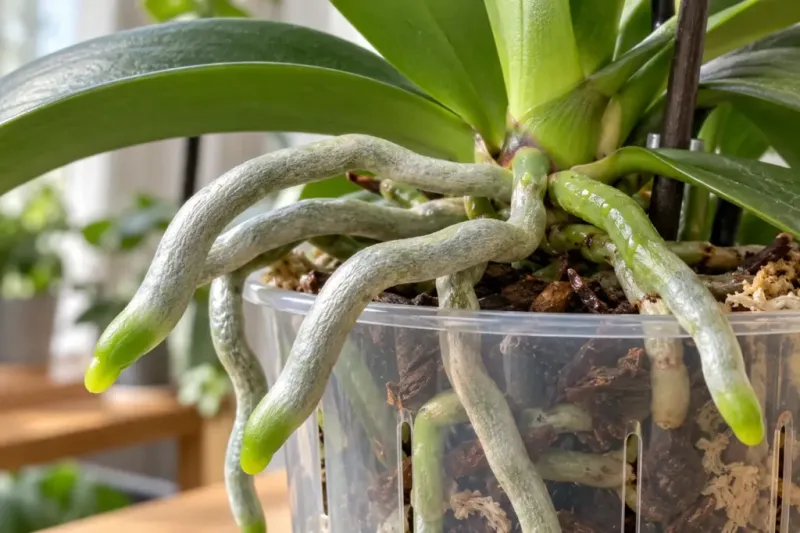
The silvery-white coating on orchid roots is called velamen. It is a spongy outer layer that helps the root soak up water and hold onto it, and a study of velamen in Applied Physics A describes it as a porous material built for fast water uptake.
Color can be a handy hint, but it is not a pass-fail test. Maryland Extension notes that Phalaenopsis roots often shift from dull silver or white to pale green after watering.
The American Orchid Society cautions that root colors vary, so texture and condition tell you more.
Use your fingers. A healthy root feels firm and plump.
A root that is mushy, papery, or flattened deserves a closer look.
A hollow root whose outer velamen has rotted away is dead. Iowa State Extension repotting advice lists soft, dead, brown, black, or hollow roots as ones to remove during repotting.
Do not assume every brownish root is gone, though. Some healthy roots look a bit dull or tan on the outside yet stay firm when you squeeze them gently.
Feel first, then decide.
Should you tuck an exposed root back in?
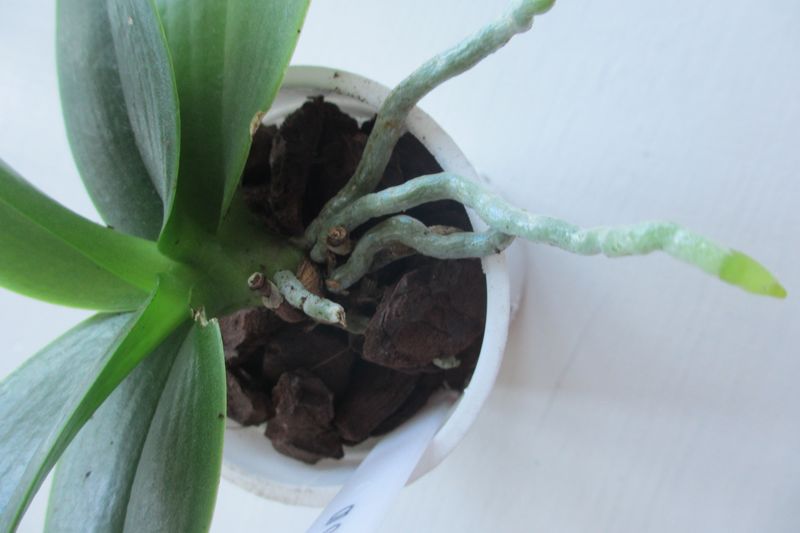
Short answer: no. A firm aerial root can stay right where it is. Do not snip it off, and do not bend it into the pot just to make things look neat.
Forcing a long root downward can crack or bruise it, and a damaged root is a bigger problem than an exposed one. A University of Maryland Extension answer says high roots do not have to be pushed into the medium.
Maryland Extension also points out that roots commonly grow outside the container and should not be cut off. That is the normal state of a moth orchid, not a flaw to correct.
There is one small exception. If you are already repotting and some young roots are flexible and reach easily, you may cover them with medium.
Keep that layer loose and light, because roots need airflow and dense packing can smother them.
Picture a handful of bark chips resting around the roots, not a thick blanket pressed on top. If a root will not reach the mix without bending sharply, leave it in the air.
Your orchid will be fine either way.
Repot when the plant or medium calls for it
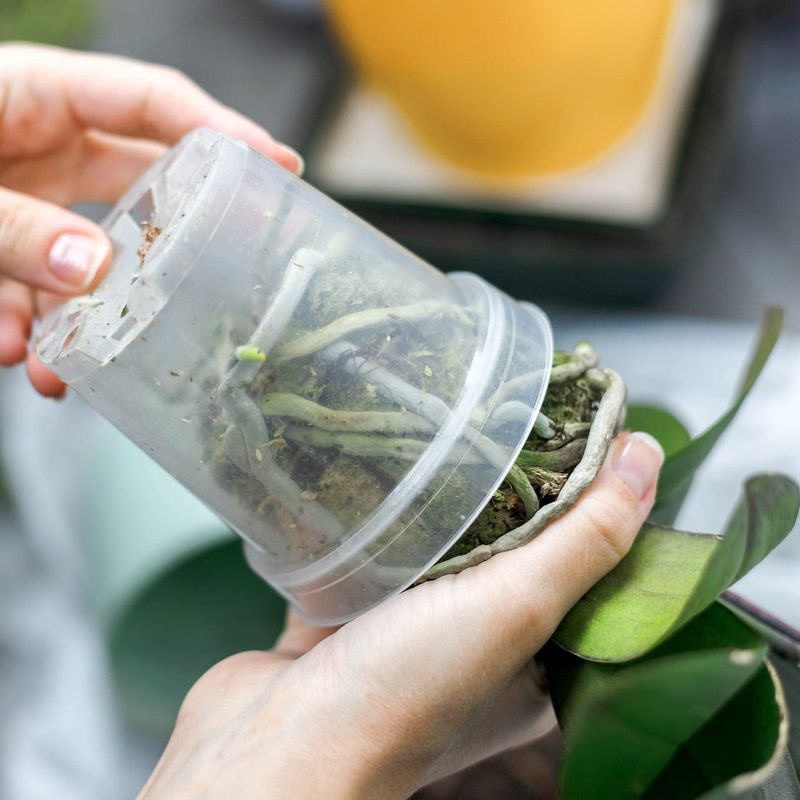
A single root outside the pot is not a reason to repot. Real reasons come from the plant and its potting mix.
One sign is a plant that has outgrown its container, with roots packed so tightly that the pot is crowded or the plant sits unsteadily. Another is bark that has broken down, drains poorly, or holds too much moisture, which can leave roots soggy and short of air.
Maryland Extension’s Phalaenopsis care page ties repotting to these kinds of problems.
Poke at the mix and see how it feels. Old bark that looks like crumbly soil, or stays wet for days, is a good clue it is time for fresh material.
The reverse is also true. If the roots still fit comfortably, the existing pot may be just fine.
Iowa State Extension’s repotting guide offers a useful reminder to match the pot to the root mass rather than upsizing out of habit.
When you do repot, choose an airy orchid mix, not regular potting soil, and a pot with good drainage. That combination lets water move through and air reach the roots.
You do not need fancy gear to get this right.
Repot gently and remove only roots that are dead or damaged
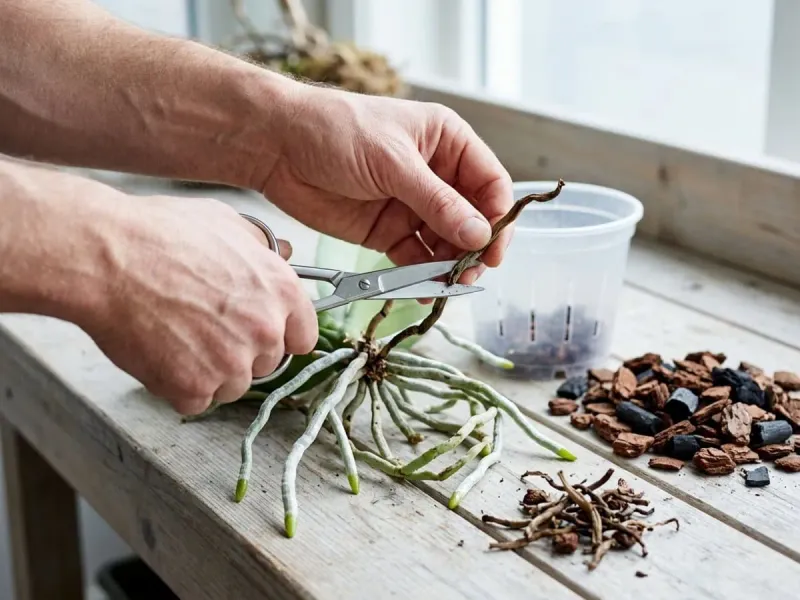
Once repotting is truly warranted, slow and gentle wins. Ease the plant out, shake off old mix, and keep healthy roots as intact as you can.
The American Orchid Society’s Phalaenopsis culture sheet stresses keeping roots as whole as possible, especially if you repot outside the usual window.
Now take a look at what you have. Trim away only roots that are dead or damaged, such as ones that are mushy, hollow, or dried out and papery.
Iowa State Extension recommends clearing out these roots during repotting, and clean scissors help prevent spreading trouble.
Leave firm roots alone, including ones that look a little tan. If you are unsure, give the root a gentle squeeze and trust what you feel.
As you add new mix, work it in around the roots without packing it down hard. Dense medium can smother roots, so aim for loose and airy.
Timing is flexible. Maryland Extension favors repotting at the start of new growth, and that is a commonly preferred moment.
Phalaenopsis can still be repotted at other times if the plant needs it and you handle the roots carefully.
Misting is not a substitute for watering the pot
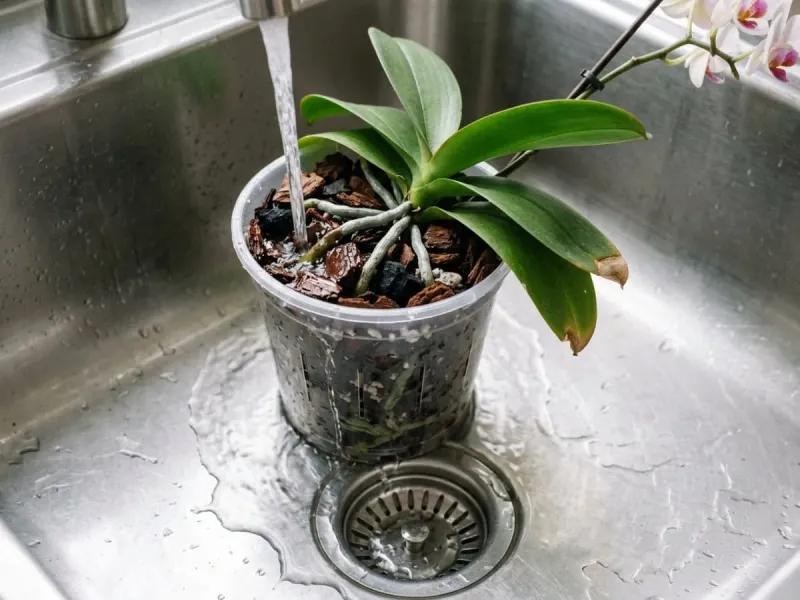
Spritzing the dangling roots with a spray bottle feels caring, but it rarely does much. Maryland Extension says misting usually does not provide enough moisture for an indoor Phalaenopsis, and an Ask Extension response adds that root misting contributes little to overall hydration.
A better habit is watering thoroughly. Soak the bark and the aerial roots, then let the water drain completely before the pot goes back in its spot.
That reaches the roots inside the pot, where much of the work happens.
Roots may turn from silvery to pale green after a good drink, which is a handy sign that they have taken up water. Treat it as a cue, not a guarantee of health.
Dry rooms are a different question. A room humidifier may help when the air is very dry, and American Orchid Society humidity guidance explains how humidity and air movement work together.
Humidity support is not the same thing as watering.
Whatever you do, keep water from pooling in the leaf crown, where the leaves meet the stem. Standing water there can lead to rot.
Blot it out with a paper towel if you spot a puddle.
Let firm roots be; act only on a real care signal
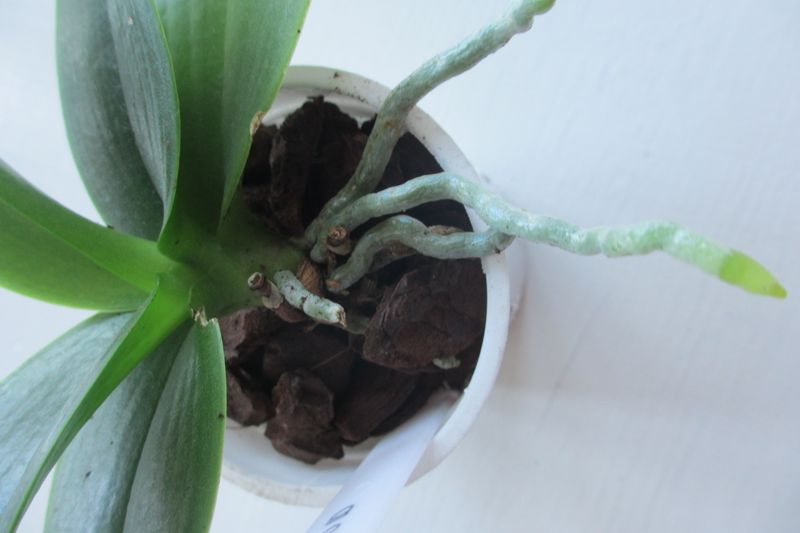
Here is the simple rule: a firm root outside the pot needs no rescue. Dead or damaged roots, or potting mix that is failing, are the signs that justify action, as Maryland Extension and Iowa State Extension both suggest.
Do not cut roots or repot just because one wandered out.
Your orchid is not trying to escape. It is reaching for air, the way it would on a tree branch.