
Screech Owls Return To The Same North Carolina Oak Every Fall Because The Yard Below Feeds Them
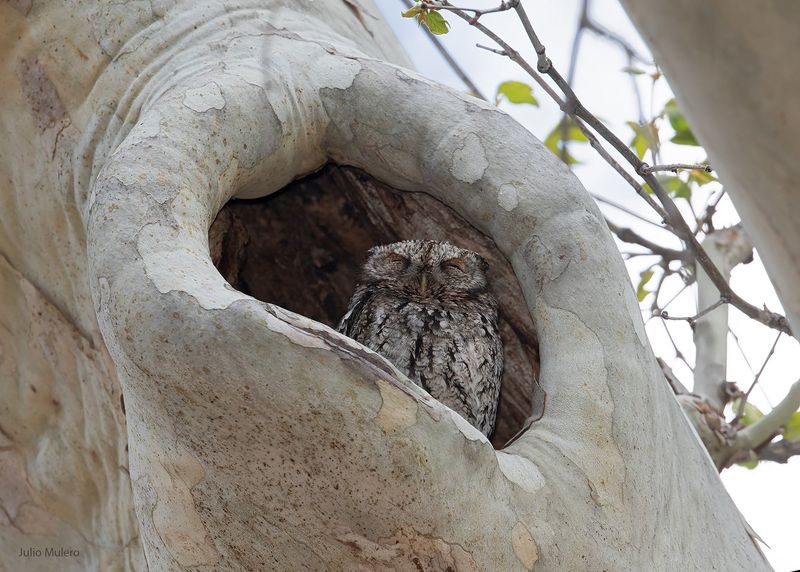
Spotting a small, camouflaged owl tucked into the same oak tree each fall feels like a special kind of magic, and it raises a natural question: why does it keep coming back? The short answer is more nuanced than a simple food supply, and understanding it can change how you look at your entire yard.
Eastern Screech-Owls are year-round residents across North Carolina, and the tree they favor most likely offers something far more specific than a meal. Knowing what draws them to one spot, and what that sighting actually tells you about your property, puts you in a much better position to protect it.
A fall sighting does not prove a seasonal return
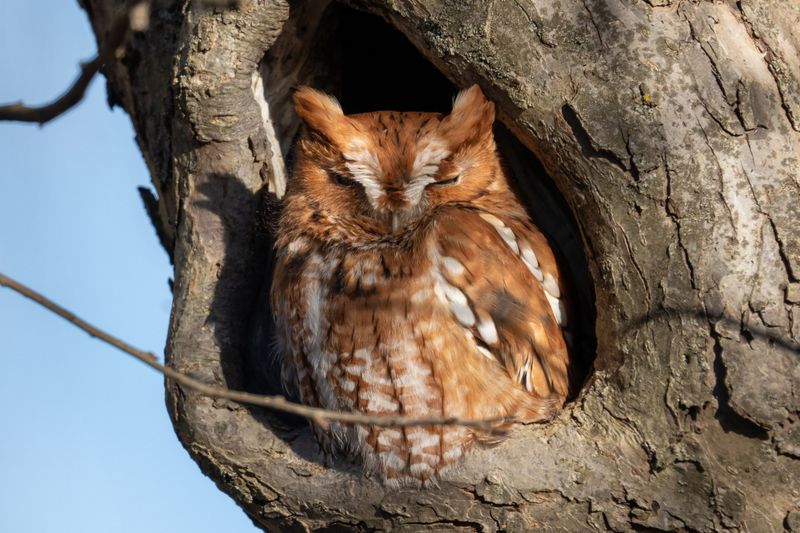
Every autumn, as leaves thin and the air cools in the Piedmont, Coastal Plain, and mountains of North Carolina, homeowners start noticing a small, bark-patterned owl settled into the same oak limb or hollow. The natural assumption is that the bird has migrated in for the season, drawn by something the yard provides.
That assumption, while understandable, does not match how Eastern Screech-Owls actually live.
According to Audubon’s field guide for the Eastern Screech-Owl, this species is a year-round resident across its range, including throughout North Carolina. It does not migrate south in fall or north in spring the way warblers or thrushes do.
The USDA Forest Service species review confirms that Eastern Screech-Owls are largely sedentary, typically holding territories they use across all four seasons rather than shifting with the calendar.
So why does the owl seem to appear each fall? Several practical explanations fit better than migration.
Deciduous trees lose their foliage in autumn, removing the dense summer canopy that hid the bird from view for months. Cooler weather may also shift the owl’s daytime roosting behavior, prompting it to settle in more exposed, sun-warmed spots that happen to be easier for people to spot.
Increased time outdoors during pleasant fall weather means more observers paying attention.
Repeated sightings in the same tree do not establish that the same individual returns each year, either. Without reliable identification evidence, such as leg bands, uniquely marked feathers, or consistent photographic documentation, two or more different owls using the same favorable roost across separate seasons are indistinguishable from a single bird.
The sighting is real and meaningful, but it is most accurately read as evidence of a suitable roost, not proof of a loyal seasonal traveler.
The oak may be offering a dependable roost
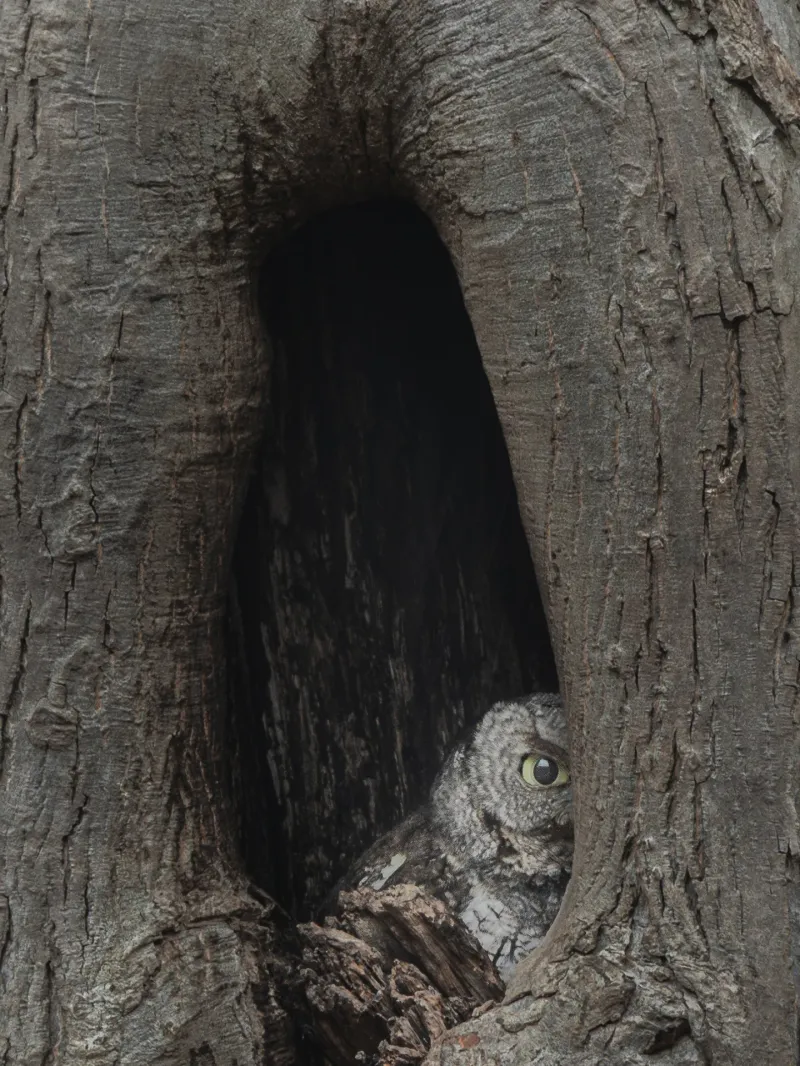
When an Eastern Screech-Owl settles into the same oak repeatedly, the tree is doing something genuinely useful for the bird. The most straightforward explanation is that it offers a dependable daytime roost, a place to sleep safely, stay hidden from predators, and ride out whatever weather the season delivers.
What makes a roost attractive has less to do with tree species than with physical structure. Eastern Screech-Owls use a remarkably wide range of roost sites.
A study of postfledging Eastern Screech-Owls published in The Auk documented roost use across dozens of tree and shrub species, including open limbs, dense tangles, conifers, and cavities. The oak in your yard may be chosen because it has a hollow, a tight fork, a sheltered branch facing away from prevailing wind, dense residual foliage, or simply bark texture that makes the owl nearly invisible to a passing crow or Cooper’s Hawk.
Weather plays a measurable role in roost selection. Research on winter roosting behavior of Eastern Screech-Owls in central Kentucky found that owls shifted toward enclosed cavities and nest boxes during wet or snowy weather and moved to open conifer limbs under milder conditions.
The same flexibility likely operates in North Carolina, where Piedmont winters differ meaningfully from mountain winters and coastal conditions differ from both.
A single territory can contain several usable roost sites, and research on male Eastern Screech-Owl roosting behavior shows that individuals often rotate among multiple cavities and perches rather than committing exclusively to one. The oak you watch may be a favored spot in a rotation, chosen on a given morning because of wind direction, recent predator activity, or simply proximity to where the bird hunted the night before.
Its repeated use signals that the tree consistently clears a threshold of shelter and concealment that other nearby options do not.
The yard can be part of a larger hunting territory
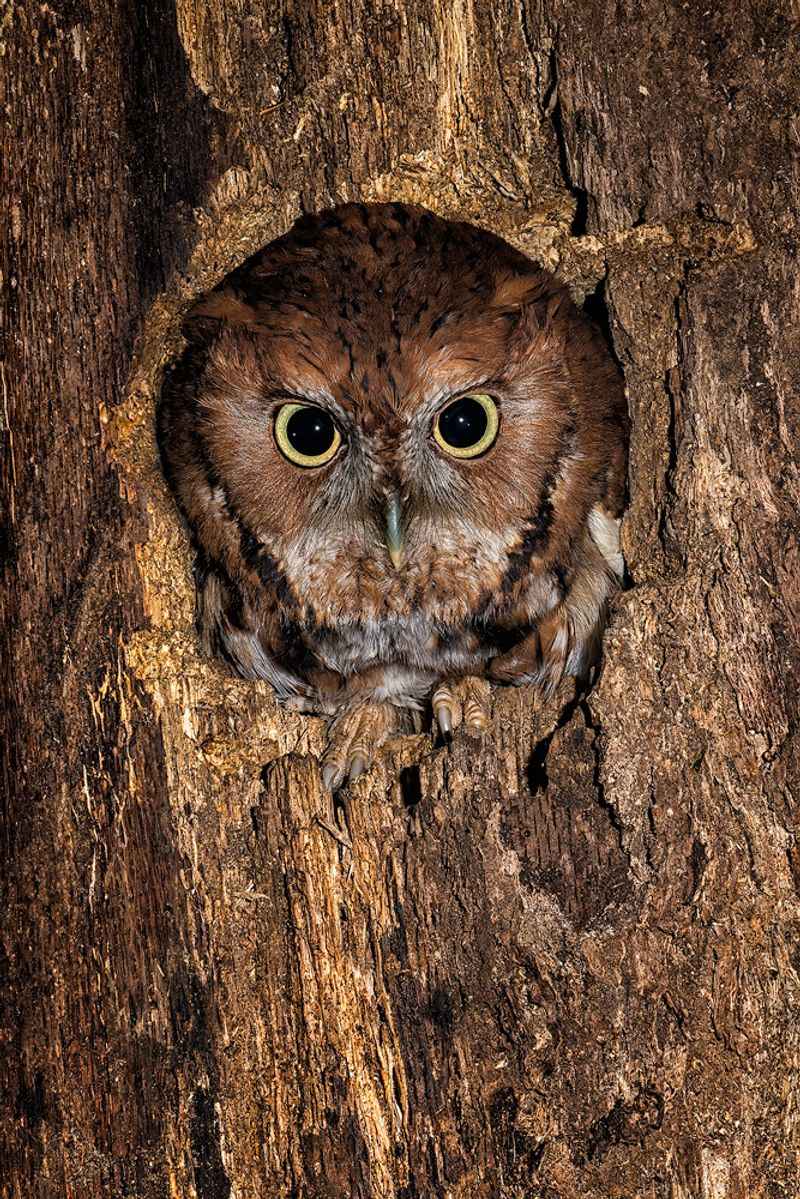
Food availability is a reasonable part of the picture, but the yard below the roost oak is probably not the owl’s only, or even primary, hunting ground. Eastern Screech-Owls operate across territories that can include multiple properties, woodland patches, open edges, stream corridors, and neighboring fields, moving through all of them on a single night’s hunt.
The species is a genuine generalist when it comes to prey. Cornell Lab of Ornithology’s Eastern Screech-Owl life history lists a diet that spans small mammals, small birds, insects, earthworms, crayfish, frogs, and lizards.
On any given night, the owl hunting across your yard might be after a cricket near the garden edge, a small frog near a low spot, or a mouse near a brush pile, depending on what is most available and easiest to catch.
The USDA Forest Service species review describes Eastern Screech-Owls using a wide variety of habitats for foraging, including suburban yards, city parks, farmland edges, open woodland, and areas near water. Your yard may contribute prey to the owl’s nightly rounds without being the sole supplier.
A stream two properties over, a neighbor’s brush pile, or a weedy field at the end of the block can all be part of the same functional territory.
Keeping the roost tree and the feeding area mentally separate helps avoid overclaiming. The oak where the owl sleeps during the day is not necessarily the spot where it hunts at night, and the yard directly below the roost is not necessarily the yard that provides the most food.
What connects all of these locations is a landscape that has remained porous enough, with enough cover and enough living complexity, to support a resident predator moving through it on its own schedule.
Treat the owl as a habitat clue, not an ecosystem certificate
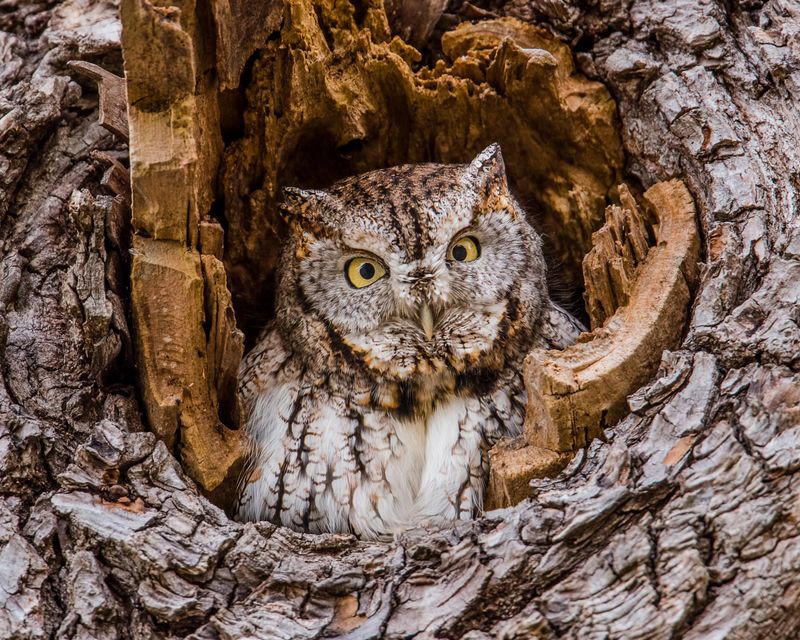
Seeing an Eastern Screech-Owl in the same oak each fall is genuinely encouraging. It means the landscape around your property currently supports at least one resident predator, which requires some combination of usable roost structure, cover, and accessible prey somewhere within the owl’s range.
That is a positive signal worth paying attention to.
What the sighting does not do is certify the yard as an unusually healthy ecosystem or confirm the absence of problems. Cornell’s life history account makes clear that Eastern Screech-Owls occupy suburban landscapes, city parks, and residential yards, including ones with pesticide use, invasive plants, and significant human disturbance.
Their adaptability is one of their defining traits. An owl in the oak does not tell you whether the yard is free of rodenticides, herbicides, or invasive species.
Specific promises about pest control are also unsupported. Eastern Screech-Owls eat varied prey, as outlined in the USDA Forest Service species review, and a sighting cannot be translated into a reliable claim about local mouse populations, rat activity, or tick abundance.
The owl may eat some rodents on some nights, but it also eats many other things, and its presence does not guarantee that any particular pest is being controlled.
Regional context matters here too. North Carolina’s Piedmont, Coastal Plain, and Blue Ridge mountains differ in tree communities, climate patterns, elevation, and surrounding land use.
A screech-owl roosting in a suburban Raleigh oak and one roosting in a mountain-edge yard near Boone are both Eastern Screech-Owls, but the habitat combinations supporting them can look quite different. The owl is a useful clue that something is working, not a report card with a final grade.
Protect the cavity before changing the tree
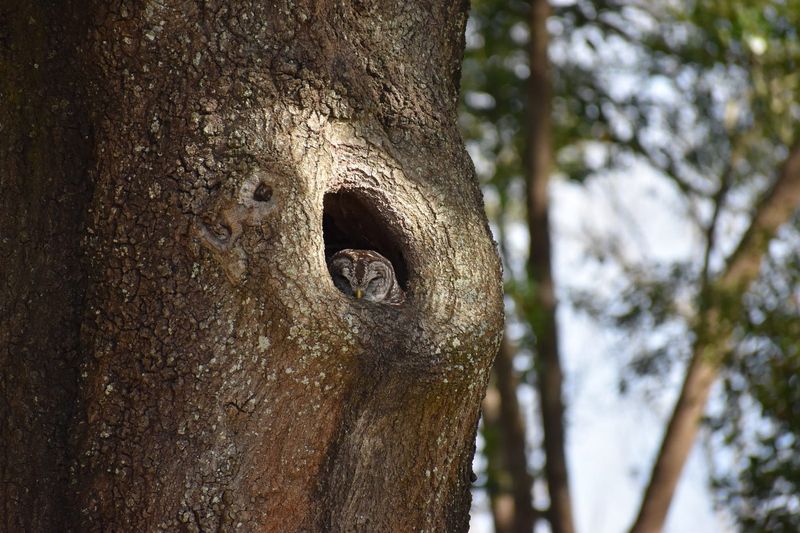
One of the most common mistakes homeowners make after spotting a roosting owl is assuming the tree needs to change. Sometimes the impulse runs the other way: the owl disappears for a few weeks, the tree looks rough, and the chainsaw comes out.
Either reaction can eliminate a roost structure that took decades to form.
Natural cavities are not easily replaced. Cornell’s Eastern Screech-Owl life history notes that the species depends on existing cavities, whether excavated by woodpeckers, formed by decay, or installed as nest boxes, because it cannot create its own.
A cavity that looks unused during one observation period may be occupied again within days, weeks, or the following season. The USDA Forest Service species review confirms that cavities and roost structures are among the most important habitat features for this species across its range.
That said, tree safety is a real concern and should not be dismissed in favor of habitat value alone. A hollow or heavily decayed oak can become structurally compromised, especially when large limbs are involved or the cavity has extended into load-bearing wood.
Before making any decision about removing or significantly pruning a cavity-bearing tree, contact a certified arborist. A qualified professional can assess whether the hazard involves the whole tree or only specific limbs, and whether the dangerous portion can be addressed while the cavity and most of the tree remain intact.
Retaining safe portions of a mature tree, even when some work is necessary, is almost always preferable to full removal. A snag, a shortened trunk, or a preserved cavity limb can continue to serve the owl and other cavity-dependent wildlife long after the tree’s active growing life ends.
Protect the structure first, then manage around any genuine safety risk with targeted, informed decisions.
Improve habitat without trying to bait the owl
Habitat improvement is the most responsible and effective way to support a roosting owl, and most of the practical steps are things that benefit a wide range of native wildlife at the same time. The foundation is retaining what already exists: mature trees, natural cavities, snags, and patches of dense cover.
These features take decades to develop and cannot be replicated quickly with purchased products.
NC State Extension’s guidance on managing urban habitats for birds recommends providing food, water, and cover through habitat design rather than feeders alone, and highlights native plants as especially valuable because they are more likely than many non-native species to support the insects, amphibians, and small animals that native predators depend on. Replacing invasive shrubs or vines with native alternatives, keeping some leaf litter on the ground, and maintaining a mix of open lawn and shrubby border all contribute to a yard that functions as connected habitat rather than an ornamental display.
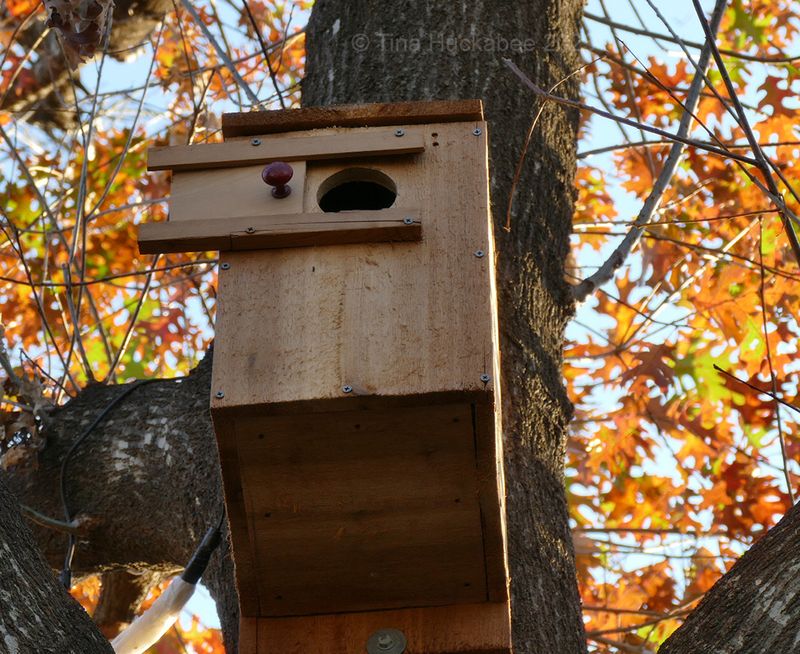
A nest box can supplement natural cavities when the latter are scarce. Cornell Lab’s Eastern Screech-Owl overview suggests installing a box before the breeding season, roughly late winter in North Carolina.
NC State’s guidance describes a typical Eastern Screech-Owl box as approximately 8 by 8 inches in floor size, 9 to 12 inches deep, with a 3-inch entrance hole, mounted between 10 and 30 feet high on a tree or post. Placement matters: face the entrance away from prevailing weather, near but not directly over dense shrubs that could shelter climbing predators.
Putting out food or live rodents to attract the owl is not a responsible approach. Cornell’s life history account supports habitat management and nest boxes as the appropriate tools; it does not support feeding.
Artificial feeding can introduce disease, create dependency, attract competing wildlife, and expose the owl to prey animals that may carry pathogens or toxins. Let the habitat do the work.
Avoid turning rodent control into a wildlife hazard

Rodents showing up near the house is a common concern for North Carolina homeowners, and the presence of a roosting owl sometimes tempts people toward a shortcut: use poison bait to increase the local rodent population the owl can hunt, or simply assume the owl is handling it. Both approaches carry real risks.
Eastern Screech-Owls do eat rodents, but as noted throughout this article, their diet is broad and variable. Relying on the owl for rodent control is not realistic, and using rodenticides in a yard where an owl is active can directly harm the bird.
EPA’s rodent control pesticide safety review identifies documented risks to birds and mammals that consume poisoned rodents, a process called secondary poisoning. When a rodent eats a bait block and is then caught by an owl, the owl ingests whatever toxicant the rodent carried.
Research makes this risk specific to Eastern Screech-Owls. A USGS study on the toxicity and risk of diphacinone to Eastern Screech-Owls found toxic effects under experimental exposure conditions, confirming that this species is vulnerable to anticoagulant rodenticides through the food chain.
Diphacinone is one of several first- and second-generation anticoagulants that remain in common use.
Before reaching for a rodenticide, work through a hierarchy of safer options. Seal gaps in foundations, siding, and utility entries to exclude rodents from structures.
Store pet food, birdseed, and compost in secure, rodent-proof containers. Remove debris piles and dense ground cover close to the house that provide rodent shelter.
Snap traps placed in tamper-resistant stations can be effective for targeted control without the secondary-poisoning risk. If chemical control becomes genuinely necessary after exhausting these steps, follow current EPA requirements and product label instructions carefully, and keep bait stations away from areas where wildlife actively forages.
Observe quietly and preserve the habitat connection
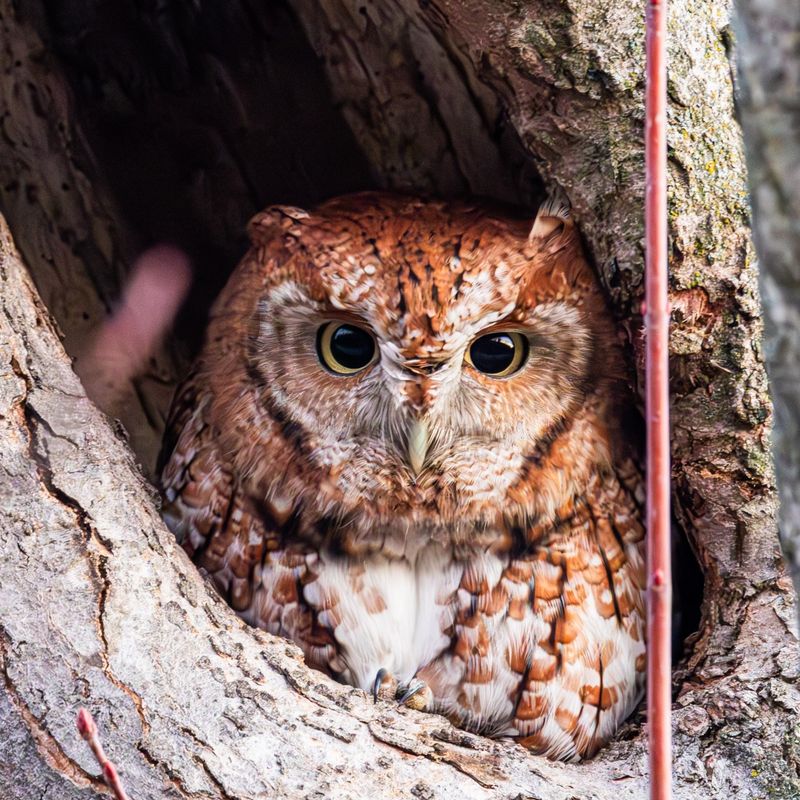
Knowing what draws the owl to the same oak changes what responsible observation looks like. The bird is not a pet, a pest-control service, or a sign that the yard has achieved ecological perfection.
What the recurring presence most reliably signals is that some part of the property and surrounding landscape currently works for a resident predator, offering enough structure, cover, and accessible prey to make a territory worth holding.
Quiet, distant observation is the right approach. U.S.
Fish and Wildlife Service guidance on bird nests notes that most nests and dependent young of native birds carry legal protection, and cavity nests in particular can be difficult to inspect without causing harm. Do not probe the cavity with a stick or flashlight, repeatedly approach the roosting tree, or attempt to handle or relocate the bird.
A startled owl flushed from its daytime roost loses rest it needs for the coming night’s hunt and may abandon a roost it has used reliably.
Cornell Lab’s Eastern Screech-Owl overview and NC State Extension’s urban habitat guidance both point toward the same practical conclusion: protect the structure, strengthen the connected habitat, skip the poison and artificial feeding, and consult a certified arborist before altering any cavity-bearing tree. An owl that keeps returning to your oak is not telling you the yard alone feeds it.
It is telling you that the landscape around it still has enough working pieces to support a small, sharp-eyed predator on its nightly rounds. That is worth protecting carefully.