
Why Yellowjackets Hammer Some North Carolina Yards All Fall While The House Next Door Stays Quiet
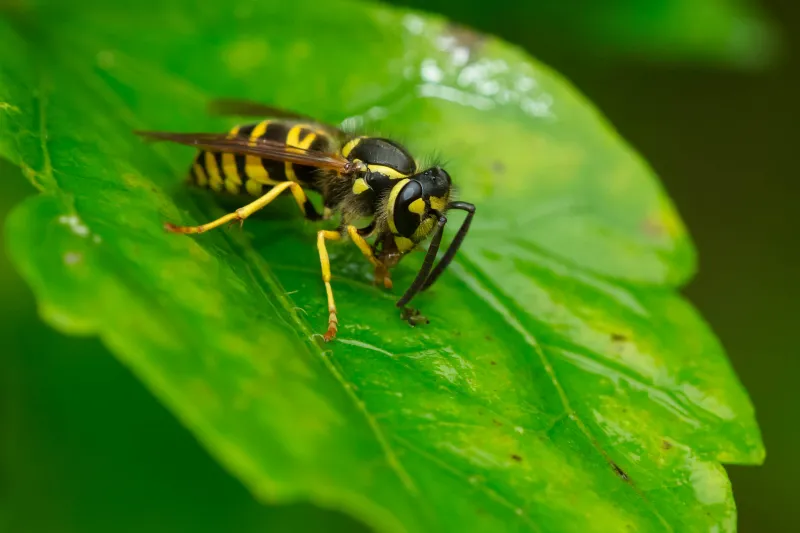
You are grilling on the patio, and the wasps seem to find you, but your neighbor sits outside without a single buzz. It can happen, and it is not always about who keeps the tidier yard.
Yellowjacket activity often grows in late summer and fall, and the reasons behind yard-to-yard differences are a mix of nests, food, and plain luck. Here is how to make sense of it and what you can realistically do.
Why yellowjackets become more noticeable in late summer and fall
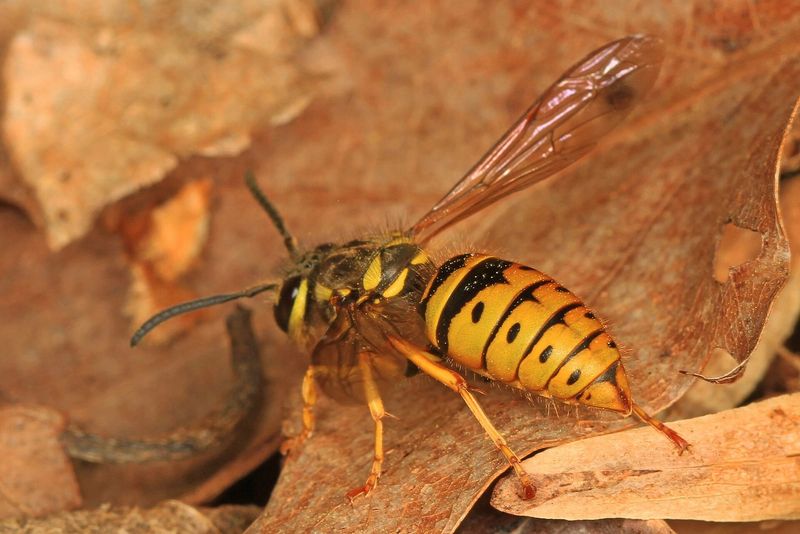
Colonies start small. In spring, a single queen builds a nest and raises the first workers, and the group grows through the warm months.
By late summer, NC State Extension explains that colonies of the eastern yellowjacket, the most abundant species in North Carolina, are at their most active, and some may reach about 3,000 workers.
More workers means more wasps out looking for food. As the season moves toward fall, foragers also tend to go after sugary foods and sweet drinks, which puts them in contact with people on patios, at picnic tables, and around trash cans.
University of Maryland Extension describes this same life cycle, in which colonies build through summer and then wind down as cold weather arrives.
Timing is a general pattern, not a calendar date. Weather, species, and location across the Coastal Plain, Piedmont, and mountains can shift when people first notice more wasps, and how long it lasts.
A busy week in September does not mean the whole fall will look the same.
Seasonal growth also cannot explain why your yard seems busier than the one next door. It tells you why wasps are more noticeable for many households at this time of year.
The reasons for differences between neighbors come from nest location, food, and local conditions, which the next sections sort out.
A nest in one yard can send foragers into another
Seeing yellowjackets in your yard does not prove their nest is there. Workers travel from the nest to find food, and Oregon State University Extension notes that foragers can range well beyond it.
A nest across the fence, down the street, or in a wooded lot could be sending wasps your way.
It works the other way too. A yard can hold a hidden nest while the people living there see little activity until the colony grows large late in the season.
So two neighbors may have very different experiences, but nothing here gives you a reliable rule for predicting which yard will be busier.
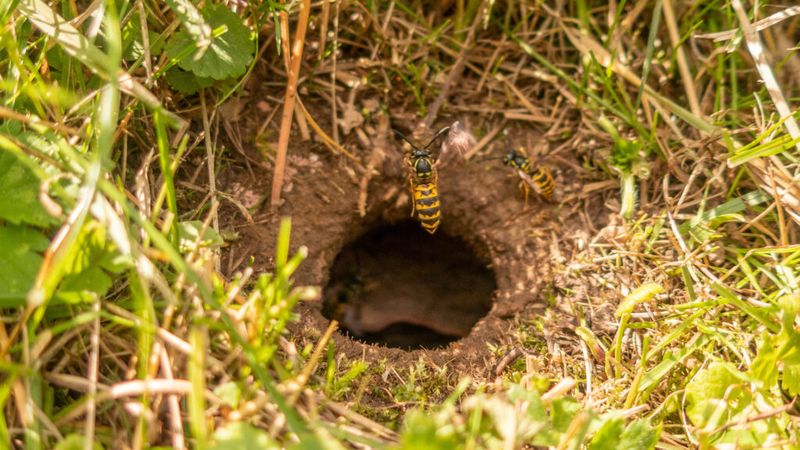
Where do yellowjackets nest? NC State Extension lists underground cavities, often near landscape timbers or in lawns.
Its turf guidance adds sandy, exposed lawn areas and the bases of trees or shrubs. Some colonies also settle in wall voids, attics, or sheds.
None of this means ordinary lawn care or changing plantings will prevent a nest. It simply helps you know which spots deserve a wide berth.
If you are unsure whose property holds the nest, treat the wasps as a shared neighborhood issue rather than a matter of blame.
Food can make a yard a foraging stop
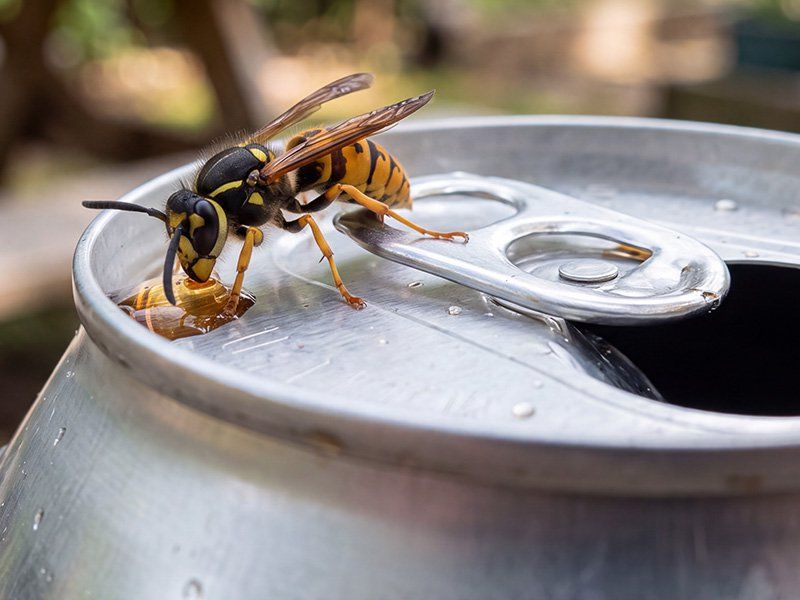
Picture a peach tree dropping fruit on the grass, an open soda can on the deck rail, and a trash can with a loose lid. To a hungry forager, that is a buffet.
NC State Extension points out that yellowjackets visit nectar and many human foods, which brings them into places where we eat and relax.
A few habits can lower the odds of run-ins. Harvest fruit as it ripens and clear what falls, especially figs, pears, apples, and muscadines.
Keep food and drinks covered while you are outside, and check cups before sipping. Use trash cans with tight lids and rinse recycling.
University of New Hampshire Extension also lists food and garbage management as a basic way to cut down on wasp visits around the home.
Now the limit. Cleanup may make a patio or eating area less attractive, but it does not remove a colony and cannot reliably prevent a nest from forming.
A tidy yard can still have wasps if a nest sits nearby, and a messy one may see few. Think of sanitation as a way to reduce conflict at the table, not a guarantee of a sting-free yard.
What repeated traffic can—and cannot—tell you
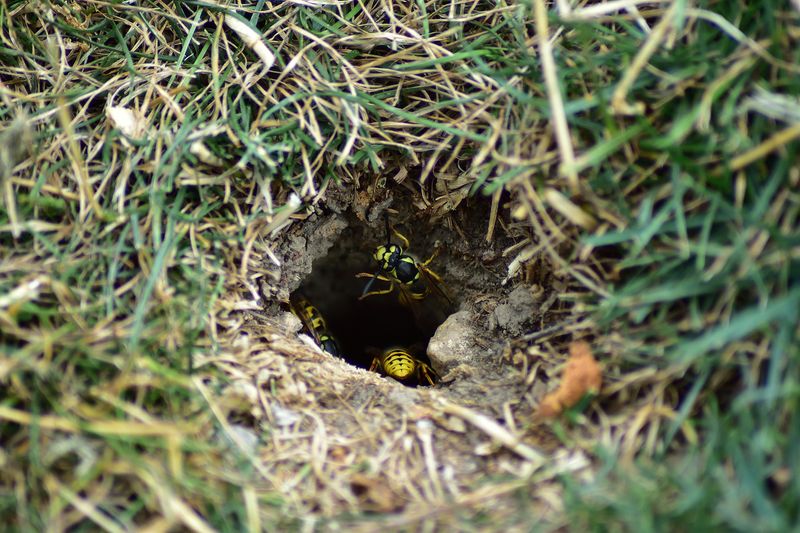
Wasps that fly in and out of the same spot again and again may be using a nest entrance. University of Maryland Extension advises avoiding such an area and not disturbing it.
Treat it as a place to stay away from, not a puzzle to solve up close.
From a safe distance, you might notice small holes in the ground, a hole at the base of a tree or shrub, or traffic near a wall crack, shed corner, or attic vent. NC State’s turf guidance notes that exposed sandy patches of lawn can be nest sites.
Watching for a few minutes can show you where the traffic is heading.
If you see a likely spot, mark it from far away with a flag or stake, then keep people and pets clear. Do not mow over it, poke it, strike it, or reach into it to check.
Watching has limits. You may not be able to confirm that a nest is really there, and you cannot tell from traffic alone who owns the land it sits on.
A single wasp landing on a hole is not proof either. The goal is simply to know where to avoid, especially before mowing or trimming.
Choose a response based on risk, not irritation
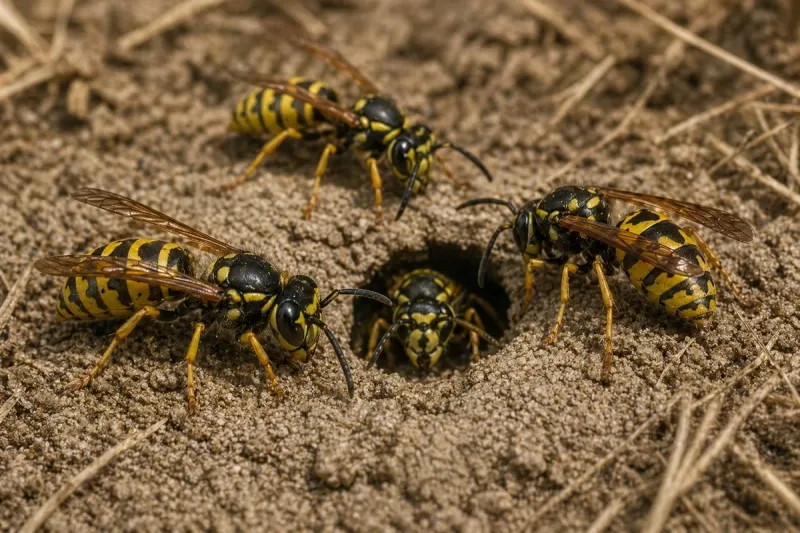
Annoyance is not the same as danger. A nest tucked into a quiet corner, far from where anyone walks, can often be left alone.
University of Maryland Extension explains that colonies die out with the season, so waiting can be a sensible choice when nobody has to pass close by.
The picture changes if the nest is near a doorway, walkway, play area, or any spot you cannot avoid. The same goes for nests in wall voids or other hard-to-reach places.
In those cases, contact a pest-management professional who can handle it safely.
Skip the dramatic home remedies. Do not burn a nest, flood it, pour gasoline or other accelerants into it, or seal an active entrance.
These steps can be dangerous and can provoke defensive wasps. Even a quick strike or a stomp can bring a swarm.
University of New Hampshire Extension also stresses caution around nests and recommends help when the situation is risky.
Keep children and pets away from any marked area, and wear closed shoes when walking through grass in late summer.
Know the emergency signs, too. After a sting, trouble breathing, swelling of the face or mouth, throat tightness, or difficulty swallowing means you should call 911.
MedlinePlus lists these as signs of a serious reaction. Do not wait to see if they pass.
Traps and pesticides have limits
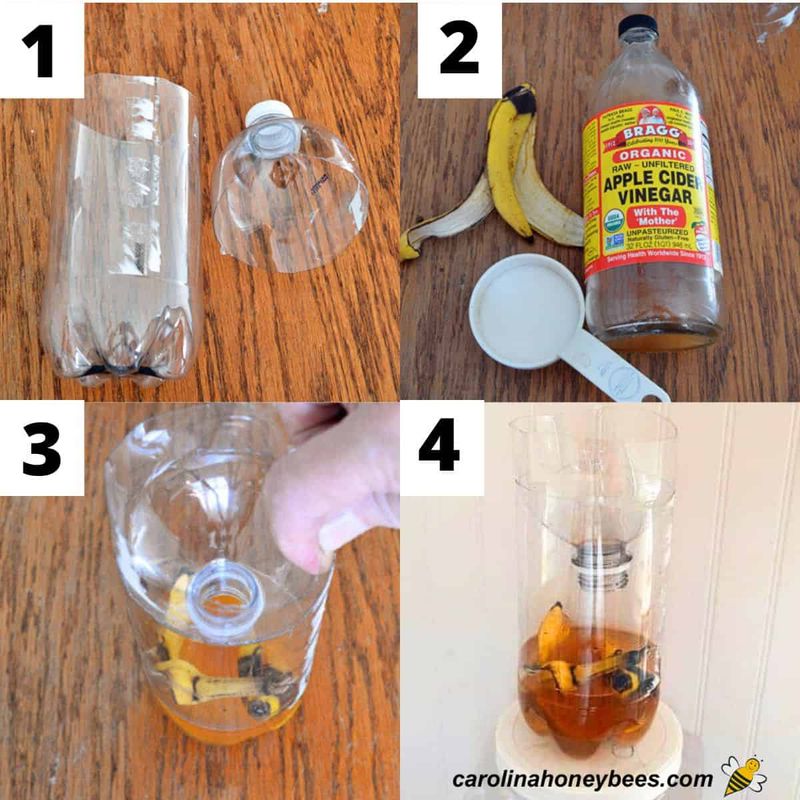
A trap can seem like a clear fix, but it has limits. Traps may catch some local foragers, yet they do not eliminate a colony, which keeps producing workers.
NC State Extension notes that common commercial lures work poorly for the eastern and southern yellowjackets that are most common in North Carolina.
If you do try one, place it away from patios and places you want to protect, since the lure can draw wasps toward it. The UC Statewide IPM Program describes traps as a limited tool, not a cure.
Remember that yellowjackets are not purely a nuisance. They prey on pest insects and visit flowers for nectar, which is part of why blanket spraying is a poor idea.
Broad treatments can also reach bees, butterflies, birds, and pets.
If treatment is truly necessary, use only a product labeled for that use and follow its current label. The EPA explains in its guidance on reading labels that labels spell out safe and effective use, and its tips for reducing pesticide impacts on wildlife show how misuse can harm species you care about.
Old directions copied onto web pages may not match what is on today’s product, so always check the label in your hand.
Prepare for next spring without expecting a guarantee
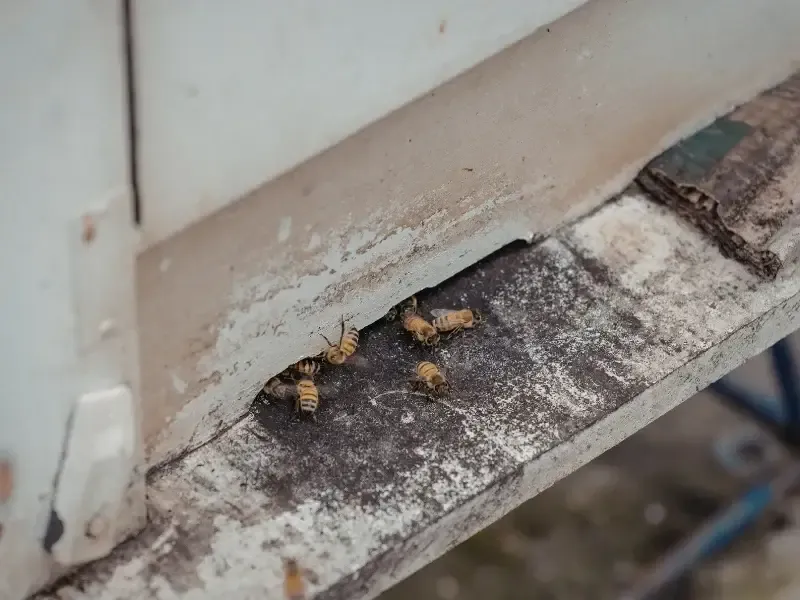
Late winter and early spring are good times for a walk around the house. Look for cracks, gaps, and small openings in siding, trim, and soffits.
University of New Hampshire Extension suggests sealing these to reduce access to wall spaces.
Never seal an opening while a nest may be active, because trapped wasps can chew through into living spaces. If a nest in a wall needs attention, arrange professional handling rather than tackling it yourself, as University of Maryland Extension cautions.
Here is the part many people miss. Colonies are annual, and NC State Extension explains that a fertilized queen overwinters and starts a new nest in spring.
Old nests are not reused, as Oregon State University Extension also describes. So removing this year’s colony cannot promise that no nest will appear nearby next year.
A sensible plan is simple. Seal building gaps in spring, pick fruit promptly, keep food and trash covered, and watch for traffic from a distance as summer builds.
You can lower the odds of trouble, but a quiet season is never something any yard can guarantee.