
What It Really Means When Wasps Keep Nesting Under Your North Carolina Eaves As Summer Ends
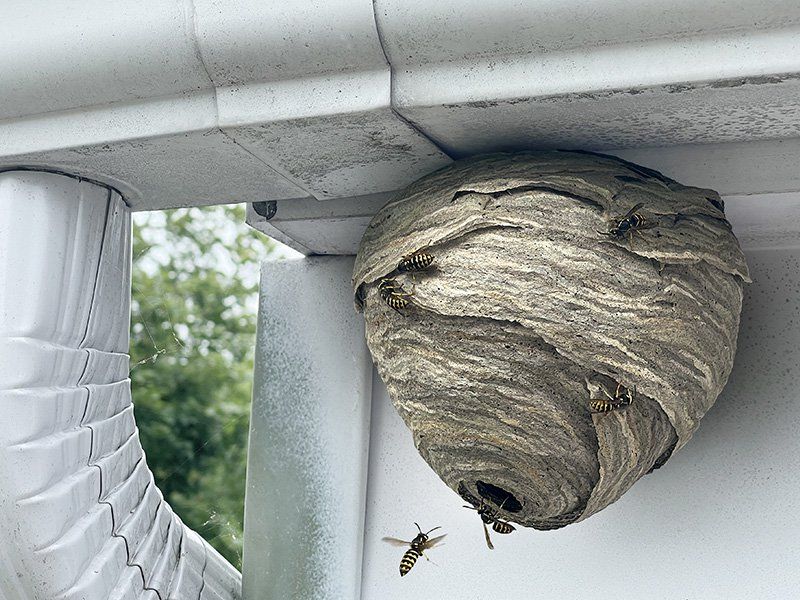
Every August and September, North Carolina homeowners start noticing more wasp activity under their eaves, and the same question comes up: what does it mean, and what should you do about it? The answer depends less on the time of year than on what you actually see – an exposed papery nest, or wasps slipping into a gap in your siding or soffit.
Reading those clues correctly helps you protect your family and pets without reaching for a spray can out of habit. This article walks through how to tell one situation from the other and how to decide on the right response.
An exposed nest and a hidden nest tell different stories
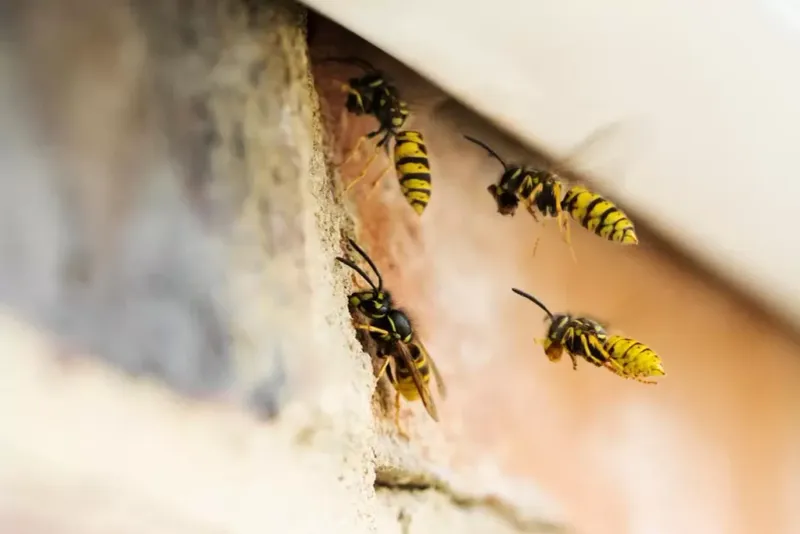
Spotting a papery gray structure tucked under your eave and watching wasps disappear into a crack in your soffit are two very different situations, even though both show up as “wasps under the eaves” in a homeowner’s mind. The distinction matters because each pattern points to a different nest type, a different species profile, and a different set of risks.
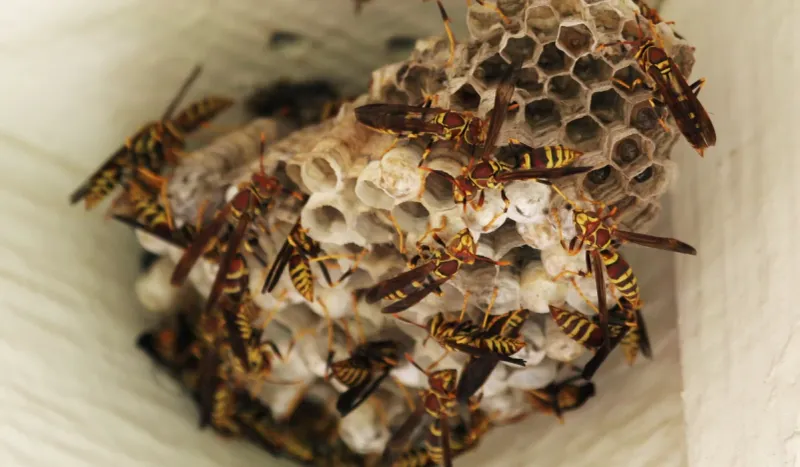
An open, umbrella-shaped comb attached by a short stalk to a horizontal surface is a classic sign of a paper wasp. NC State Extension’s guide to non-honeybee stinging insects describes paper wasps as slender, long-legged wasps that build exposed nests with visible hexagonal cells, commonly under eaves, overhangs, awnings, and porches.
The eave provides exactly what the nest needs: a sheltered horizontal surface, protection from rain, and stable attachment. That choice reflects the structure’s physical qualities, not a signal that the house has a cleanliness problem, excess moisture, or a hidden insect infestation inside the walls.
Activity disappearing into a gap tells a different story. Wasps entering a soffit hole, a crack in the fascia board, or an attic vent may be accessing a concealed cavity nest.
UC IPM’s overview of yellowjackets and other social wasps notes that cavity-nesting species, including yellowjackets, readily use wall voids and structural gaps. That situation warrants a different risk assessment than a visible paper-wasp nest hanging in open air.
One reason the nest surprises homeowners in late summer is timing. Penn State Extension’s paper on European paper wasps explains that colonies start small in spring and grow steadily through summer.
By late summer or early fall, the colony and its flight activity are large enough to notice for the first time. The nest did not appear overnight; it simply became visible.
The decoding method used throughout this article rests on five clues: species characteristics, nest design, location relative to human activity, traffic level at the entrance, and seasonal timing. None of those clues alone is definitive, but together they give a homeowner enough information to make a calm, evidence-based decision.
The nest shape narrows the identification
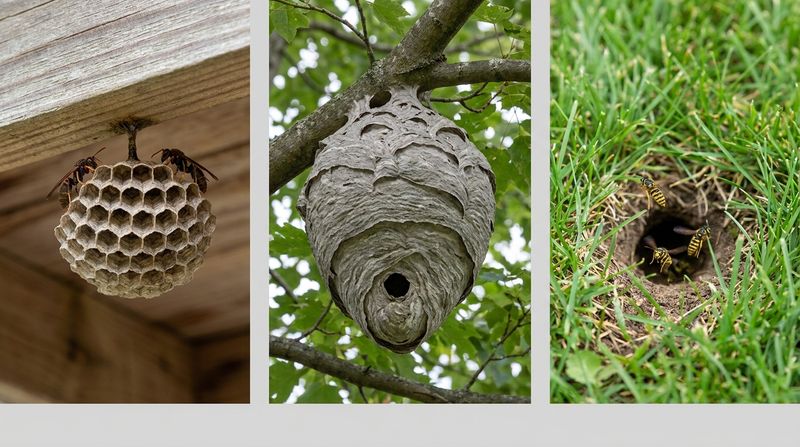
Nest shape is the fastest sorting tool available without touching or disturbing anything. A few calm observations from a safe distance can narrow the field considerably, even if they cannot give you a laboratory-grade identification.
An exposed comb with visible hexagonal cells, attached beneath an eave by a short central stalk, points strongly toward a paper wasp. NC State Extension’s stinging insect resource describes North Carolina paper-wasp colonies as typically reaching several dozen adult workers.
They are active predators of caterpillars and soft-bodied arthropods, which gives them genuine ecological value in a garden. Their defensive behavior is focused on the nest: disturb it, and you risk stings; walk past it without threatening it, and most encounters are uneventful.
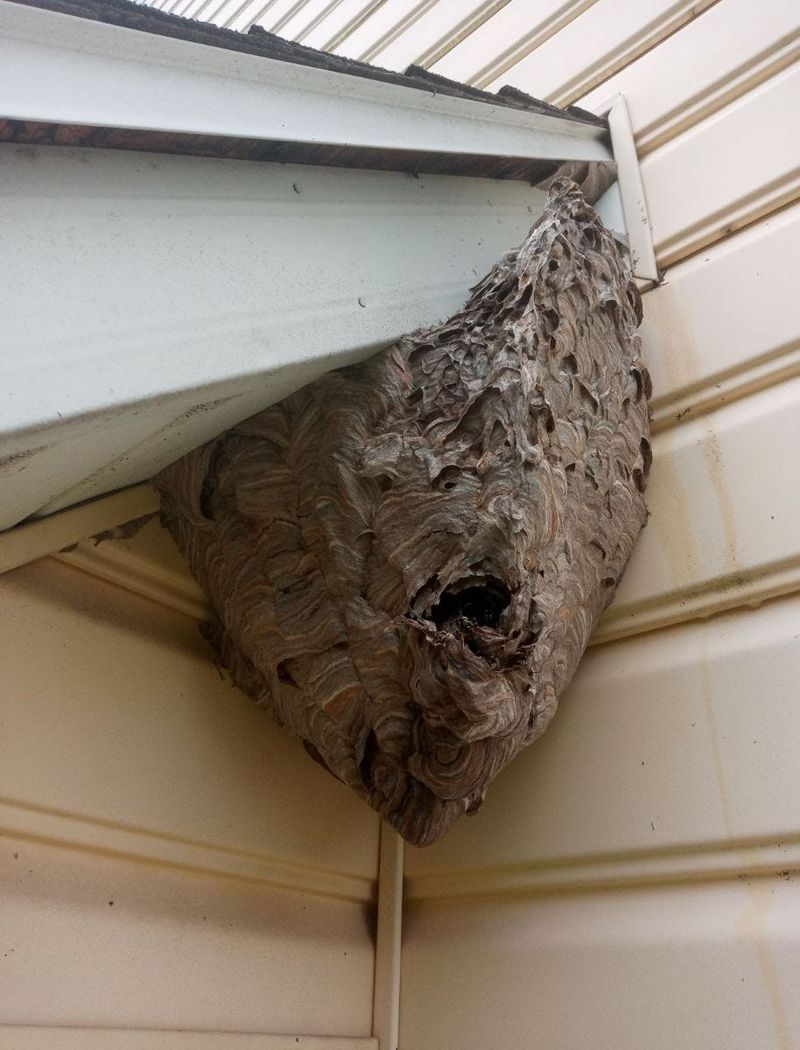
A large, enclosed, football-shaped nest covered in gray paper is a different matter. NC State Extension’s bald-faced hornet page explains that these insects, technically an aerial yellowjacket species, build layered paper nests that may be attached to trees, shrubs, or protected building locations.
Their colonies can be highly defensive when the nest is approached, which changes the risk calculation compared to a small paper-wasp comb.
Wasps entering a hole in a wall, a gap around a soffit, or an attic vent suggest a concealed cavity nest. UC IPM notes that yellowjackets frequently use underground burrows but also nest in wall voids, attics, and other structural cavities.
Their colonies can reach hundreds of workers and they can sting repeatedly, so a cavity nest near living areas carries more risk than a small exposed comb in a corner of the porch.
Two other types are worth recognizing so they are not treated like social wasps. Mud daubers build small, tubular nests made of hardened mud on walls and under overhangs.
NC State’s bee hotel resident guide notes that solitary wasps generally do not defend a communal colony the way paper wasps or yellowjackets do. Mud daubers are rarely aggressive toward people and present a much lower sting risk than social species.
Penn State Extension’s stinging-insect management guide reinforces that identification should precede any decision about removal, because the appropriate response varies significantly by species.
Why late summer makes the signal louder
Wasp activity feels more intense in August and September partly because it actually is more intense, and partly because the same nest that was invisible in May has grown large enough to be impossible to ignore. Understanding why that happens helps separate a genuine change in risk from a seasonal illusion.
Paper-wasp colonies expand continuously from the time a queen starts the nest in spring through the end of summer. NC State Extension’s stinging insect guide describes early fall as the period when paper-wasp colonies begin producing reproductive males and new queens rather than additional workers.
Flight activity around the nest reflects that larger population, which is why a homeowner who never noticed the nest in June may find it hard to miss in September.
Yellowjacket colonies follow a different arc. NC State’s arthropod pest guide notes that yellowjacket colonies can remain active into late fall or early winter, depending on conditions.
By late summer their worker populations are at peak numbers, and the colony’s demand for carbohydrates increases. Burke County Cooperative Extension’s stinging insect summary points out that yellowjackets become more noticeable around outdoor food, sweet drinks, pet food, garbage, and fallen fruit during this period.
That scavenging behavior is what puts them at picnic tables and near trash cans, not simple aggression toward people.
Paper wasps behave differently from yellowjackets in this respect. University of Minnesota Extension’s wasp resource notes that paper wasps primarily defend the nest when it is threatened rather than actively pursuing people in the surrounding area.
The practical takeaway is that late summer deserves more attention, but the calendar alone does not determine whether a nest needs to come down. The nest’s location and how close people actually get to it matter more than the month.
When can a North Carolina homeowner leave the nest alone?
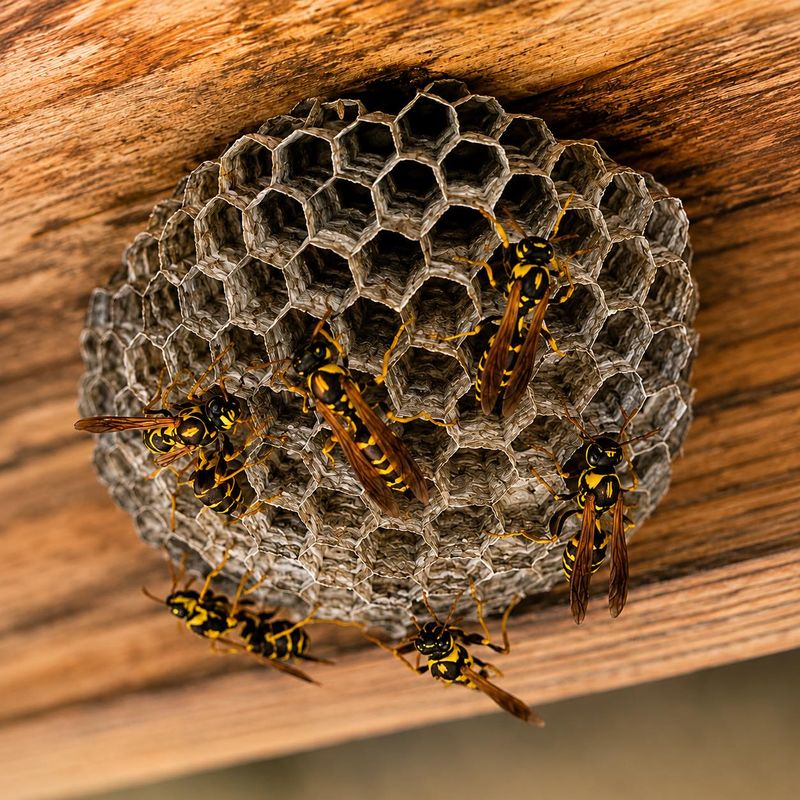
A wasp nest on your property is not automatically a problem that needs solving. The more useful question is whether the nest’s location creates meaningful exposure for the people and pets who use your yard.
Leaving a nest undisturbed makes the most sense when it sits well away from doors, walkways, patios, play areas, and routine maintenance zones. NC State Extension recognizes paper wasps as beneficial predators of caterpillars, flies, and other soft-bodied arthropods, making them useful residents in a wildlife-friendly North Carolina yard.
Leaving a nest in a low-traffic corner of the eave preserves that predation without putting anyone at risk. That tradeoff is worth making when the exposure is genuinely low.
The word “beneficial” does not mean harmless, though. NC State’s bald-faced hornet resource makes clear that even ecologically valuable species can be highly defensive when their nest is approached.
A nest that happens to be near a door people use twenty times a day, above a path children run through, or in a corner that a lawn mower passes close to is a different situation from a nest tucked under a back eave nobody walks beneath.
Several conditions reliably shift the calculation toward removal. Penn State Extension’s management guide identifies proximity to an entrance, location above a frequently used path, presence of children or pets in the area, and likelihood of disturbance from mowing, pruning, or repairs as key factors.
A nest inside a wall, attic, or other structural cavity carries additional risk because the colony size and behavior are harder to assess from outside, and the nest may not be accessible without opening the structure.
People with a known sting allergy in the household change the math entirely. Penn State’s bald-faced hornet guide recommends professional removal when allergy risk is present, regardless of nest size or species.
The decision to coexist should be based on an honest look at who uses the space and how close they actually get to the nest, not on a general preference for or against wasps.
Removal is a risk-management job, not a spraying reflex
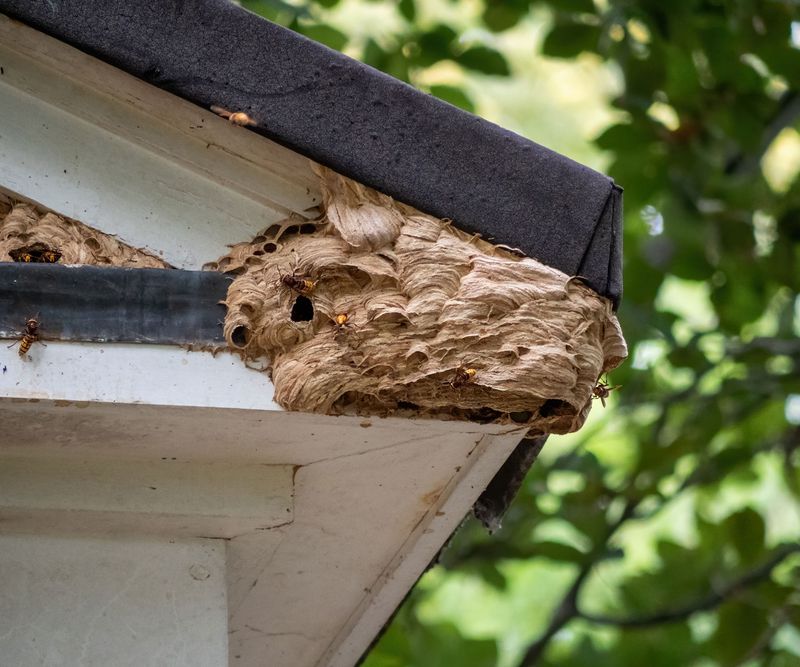
Before deciding how to handle an active nest, gather some basic information without putting yourself in range of a defensive response. Watching from a safe distance during daylight hours – without poking, knocking, hosing, or climbing toward the nest – tells you most of what you need to know.
Note the nest type and approximate size, where the wasps are entering and leaving, how close their flight path comes to doors or walkways, and whether any routine activity in that area would bring people within a few feet of the nest. Penn State Extension’s stinging-insect guide recommends this kind of calm observation as the foundation for any removal decision.
The goal is to match the response to the actual exposure, not to react to the presence of wasps as an automatic emergency.
Do-it-yourself removal can be reasonable for a small, accessible, exposed paper-wasp nest in a location where you can reach it safely from the ground with a clear exit route. UC IPM’s social wasp guidance notes that treatment timing, application method, and protective equipment all affect the outcome and should be matched to the specific situation rather than guessed at.
Several situations call for a licensed pest professional rather than a DIY attempt. Penn State’s bald-faced hornet resource specifically advises professional removal when the nest is large, when anyone involved has a known sting allergy, when the nest is concealed inside a wall or attic, or when accessing it requires a ladder or awkward roof position.
A fall from a ladder while being stung is a compounded hazard that outweighs any savings from handling the job yourself. Keeping the response matched to the structure, species, and exposure level gives you a better outcome than defaulting to the nearest spray can.
Small repairs can reduce repeat conflicts
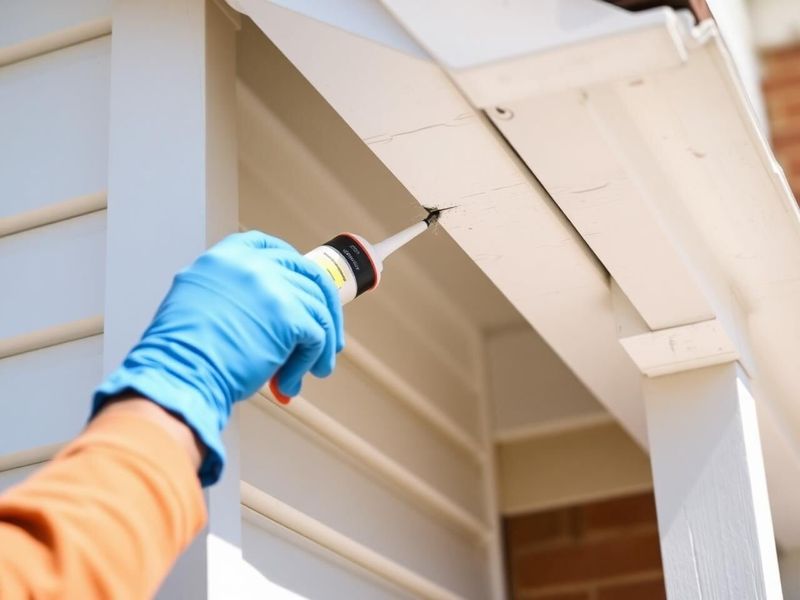
Addressing the active nest and reducing the chance of a repeat are two separate jobs that should be handled at different times. Prevention work makes the most sense after the season ends or after the current nest has been dealt with, not while wasps are still flying.
Structural repairs are the most durable prevention measure for exposed nests and cavity nests alike. Penn State Extension’s European paper wasp page recommends repairing gaps around soffits and eaves, screening vents and louvers, and caulking appropriate cracks that lead into structural cavities.
These steps remove the attachment points and entry routes that make your home’s exterior attractive to cavity-nesting species in the first place. They are worth doing regardless of whether you currently have a nest, because they also reduce opportunities for other pests to access the building.
For late-summer yellowjacket activity specifically, food management is the most direct lever available. Burke County Extension’s stinging insect guidance recommends keeping outdoor food and sweet drinks covered, securing garbage lids, and cleaning up pet food promptly.
UC IPM adds that removing fallen fruit from beneath trees cuts off a significant late-season carbohydrate source that draws yellowjackets into yards and near outdoor seating areas.
One widely circulated idea that does not hold up is the fake-nest deterrent. Penn State Extension reports no clear evidence that commercial or homemade decoy nests prevent wasps from nesting nearby, and notes observations of real nests being built in close proximity to decoys.
Skipping that step and focusing on physical exclusion and food management gives you a more reliable result. No single measure guarantees a wasp-free eave, but a combination of structural upkeep and reduced food attractants meaningfully lowers the odds of a repeat conflict.
Pesticide labels and sting symptoms set the hard limits
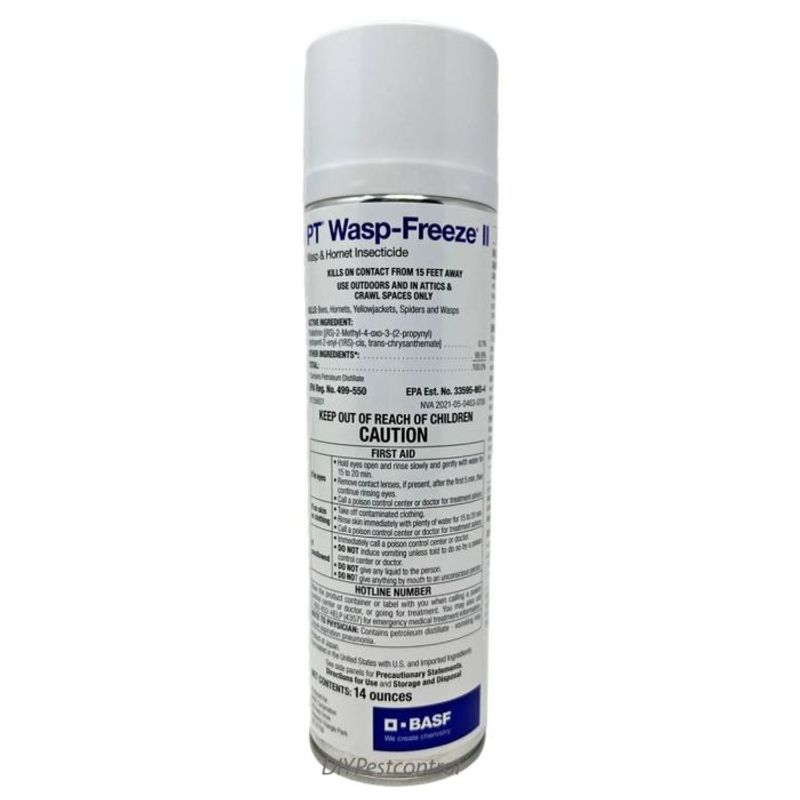
Two areas require clear limits: what is legal and safe when using a pesticide, and how to respond after a sting. Getting either one wrong can turn a manageable situation into a medical or safety emergency.
Any pesticide used against wasps must be registered for the specific pest, site, and application method listed on the label. The EPA’s introduction to pesticide labels states plainly that using a pesticide inconsistently with its label is illegal.
EPA pesticide registration guidance explains that labels specify outdoor use restrictions, proximity to water, protective equipment requirements, treated surfaces, and reentry timing. Those requirements are not suggestions.
Some product labels, such as registered wasp and hornet aerosol formulations, recommend applying when insect activity is lower, typically early morning or late evening. Other label formats include specific distance and directional requirements.
Timing guidance from a label can reduce the number of foragers present, but it does not make a large or concealed nest safe to approach. The label for the specific product you are using controls every aspect of the application.
Never use gasoline, kerosene, fire, or other improvised methods; these create fire hazards, toxic exposure risks, and property damage that no pest situation justifies. Penn State Extension is unambiguous on this point.
For sting response, the immediate steps are straightforward: wash the site with soap and water, apply a cold compress, and move away from the nest calmly rather than swatting at wasps. CDC guidance for outdoor workers recommends these same basic measures.
The harder part is recognizing when a sting has crossed from a local reaction into a systemic emergency.
Difficulty breathing, swelling of the throat or tongue, widespread hives, dizziness, or collapse are emergency warning signs that require a call to 911 and immediate medical care. The American Academy of Allergy, Asthma and Immunology notes that people with diagnosed severe sting allergies should carry prescribed epinephrine and use it as directed, but still seek emergency care afterward.
MedlinePlus’s insect sting article reinforces that epinephrine buys time but does not replace emergency evaluation. Any symptoms involving more than one body system after a sting are a reason to call for help, not to wait and see.
Read the nest before you choose the response
The sequence that leads to a good outcome is short: determine whether the wasps are using an exposed nest or entering a structural gap, identify the likely nest type from its shape and the wasps’ behavior, note how close the nest sits to doors and paths people actually use, and factor in late-season colony size before deciding what to do.
An exposed nest usually says more about available shelter than about any defect in the home or yard. NC State Extension frames paper wasps as beneficial residents of the North Carolina landscape when they are not posing a direct risk.
Concealed activity at a gap or vent warrants closer attention to structural access and a more cautious risk assessment, since cavity nests are harder to evaluate and harder to treat safely. Penn State Extension and UC IPM both point toward professional help when the nest is concealed, large, or accessible only from a ladder.
The stewardship balance for a North Carolina yard is genuinely achievable: protect the people and pets where the risk is real, and leave room for the wasps where it is not. A nest in the back corner of the eave, far from foot traffic, is a working part of the yard’s food web.
A nest above the front steps is a different conversation entirely.