
The One North Carolina Native That Hummingbirds Claim The Moment It Blooms In Your Yard
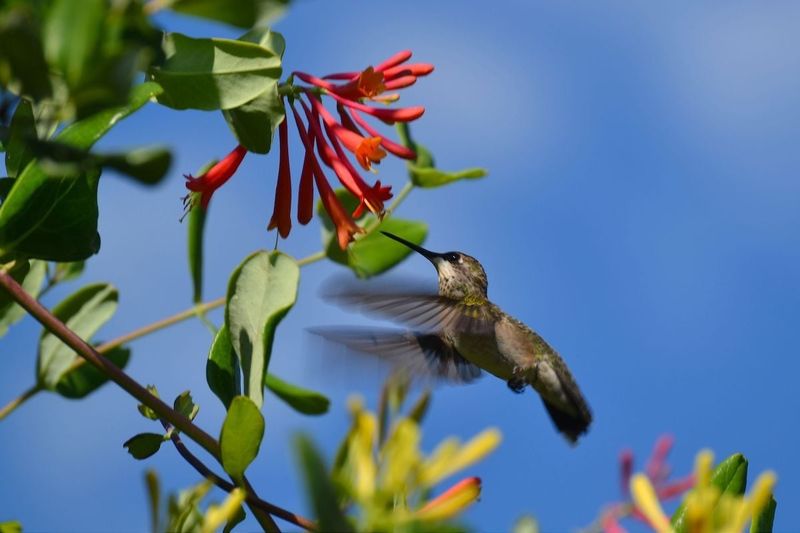
Most North Carolina yards get only fleeting hummingbird visits, but one native vine changes that equation in a real way. Coral honeysuckle, also called trumpet honeysuckle (Lonicera sempervirens), grows across the Coastal Plain, Piedmont, and mountains and produces clusters of red, tubular flowers that hummingbirds actively seek out for nectar.
Planting it will not conjure birds out of thin air or keep them in your yard forever, but it gives your garden something hummingbirds are wired to notice. Here is what makes this vine the strongest single native choice for most North Carolina homeowners, and how to use it well.
Coral Honeysuckle Is the Standout Native for Most North Carolina Yards
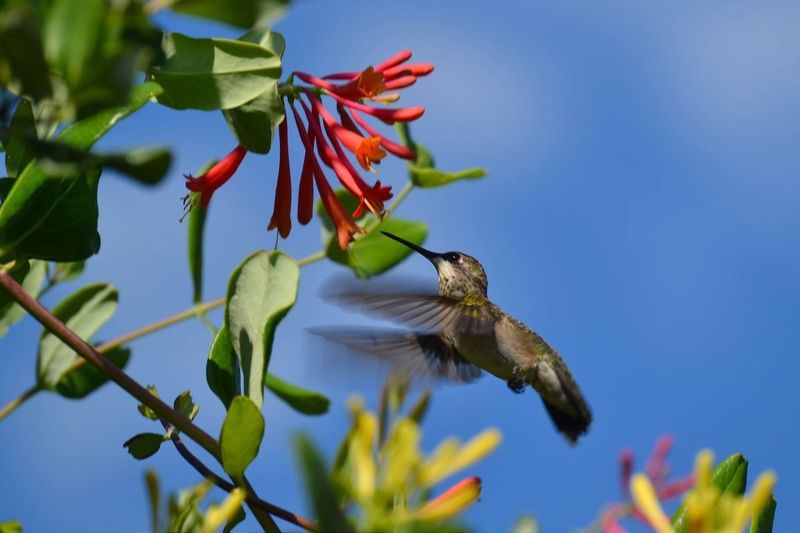
Coral honeysuckle, also known as trumpet honeysuckle (Lonicera sempervirens), earns its top spot not through marketing but through geography and biology. NC State Extension’s Plant Toolbox confirms that this perennial, twining vine is native across North Carolina’s Coastal Plain, Piedmont, and mountain regions, which means it is adapted to the full range of conditions that NC homeowners deal with, from humid coastal summers to cooler mountain springs.
That statewide range matters more than most gardeners realize. A plant that is native to your specific region has already sorted out local soil chemistry, seasonal rainfall patterns, and the insects that live alongside it.
Coral honeysuckle does not need coaxing to establish in an ordinary, well-drained garden bed, provided it receives adequate sun and a structure to climb. Its roots are already coded for North Carolina.
The promise in this vine’s reputation deserves a clear-eyed reading. Coral honeysuckle can make your yard significantly more inviting to hummingbirds, and repeat visits are a realistic outcome once the plant is established and blooming well.
What it cannot do is guarantee that a hummingbird will appear the first day the flowers open, remain in your yard exclusively, or stay through seasons when blooms are sparse. Attraction is the right word, not ownership.
For homeowners who want the clearest single recommendation, though, coral honeysuckle is it. Its native status, broad regional range, manageable garden requirements, and documented connection to hummingbirds place it ahead of any other single-plant option for most North Carolina yards.
Why Hummingbirds Key In on Its Flowers
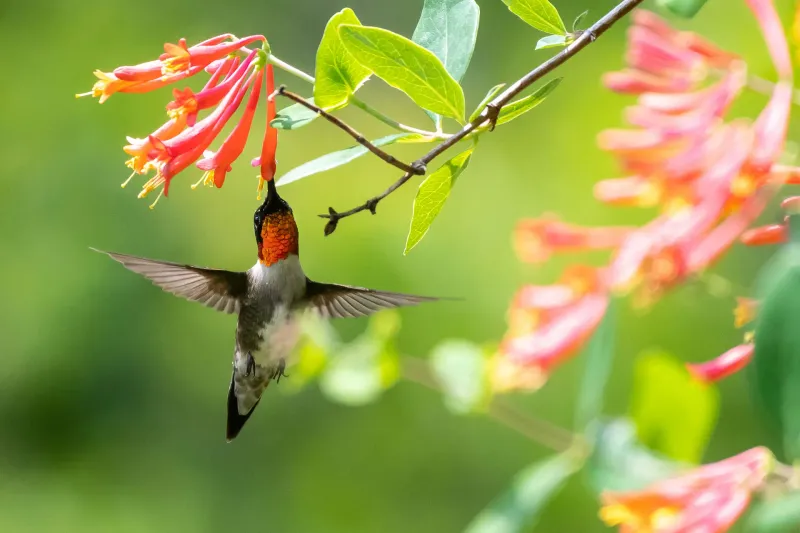
Ruby-throated hummingbirds and coral honeysuckle have a relationship that goes well beyond casual interest. NC State identifies hummingbirds as the plant’s primary pollinators, and the vine’s flower architecture explains why: the long, narrow, red tubes are shaped almost precisely for a hummingbird’s bill and reach, while bees and most other insects are locked out of the deepest nectar reserves.
Tubular flower form is a documented feature that NC State’s guide to managing urban habitats for birds links directly to ruby-throated hummingbird attraction. The birds hover in front of a flower, insert their bill, and lap up nectar with a tongue that moves at remarkable speed.
Coral honeysuckle’s blossoms are built for exactly that feeding style, and when a vine is in full flush, it can present dozens of flowers at once, giving a visiting bird a reason to linger rather than move on quickly.
Color is part of the picture, but it is only one piece. Research published in the Journal of Animal Ecology found that hummingbirds respond to a combination of flower shape, nectar reward, floral abundance, and accessibility, not color alone.
Red and orange flowers may catch a hummingbird’s eye during a scouting flight, but a flower that offers a poor nectar reward or is difficult to reach will be skipped over regardless of its color.
Coral honeysuckle scores well on multiple counts: the right shape, a reliable nectar reward, and enough flowers per vine to make a visit worthwhile. That combination is why the plant shows up consistently in hummingbird gardening recommendations from NC State and Audubon alike, rather than simply being promoted for having red flowers.
The Right Placement Turns a Native Vine Into a Visible Nectar Stop
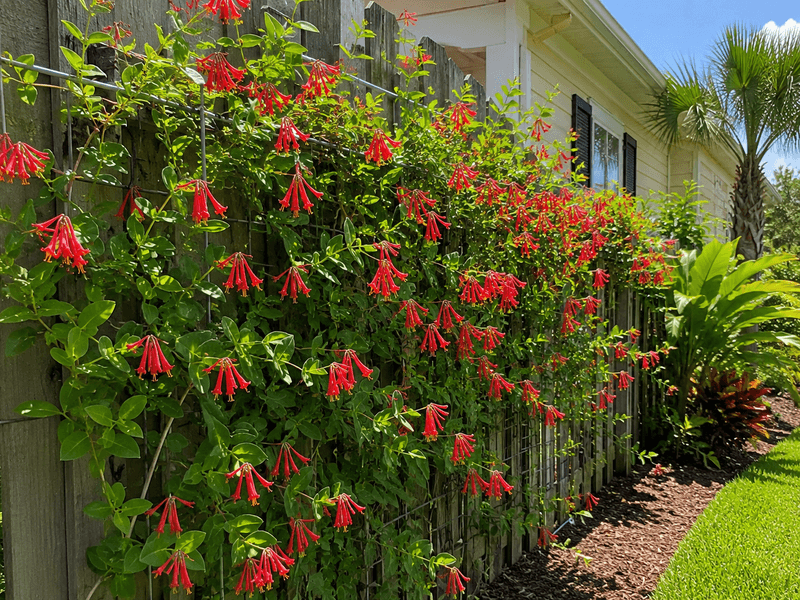
Location decisions made at planting time will shape how well coral honeysuckle performs for years. Full sun is where the vine earns its keep: NC State’s Plant Toolbox entry for Lonicera sempervirens specifies full sun for best flowering, and gardeners who tuck the vine into a shaded corner often find that it survives but produces far fewer blooms than expected.
Partial shade is tolerated, but shade reliably trims flower production, which is the one thing that makes the plant valuable to hummingbirds in the first place.
Soil preparation is straightforward. Coral honeysuckle prefers medium-moisture, well-drained, humus-rich soil.
It does not demand amended beds, but it will struggle in compacted clay that stays waterlogged after rain. If your site drains slowly, raising the planting area slightly or working in compost before planting can make a meaningful difference in how quickly the vine establishes and begins flowering.
Support is non-negotiable. The vine is a twiner that can reach roughly 10 to 20 feet at maturity, and without something to climb, it will sprawl across the ground or collapse on neighboring plants.
A sturdy trellis, wooden arbor, split-rail fence, or pergola post all work well. Choose a structure rated for the vine’s mature weight, especially in sites exposed to wind.
Lightweight wire trellises sometimes buckle under an established vine after several seasons of growth.
Coastal homeowners get a bonus that Piedmont and mountain gardeners do not: NC State lists coral honeysuckle as salt tolerant, which makes it a practical choice for yards near the coast where salt spray rules out many other ornamental vines. That said, salt tolerance does not mean the plant thrives in every exposed, windswept site; a location with reasonable shelter and good drainage still gives the best results along the coast.
Place the vine where you can see it from a window or sitting area. Hummingbird visits tend to be brief, and a plant positioned at the back of the property against a fence you rarely pass will give you far fewer sightings than one near a porch or patio where you spend time outdoors.
Its Spring Bloom Can Support Migration Season, but Timing Varies
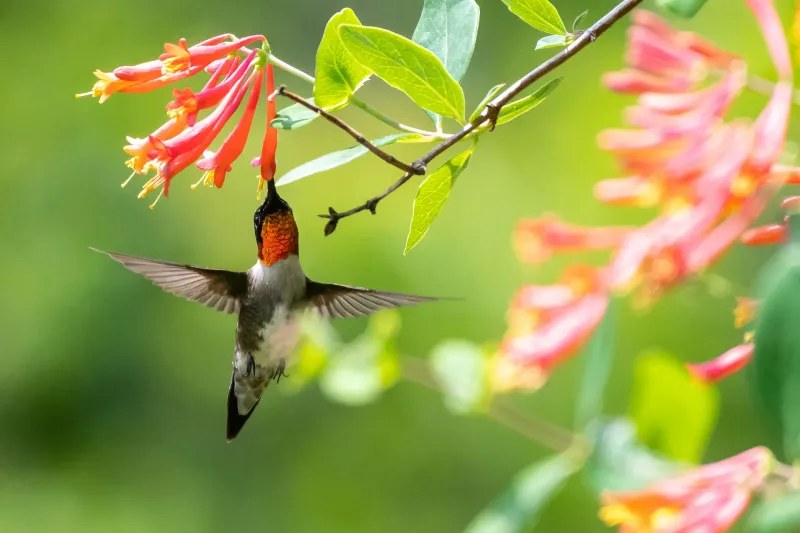
Mid-spring is when coral honeysuckle typically puts on its biggest show. NC State lists mid-spring as the plant’s primary flowering period, and Audubon describes a major spring flush followed by smaller repeat flushes through summer and into fall.
That pattern is useful to understand because it sets realistic expectations: the vine is not a continuous, wall-to-wall bloomer all season, but it does offer nectar across a longer window than a single-flush perennial.
The timing connection to spring migration is real but not guaranteed. Ruby-throated hummingbirds move through North Carolina on their way north in spring, and a vine in full bloom during that window can provide exactly the refueling stop a traveling bird needs.
The catch is that “mid-spring” plays out differently across the state. A coral honeysuckle on a south-facing fence in the Coastal Plain may open its first flowers two to three weeks before one planted on a mountain slope in the Blue Ridge.
Weather, microclimate, and the vine’s age all shift the schedule further.
Protecting the spring bloom starts with pruning discipline. Coral honeysuckle flowers on new growth, so pruning should happen after flowering, not before.
Cutting the vine back in late winter or early spring, before it has had a chance to bloom, removes the growth that would have carried this season’s flowers. Prune lightly right after the main flush finishes, shaping the vine and removing any dead or tangled stems.
Fertilizer choices also affect flowering. High-nitrogen fertilizers push leafy growth at the expense of blooms, so skip the standard lawn fertilizer near this vine.
If the soil is genuinely poor, a balanced, slow-release fertilizer applied sparingly in early spring is a safer option than a nitrogen-heavy product.
Cornell Lab of Ornithology notes that ruby-throated hummingbirds generally depart for Central America in early fall, so the vine’s summer and fall flushes serve birds that are resident in the area or passing through on southward migration, not a permanent year-round population. Keep an eye out for aphids, powdery mildew, and leaf spots during hot, humid stretches; these problems rarely kill a healthy vine but can reduce its vigor and indirectly cut flower production if left unaddressed.
Plant the Native Species—not an Invasive Look-Alike
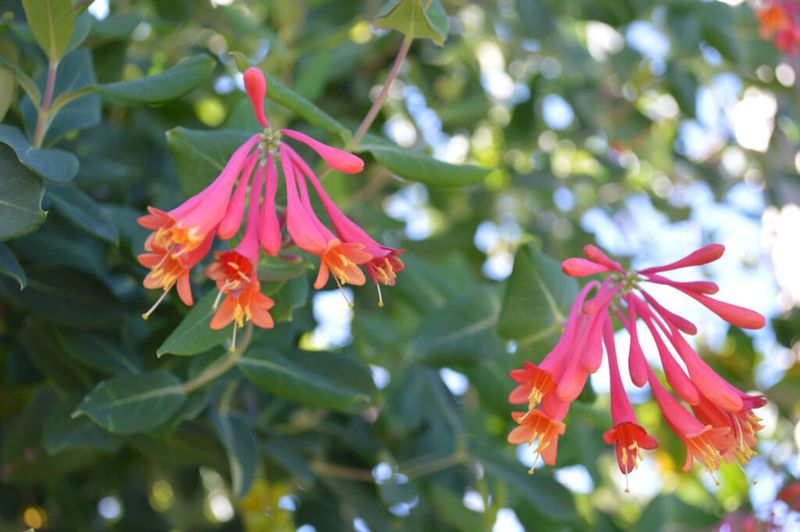
One of the most consequential mistakes a North Carolina homeowner can make when shopping for coral honeysuckle is buying the wrong vine. Japanese honeysuckle, Lonicera japonica, is sold or spread widely across the state and is sometimes confused with the native coral honeysuckle, Lonicera sempervirens.
The two plants are not interchangeable. NC State’s Plant Toolbox classifies Japanese honeysuckle as invasive in North Carolina, describing a vine that spreads by runners and rhizomes, smothers native vegetation, and displaces the plants that local wildlife actually depends on.
The visual differences between the two species are clear once you know what to look for. Coral honeysuckle has red to coral-orange tubular flowers, often with a yellow interior, and semi-evergreen to deciduous leaves that are sometimes fused around the stem near the flower clusters.
Japanese honeysuckle has fragrant white and yellow flowers that are more open and irregular in shape, and its leaves are not fused. The fragrance is one of the most reliable field clues: coral honeysuckle has little to no scent, while Japanese honeysuckle is notably sweet-smelling.
NC State’s Extension Gardener Handbook on weeds specifically warns that Japanese honeysuckle is often mistaken for native species and recommends getting an uncertain vine identified before applying any chemical control. If you find a honeysuckle-type vine growing in your yard and you are not certain which species it is, photograph the leaves, flowers, and stem and submit it to your local Cooperative Extension office or use a reliable plant identification app before taking action.
When purchasing coral honeysuckle, always verify the scientific name on the label. A tag that reads only “honeysuckle” or uses an informal common name without the species designation Lonicera sempervirens should prompt you to ask the nursery staff for clarification before buying.
One additional safety note: NC State gives coral honeysuckle a high flammability rating and advises against planting it within the defensible space immediately around a home. Keep the vine on a trellis or fence at a safe distance from siding, eaves, or any structure where ignition risk is a concern, particularly in drier mountain communities or during drought conditions.
One Vine Starts the Invitation; a Habitat Keeps the Yard Useful
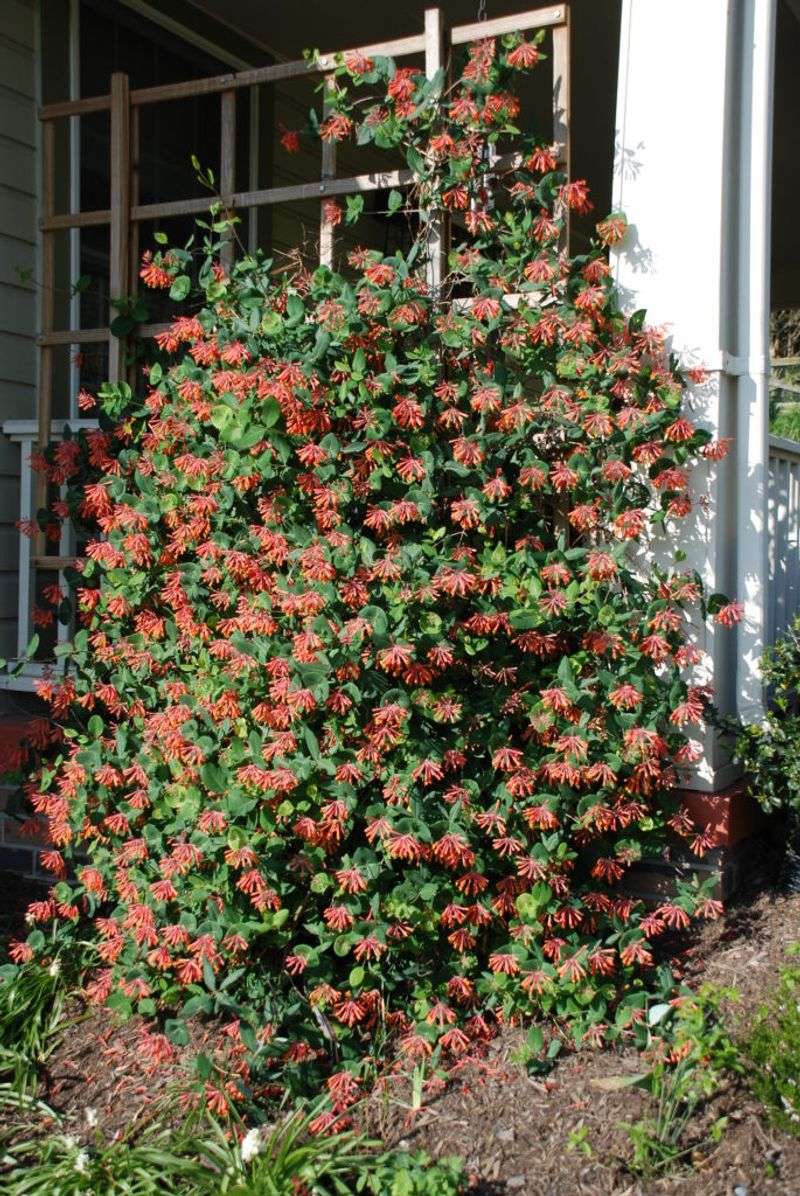
Coral honeysuckle is the strongest single starting point, but a yard built around one plant will always fall short of its potential. NC State’s publication on hummingbirds and butterflies recommends a diversity of native trees, shrubs, vines, and perennials with staggered bloom times to provide nectar across the warmer months.
When coral honeysuckle’s main flush winds down, other native plants can carry the nectar supply forward, giving visiting birds a reason to return rather than moving on to a neighbor’s yard.
Nectar is only one piece of what hummingbirds need. NC State’s guide to managing urban habitats for birds makes clear that hummingbirds also feed on small insects, which provide the protein that nectar alone cannot supply.
A yard treated heavily with broad-spectrum insecticides will be less hospitable to hummingbirds regardless of how many flowers it contains. Native plants support native insects, which in turn support the birds.
Shelter, cover, and nesting sites round out the picture. Dense shrubs, small trees, and layered plantings give hummingbirds places to perch between feeding bouts and to build nests.
A yard that offers nectar, insects, and safe cover is far more likely to see repeat visits than one that offers only a single flowering vine.
If you choose to add a feeder, keep it secondary to planting and maintain it carefully. Cornell Lab of Ornithology recommends a solution of one part table sugar to four parts water, with no food coloring or honey.
In hot North Carolina summers, sugar water can ferment within a day or two; clean the feeder and replace the solution every two to three days during warm weather to avoid harming birds with spoiled liquid.
Ruby-throated hummingbirds, the species most North Carolina residents will see, generally leave the state in early fall for their migration to Central America. A well-planted yard with staggered bloom times and good insect habitat gives them the best possible experience during the months they are here, and that is what brings them back the following spring.
When Cardinal Flower Is the Better Fit
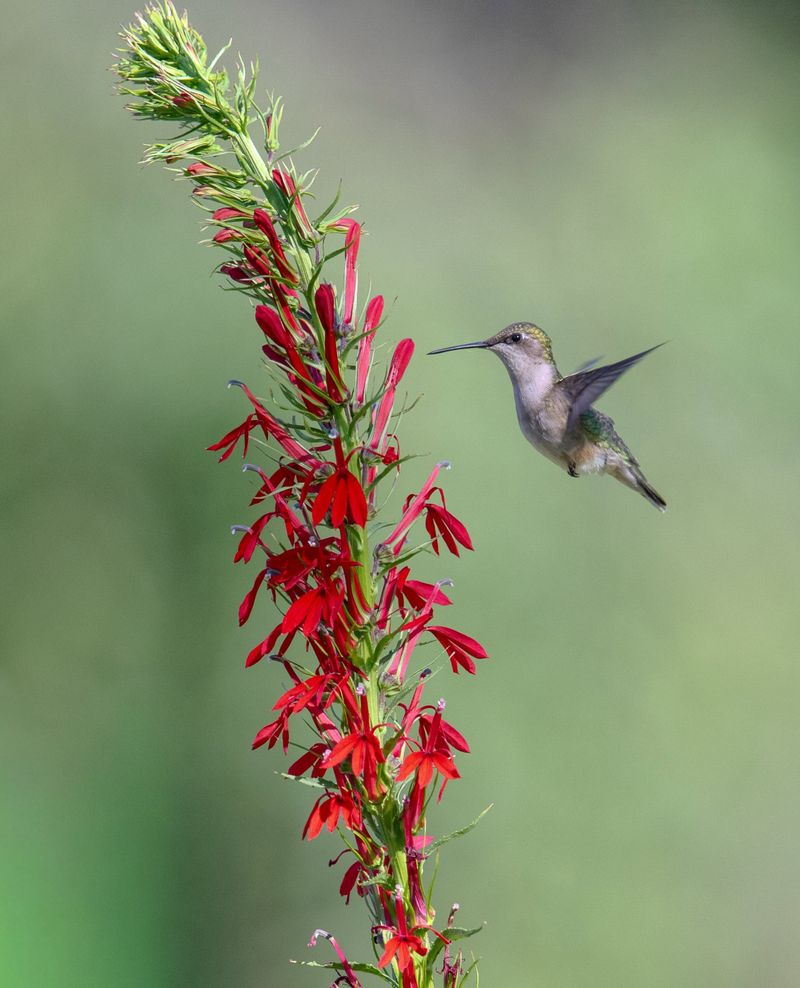
Cardinal flower, Lobelia cardinalis, belongs in a different category than coral honeysuckle, not because it is less valuable to hummingbirds, but because it succeeds in a narrower set of conditions. NC State’s Plant Toolbox describes cardinal flower as performing best in rich, consistently moist to wet soil, with full sun to part shade and blooms that arrive from late summer into mid-fall.
That bloom timing is genuinely useful: it bridges the gap between coral honeysuckle’s later flushes and the point when ruby-throated hummingbirds begin their southward migration.
The right home for cardinal flower is a rain garden, pond edge, streamside planting, wet meadow, or damp woodland garden where soil moisture stays reliably high. In those settings, the plant’s brilliant red tubular flower spikes can reach four feet or more and become a genuine focal point for hummingbirds in late summer.
For a homeowner with a low spot that stays soggy after rain or a yard that borders a creek, cardinal flower fills a slot that coral honeysuckle simply cannot.
NC State notes that cardinal flower is a short-lived perennial that may not persist beyond two or three years without self-seeding or division. That characteristic makes it a less reliable long-term anchor than coral honeysuckle, though a plant that self-seeds freely in a moist site can effectively renew itself.
Plan for propagation by division every couple of years if self-seeding does not occur naturally in your garden.
For a dry Piedmont slope, a sandy Coastal Plain bed that drains quickly, or a mountain yard with rocky, fast-draining soil, cardinal flower is the wrong tool. Coral honeysuckle handles those conditions far better.
Think of cardinal flower as the specialist and coral honeysuckle as the generalist: both have genuine value, but only one of them works across most North Carolina yards without special accommodations.
Make Coral Honeysuckle Your Strongest First Move
Getting started with coral honeysuckle comes down to a short checklist that pays off across multiple growing seasons. Choose a plant sold under the verified scientific name Lonicera sempervirens, confirm the label before leaving the nursery, and place it in a spot that gets full sun for most of the day.
Set up a sturdy trellis, fence, or arbor before planting so the vine has something to reach for from its first week in the ground.
Keep the planting location at a safe distance from your home’s exterior walls and any structure where fire risk is a concern, given the vine’s high flammability rating from NC State Extension. After the main spring bloom finishes, prune lightly to shape the vine and remove dead growth, but hold off on heavy cutting until flowering is complete.
Skip high-nitrogen fertilizer and watch for aphids or mildew during humid stretches.
From there, build outward. NC State’s hummingbird and butterfly guidance points toward a layered native landscape with staggered blooms, insect habitat, and shelter as the real engine behind consistent hummingbird activity.
Coral honeysuckle is the best all-around single plant to anchor that effort for most North Carolina yards, not a substitute for a diverse native landscape, and not a promise of permanent hummingbirds. A yard that earns a ruby-throated hummingbird’s repeat attention is one worth returning to, and that is exactly the kind of yard coral honeysuckle helps you build.